



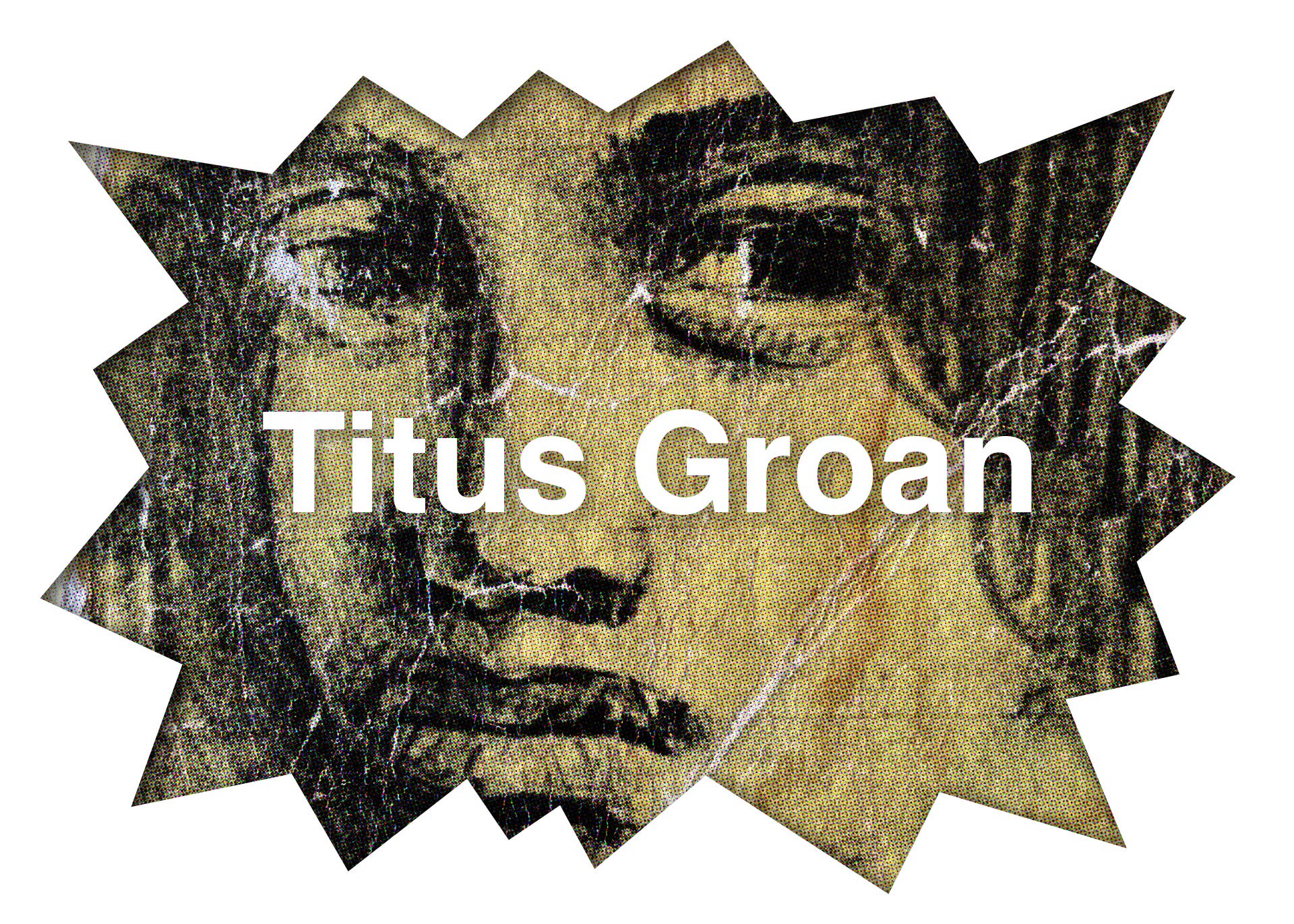
Gormenghast is a vast and labyrinthine castle, immured by tradition and ritual. But new life has come in the form of Titus Groan: a son to the melancholy Lord Sepulchrave Groan and the countess Gertrude, a brother to the wilful young Fuchsia. There is also Steerpike, a youth who has escaped the monstrous kitchens to become an assistant to the family doctor Prunesquallor and who wishes to rise further. To do so he embarks on a campaign of manipulation and destruction that ends in the death of Sepulchrave. Change and youth has come to Gormenghast, and that may not be a good thing.
The Legend
Mervyn Peake’s Gormenghast trilogy -- Titus Groan (1946), Gormenghast (1950) and Titus Alone (1959) -- is one of the great fantasy epics of post-Second World War Britain. However, it is not one of those fantasies.
Largely identified with the legacy of Tolkien’s Lord of the Rings (1954-55), fantasy as a genre has become associated with pseudo-medieval secondary worlds, complicated maps and names with apostrophes in them. There are other traditions associated with C. S. Lewis’s Chronicles of Narnia (1950-56) and T. H. White’s Once and Future King (1938-58), although those are, respectively, secondary world and pseudo-medieval.
Titus Groan is not like these books; it is not an heroic fantasy of kings and monsters. To begin with, Peake goes under his full name, Mervyn, instead of his initials, which tells us something about the man. And while the book is full of silly names, it has no map in the front; indeed, the castle defies cartography. Titus Groan has more in common with Kafka than the Brothers Grimm, and more in common with Dickens than Beowulf. It is fantastical, rather than a fantasy.
What it does have in common with these other post-Second World War epics is that it is a product of its times. The Lion, The Witch and The Wardrobe (1950) is set during the Blitz and concerns a moral struggle with forces of oppression. The Once and Future King is about an Albion modelling for the world a better way of living than ‘might makes right’. Much as Tolkien resisted any contemporary political parallels, The Lord of the Rings features a struggle against a world-dominating power in which victory is won, ultimately, through the selfless service of the petit bourgeoisie (and his batman).
Peake sees mid-century Britain in a more acerbic light. The aristos are mad, and everyone else is a servant. Whatever glories it might once have had are mouldering or gone; the infrastructure is moribund and meaningless. The whole thing is bound together with maddening ritual and suffocating tradition that allows for no innovation, no life, no joy. Gormenghast is a model of post-Imperial Britain, and instead of looking back at past splendour it looks forward to future squalor: the Britain of the ‘70s and ‘80s, a grim little isolated island full of decaying relics and weird characters.
This was the last book I had read to me as a child. Well, not the whole book: my father read me the first paragraph or so and then handed it to me to finish for myself. Reading it subsequently at a British boarding school in the early ‘80s, I recognised its world immediately. Not only because I too was trapped by tradition in a crumbling pile of masonry haunted by monstrous individuals, but because that wider vision of an outdated and inward-looking culture was all too accurate.
The first paragraph captured me instantly:
GORMENGHAST, that is, the main massing of the original stone, taken by itself would have displayed a certain ponderous architectural quality were it possible to have ignored the circumfusion of those mean dwellings that swarmed like an epidemic around its outer walls. They sprawled over the sloping earth, each one half way over its neighbour until, held back by the castle ramparts, the innermost of these hovels laid hold on the great walls, clamping themselves thereto like limpets to a rock. These dwellings, by ancient law, were granted this chill intimacy with the stronghold that loomed above them. Over their irregular roofs would fall throughout the seasons the shadows of time-eaten buttresses, of broken and lofty turrets, and, most enormous of all, the shadow of the Tower of Flints. This tower, patched unevenly with black ivy, arose like a mutilated finger from among the fists of knuckled masonry and pointed blasphemously at heaven. At night the owls made of it an echoing throat: by day it stood voiceless and cast its long shadow.
Yep, that’s just a paragraph. Remember the reference to Dickens I made earlier?
Peake was better known as an illustrator and painter before he wrote Titus Groan. And he writes like a painter: his style is Impressionistic, piling up language like paint to create an impasto, a physical landscape of verbiage, full of light and shade. But the effect is Expressionistic. Everything is packed with emotion. He looks as an artist, seeing everything minutely; but he describes what he sees with the pathetic fallacy of a poet, investing it with meaning. Everything becomes present and alive. It is, for a certain kind of reader, an intoxicating experience.
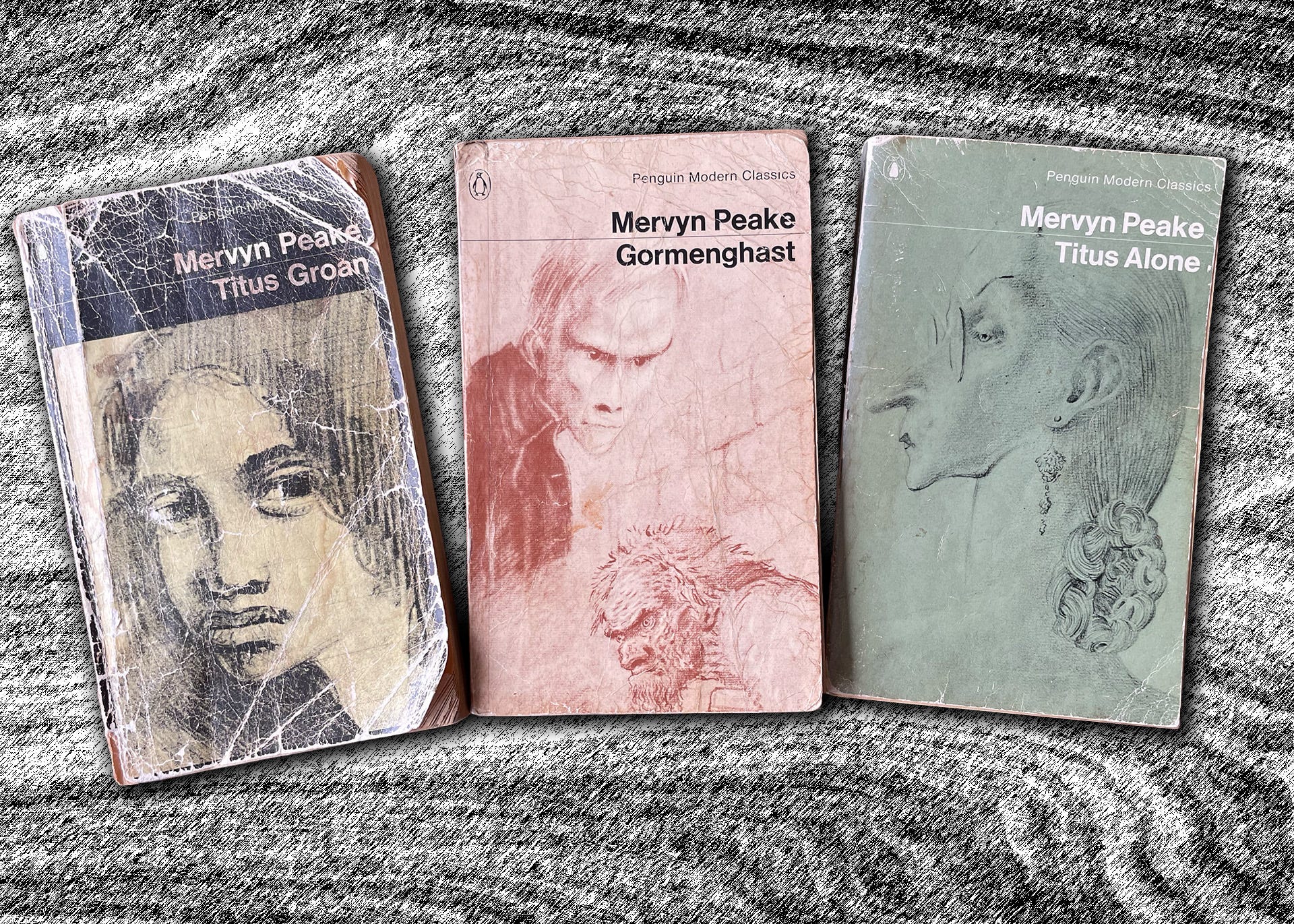
Peake was a child of Empire. The son of missionaries, he grew up in colonial compounds in China; he was an outsider there, and was subsequently an outsider in Britain. That view from without, and the Chinese culture he grew up around, deeply influenced the style and subject of his books.
This makes Titus Groan itself an outsider in the British post-War fantasy canon. It is not quite a secondary world, but it is also not quite ours; it is not pseudo-historical, but it is also not quite contemporary. It is not quite anything else; it is wholly itself.
Its legacy does not compare with the vast shadow that Mordor casts over contemporary culture, but it is perceptible in some places: in ‘All Cats Are Grey’ and ‘The Drowning Man’ on The Cure’s album Faith (1981); in characters in George R. R. Martin’s books; in the fugitive corridors and odd rooms of Hogwarts.1 A certain kind of reader will always find Titus Groan: outsiders, or those who would like to be outsiders. And then the book will find its way into them.
The Reality
‘A certain kind of reader’. Let’s be honest, a male reader, most likely. A young male reader. Probably not great at PE, possibly given to writing bad poetry, definitely with a high opinion of their own intellectual or artistic abilities.2
Like many ‘cult’ works, the cult is as exclusionary as it is inclusive. Peake’s prose bears a lot of responsibility for this. He is an artist with a thesaurus as a palette, picking obtuse and esoteric words to fling at the page. The reader is either going to embrace this kind of sesquipedalian extravagance, happy to have their vocabulary expanded along with their mind; or they will quail in horror, overwhelmed and under-entertained.
The prose is symbolic of a deeper theme. Peake’s paragraphs are as torturous and antiquated as the castle; the language models the dark complexity of his setting and typifies the density of the culture he is depicting. It also models a certain personality: the trivia-hound, the snapper up of unconsidered trifles, the flaneur, the collector. Gormenghast, the castle, and Titus Groan, the book, are as full of weird detail and strange objects as the bookshelves, pockets and mind of a certain kind of small boy.
Along with all that junk there are, of course, bright gems: startling visions that lodge in the imagination. The Hall of Bright Carvings. The Room of Cats. The Tower of Flints. The sisters, Cora and Clarice, taking tea on the trunk of a dead tree growing horizontally out of the top of a tower. Fuschia’s attic, populated with imagined characters who caper for her amusement. Gertrude’s bedroom, dark with ivy and rustling with birds and cats.
There is a moment in Titus Groan that is easily overlooked, but which I think is key. In an obscure corridor, in a heap of rusting and cobwebbed armour, Steerpike finds a swordstick. He purloins it, cleans it up and uses it as a cane. The swordstick is a metaphor for Steerpike; it presents as purely practical and useful, but contains the potential for violence and death. It is also emblematic of Steerpike’s role in the world of Gormenghast: crafting a new sharp reality out of untidy remains.
And it is also emblematic of a major theme of the book: that this terrible, stifling place is full of wonders, for those who look for them. Steerpike is one of those people; the Lady Fuschia, Titus’s older sister, is another. These are the young people who struggle against the dead weight of tradition and the stones of Gormenghast.
Steerpike, though, is the villain. Peake is very clear that his ruthless individualism is just as horrible as the relentless ritual of previous generations. Peake evidently has a cynical view of the coming generation of the ‘50s, seeing them as a mixture of rebellion for rebellion’s sake and of naked self-interest.
Fuschia has the soul of an artist, and covers the walls of her room with drawings; her mind is full of fertile imaginings, and she is consequently doomed. Neither the traditions of Gormenghast nor the manipulations of Steerpike have room for her. Titus, who is an infant for most of this book, will eventually flee the castle entirely.
The hero of the series turns out to be the unlikely Dr Prunesquallor, the family doctor. He is a ridiculous figure, etiolated and effete, and cursed with a hideous whinnying laugh. Behind his thick spectacles his magnified eyes swim like jellyfish. A member of the educated, tasteful, professional bourgeoisie, within the castle he belongs neither to the ruling class nor to the servants. He scorns the affectations and traditions of the aristocracy, but he also suspects the greedy insurrection of Steerpike. He is the only one with an independent and functioning mind and, more importantly, a moral core of iron.
In placing his hero among the bourgeoisie, Peake is finally in accord with the other post-Second World War British fantasy epics. T. H. White’s King Arthur is not raised as a knight, but as a lowly member of his foster-father’s household; he comes to Camelot as an outsider. Narnia is saved by a gaggle of middle-class kids; Middle Earth is saved by an independently wealthy gentleman and his gardener.
After all, these polite country squires and small town doctors and modest gardeners had just joined in epic journeys across North African deserts and South East Asian jungles and up onto European beaches to help save civilization. And these were the people who were to define the post-Second World War country, a country which is now majority ABC1s (although, tellingly, half of them claim to be working class).3
Perhaps the thing that has stopped the Gormenghast trilogy reaching the national treasure status of Lord of the Rings or the Chronicles of Narnia is that, for all its fantastical setting, it’s entirely too truthful in its vision of that nation.
Speaking of treasures, national and eldritch, here’s where that ring came from:
The Hobbit

We were raised by Puffins. With three TV channels and no internet, for long stretches of our lives reading was the best (and sometimes, the only) way to pass the time. Here we return to the books that made us and analyse what makes them great.
We shall draw a veil over Sting’s performance in the 1984 Radio 4 adaptation, which would be a perfect version were it not for Gordon’s ‘acting’.
I know, I’m generalising; but, for instance, 2025 YouGov data shows 51% of women like Lord of the Rings compared to 69% of men. They didn’t ask about Titus Groan, sadly.
I’ve always loved Gormenghast - even the Dot Cotton TV adaptation. It’s striking how politically legible it still feels. Brexit, in particular, feels very Peakean - the rejection of a complex, functioning system in favour of symbolic gestures of sovereignty, followed by years of paralysis. Power still being performed, but not quite exercised. The late Tory party has something of the Groans about it – exhausted, inward-looking, clinging to inherited authority – while Labour risks the Steerpike temptation: mistaking competence for moral renewal. And the rise of Reform, like Steerpike himself, thrives on institutional decay without offering much beyond grievance and spectacle. Even Trump’s America feels relevant here: Britain watching a louder, faster version of political nihilism whilst occasionally importing some of its habits.
And it’s the gardener who saves the day