



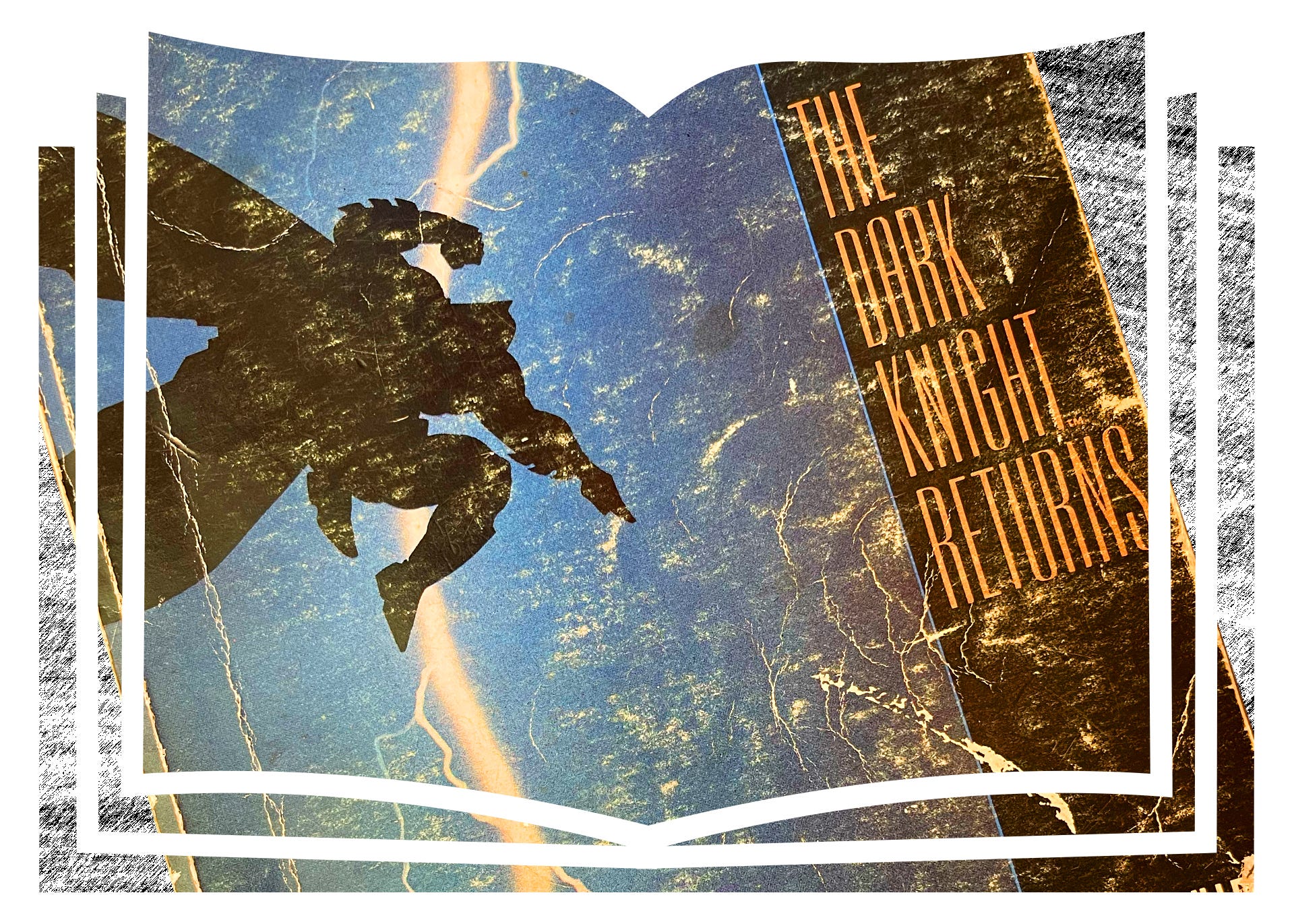
A grim and gritty updating of Batman for the late ‘80s that put the dark back into the Dark Knight, while pushing out any sense of chivalry. An aged Bruce Wayne (55! Soooo old), realises that Gotham City has grown worse since Batman retired ten years ago, and so struggles once more into his monogrammed onesie and pointy ears to fight a feral street gang, a hypersexual psychopathic Joker and, finally, the biggest villain of all, an immigrant journalist who stands for a just and fair society: Superman.
Preface
‘Biff, Bang, Pow! Comics aren’t just for kids anymore!’
If there was one thing more common than headlines like that in the mainstream press in the late ‘80s, it was interviews with comics aficionados and professionals in the trade press complaining about headlines like that.
To be fair to that mainstream press, though, in the late ‘80s comics like The Dark Knight Returns were new -- or at least, they appeared to be new to mainstream observers. Comics about superheroes that were nevertheless not for children; comics about pulp do-gooders that were nevertheless about the moral ambiguity of crime-fighting; primary coloured cartoon strips that were nevertheless aspiring to be art. Enthusiasts were kvetching because they knew this had been going on the whole time; it was just that up till now, only kids had been paying attention.
Batman himself is an excellent example of this. The character was invented in the wake of the bolt out of the blue that was the arrival of Superman in 1938, when everyone was trying to think of a new iteration of this new idea: the superhero. Unlike the bright, sci-fi Superman, a hero who literally derives his powers from sunlight, Batman is made of older, more shadowy stuff. His Frankensteins, Bill Finger and Bob Kane, patched him together out of gothic odds and ends: Dracula, the 1926 mystery movie The Bat, the sinister, gun-toting pulp vigilante The Shadow, outlaw figures like Zorro, Robin Hood and The Scarlet Pimpernel.
In his origin, Batman’s entire purpose was to scare people:
‘Criminals are a superstitious cowardly lot. So my disguise must be able to strike terror into their hearts. I must be a creature of the night, black, terrible…’
He was supposed to be an alarming figure. His early adventures are the stuff of film noir and prohibition-era gang war, his rogue’s gallery monstrous and freakish like Dick Tracy’s mobsters, his methods summarily two-fisted with a ‘hearty sense of malice’ as Frank Miller, the writer of The Dark Knight Returns, put it.
Miller is, in fact, something of a connoisseur of pulp himself; he went on to produce the Sin City series of hard-boiled crime stories. As the ‘returns’ in the title implies, The Dark Knight Returns was not just about Bruce Wayne coming out of retirement; it was also about returning Batman to his shadowy origins.
This too was not an original ideal; Batman had already been reinvented in a gritty mode in the ‘70s by Denny O’Neil and Neal Adams, who were responding to the child-friendly antics of the ‘60s TV show. But outside of comics, the TV show remained the image of Batman in the public imagination: a dependably square uncle with an odd dress sense and weird hobby; Adam West, hilariously straightfaced in his wrinkly unitard, trading Pop Art ‘BIFF’s with scenery-chewing character actors in heavy makeup.
The contrast between that childlike and childish TV fun and Frank Miller’s nihilistic, violent and explicit comic made the latter seem significantly more surprising and mature. Pow! Comics weren’t just for kids anymore. They were something more grown up: they were graphic novels.
Contents
Comic book aficionados also knew that the term ‘graphic novel’ wasn’t new; there’s a decent argument that the notion is as old as the form. Visual storytelling predates written language (indeed, it’s the origin of written language) but the closest thing to a first ‘comic book’ is the Histoire de Mr. Vieux-Bois (1827) by Rodolphe Töpffer, a picaresque novel told in graphical form.
Then there was the European tradition of the comics ‘album’, the adventures of Tintin and Asterix and Corto Maltese: pulp adventures told with graphics and bound up as comic ‘books’. Even when the great master of the medium, Will Eisner, used the term ‘graphic novel’ to describe his own work in 1978, he admitted he knew it wasn’t his coinage.
But, if only by dint of being a story about a globally recognisable superhero, A Dark Knight Returns is a key exhibit in the use of ‘graphic novel’ as a marketing term: a means of packaging and reselling monthly comics, and also a way to establish a new critical acceptability for a medium mostly seen as dumb entertainment for uncritical kiddiwinks and readers who needed the pictures to help them with the words.
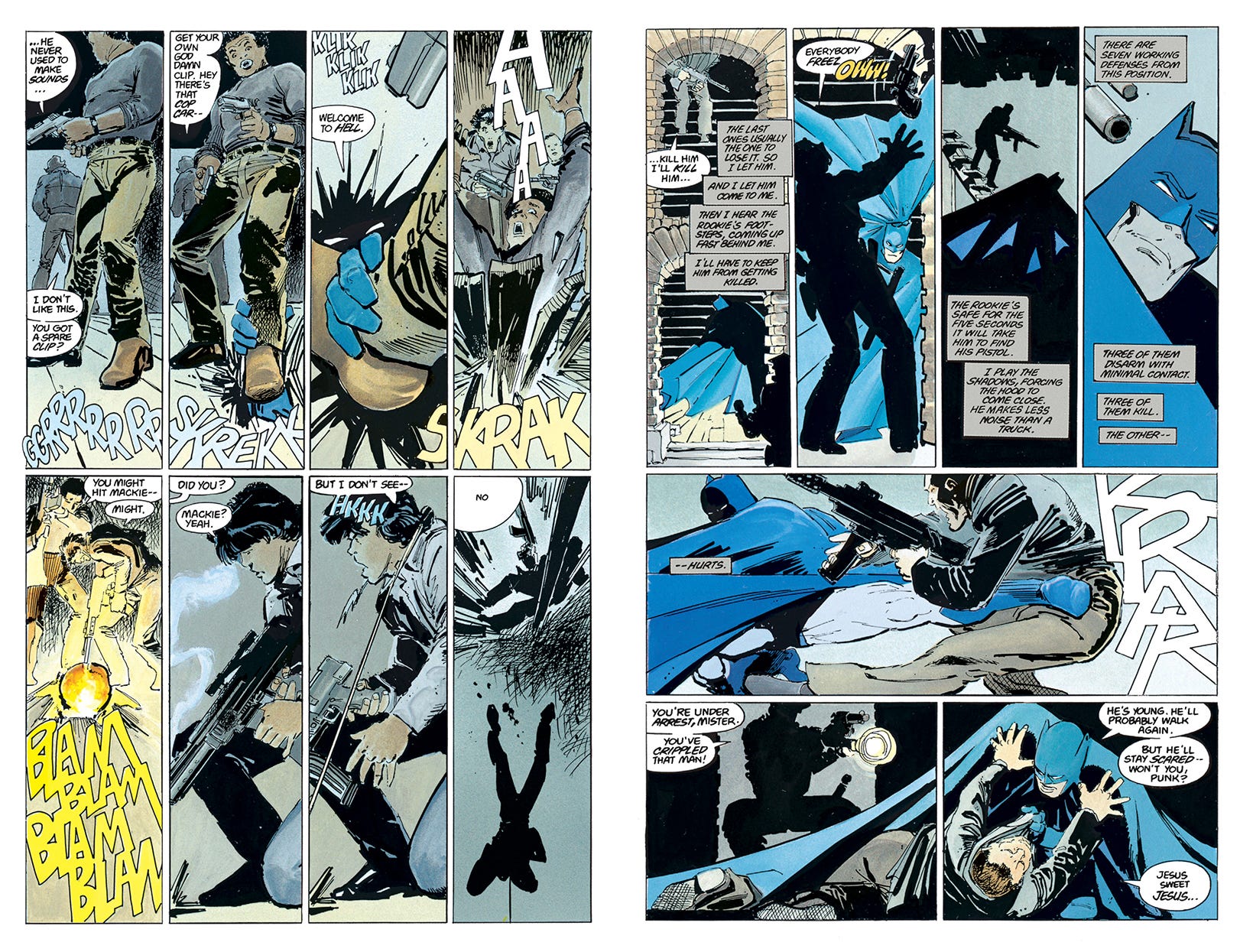
The Dark Knight Returns is at least definitely a novel, in the sense of a self-contained work of extended narrative fiction. And, unlike most commercial comics, it was the work of a singular, individual vision. It was written and drawn by Frank Miller, and then inked by Miller with help from Klaus Janson (comics are generally first drawn in pencil before being inked over in clear lines and then coloured). The colouring of The Dark Knight Returns, a beautiful, muted watercolour palette, was by Lynn Varley. All three were tight collaborators, but The Dark Knight Returns is primarily Miller’s work. His artwork is of a piece with his story, tight and propulsive, while his line is expressive and full of pulp dynamite.
He uses a basic sixteen-panel grid – four rows of four panels – which makes for an exceeding dense page. The panels often feature tight close-ups, repeated with dense captions and speech around them. This gives a driving rhythm to the pages, packing in story and characters at a considerable rate. Miller builds on this with an exceptionally ‘80s multimedia approach; the panels frequently become the rounded rectangles of cathode-ray TV screens as talk-show hosts and news anchors comment on the comic’s proceedings. This builds an image of a seething, crowded Gotham, tense and ferocious like Miller’s Batman.
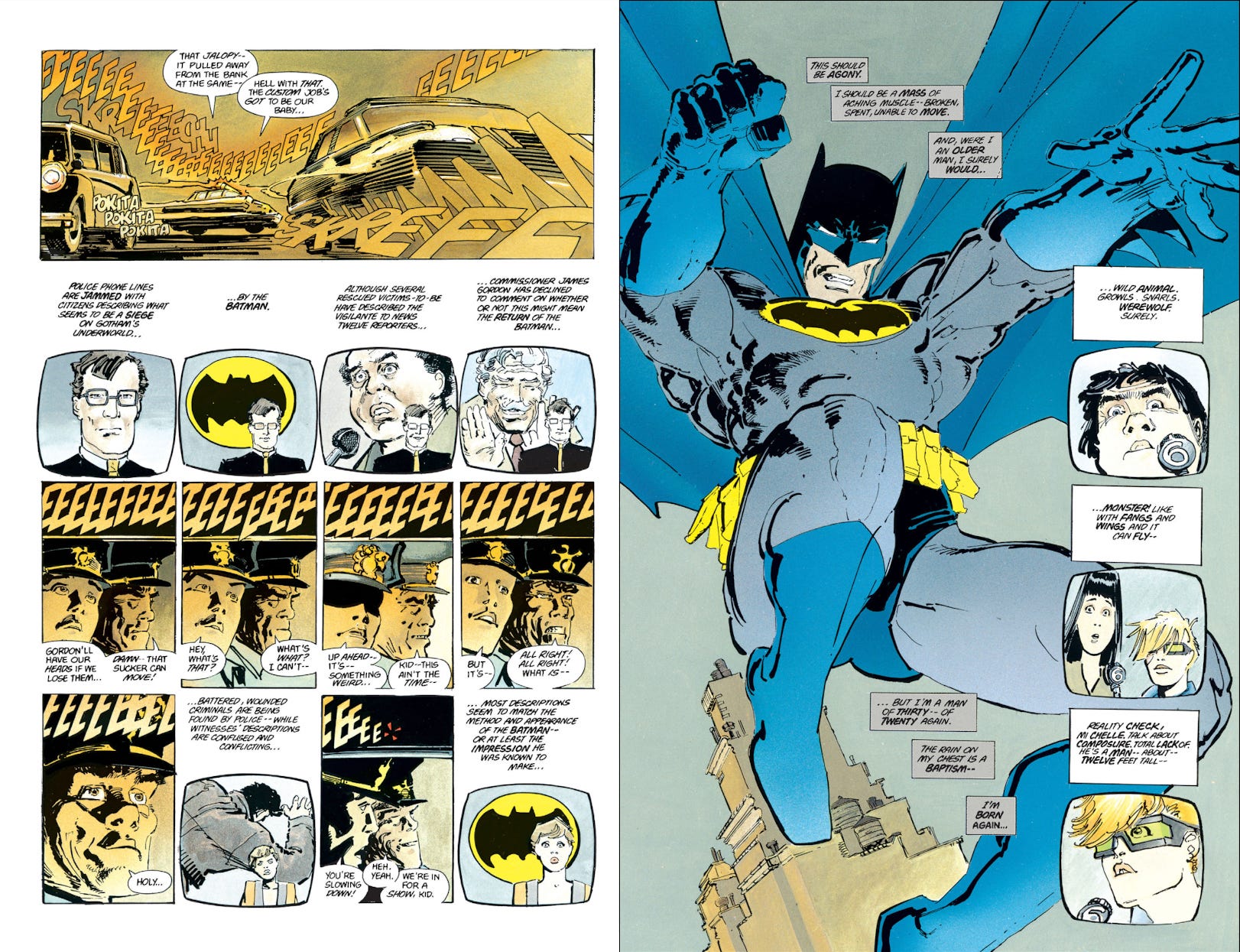
Against this rigid structure his art scratches and writhes, all sketchy lines and expressive, cartoony anatomy or gestural silhouettes of solid ink. When it does succeed in breaking out, as when the bright yellow of the Bat Signal breaks out of the grey, rectangular city architecture, it does so in operatically dramatic splash pages, full of action and emotion. The dialogue, boiled hard and welded to the bottom of the pan, rages inside its little boxes:
‘I play the shadows, forcing the hood to come close. He makes less noise than a Mack truck. There are seven working defenses from this position. Three of them disarm with minimal contact. Three of them kill. The other -- hurts.’
It’s not surprising that the comic was partly inspired by Clint Eastwood’s Dirty Harry movie Sudden Impact (1983), the sort of movie that Frank Miller has referred to a ‘a right-wing version of… old [Batman] comic books’. This is the rugged self-sufficiency myth of the Wild West transposed to the diverse and culturally fecund twentieth century city, and finding itself very uncomfortable there. A politics suspicious of everything – government, reform, other people – but wholly convinced of its own correctness, the unassailable moral rightness of the Great Man.
Of all the superheroes, this mode is most appropriate for Batman, a character whose roots are in the gangster-haunted cities of Prohibition-era America. Here is a billionaire so convinced of his own exceptionalism that he spends his money not on philanthropic projects, but on a single-handed war on crime. While wearing his jimjams.
Afterword
Much like prehistory, superhero comic history is generally divided into Ages, and these Ages are thought of as having gradually declined: from the 1940s Golden Age of Superman and Batman, through the giddy Silver Age, to the grimmer Bronze Age of the ‘70s and ‘80s. The Dark Knight Returns is one of the works that introduced what is sometimes known as The Dark Age of comics.
I thrilled to its darkly cynical politics when I read the comic as a teenager, just as I thrilled to the art and the pulp action. I had a fundamental adolescent need to besmirch the treasures of childhood, just as others pointed out the hidden swearing in The Clangers, pondered the exact nature of the relationship between Bert and Ernie and sniggered at Barbie’s lack of genitals.1 It’s all part of an attempt to reconcile childish delights with the grown-up world, just as a teenager tries to fit their childhood identity into adult clothing. This is certainly part of the appeal of The Dark Knight Returns. The mesmerising revelation that the Batman I knew from the ludicrous TV show, from Dinky Batmobiles and rubbery Mego action figures, was now growling ‘Welcome to hell’ from the shadows as he beat up machine-gun toting gang members.
The Dark Knight Returns had the same impact on comics as it had on me as a teenage reader. Suddenly, all the primary-coloured do-gooders of my childhood were indulging in overwrought narration, bad language and a little bit of the old ultra-violence. This wasn’t Miller’s fault alone; a cadre of British creators also brought a more acerbic and satiric mode to American comics (although at least two of the major figures of that invasion, Alan Moore and Grant Morrison, have since repudiated a lot of this excessively grim posturing). But the influence of The Dark Knight Returns is nevertheless inescapable. It became the jumping-off point for a whole cavalcade of movie Batmen, from Tim Burton’s 1989 gothic Batman to Chris Nolan’s po-faced angst and Zack Snyder’s monochrome objectivist slugfests. And it’s still there in DC’s new Absolute Batman line, which adopts Miller’s TV inserts as a deliberate homage even as it tries to establish a completely different politics for the character. Even a working-class, anti-1% Batman must also be a massive, impassive slab of muscle, just like Miller’s.
A lot of that impact came from the fundamental idea of taking Batman seriously. What would a mask-wearing, crime-fighting billionaire actually be like? He’d be insane, right? He’d be just as psychopathic as the Joker or Two Face or The Mad Hatter, or any of the other weirdos he fights. This, ultimately, is the real legacy of The Dark Knight Returns. What if we took superheroes seriously? What if, instead of them just being halftone smudges on pulp paper, they were actual people; or at least, real-life actors in convincing costumes and not-quite-as-convincing CGI settings? What if they were multiple-million-dollar smash-hit movies? What if they were a cornerstone of global pop culture? What then?
‘Biff, Bang, Pow! Comics aren’t just for kids anymore!’
Of course, there were plenty of comics in the mid ‘80s that weren’t for kids and also weren’t, more importantly, about superheroes:
The Return of Mister X

We were raised by Puffins. With three TV channels and no internet, for long stretches of our lives reading was the best (and sometimes, the only) way to pass the time. Here we return to the books that made us and analyse what makes them great.
To be fair, this isn’t always useless; the question of Barbie’s missing genitals informs the grand conclusion of Greta Gerwig’s unexpectedly thoughtful 2023 film. And where would The Metropolitan be without taking apparently trivial things seriously?
Ah it's all very well, but it's not Judge Dredd.
Didn’t suck