



We were raised by Puffins. With three TV channels and no internet, for long stretches of our lives reading was the best (and sometimes, the only) way to pass the time. Here we return to the books that made us and analyse what makes them great.
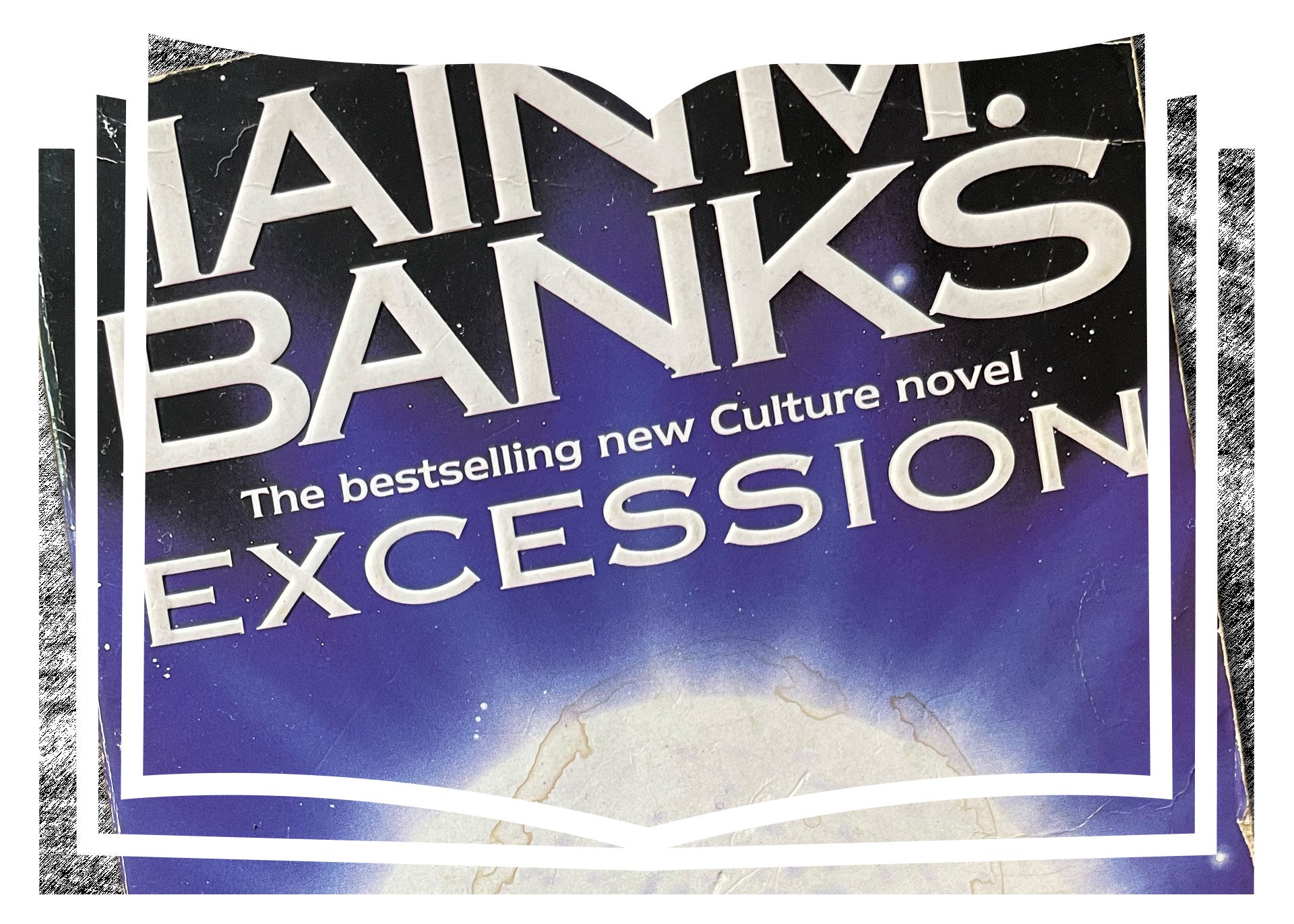
An unimaginably powerful object, possibly from another universe, has appeared in an obscure corner of the galaxy and is attracting the attention of interstellar civilisations including the cruel and colonial Affront and the hippie explorers the Zetetic Elench, and the great, star-faring meta-civilisation The Culture. The Culture is essentially a collection of continent-sized starships run by god-like artificial intelligences called Minds. These Minds are now scheming about how they might take advantage of this new alien artefact, which they term ‘The Excession’.
Preface
The ‘M’ in Iain M. Banks is significant. He had a parallel life as the un-emmed mainstream author Iain Banks, but adopted the middle initial to signify to readers when he was indulging in science fiction. His conventional novels were frequently magical realist, or tinged with science fictional ideas or gothically grand guignol; but once he donned the M he became properly space operatic, all lightspeed spaceships and alien races and silly names.
What’s significant was that he had to signify this separation at all: that it was considered useful to demark which of his novels were ‘mainstream’. That there are some fictions that are ‘genre’ and some that are, inexplicably, not. That science fiction needed to have that ‘M’ stuck on it like a warning label. For imMature audiences only.
Science fiction has a bad reputation, literarily speaking. This is largely because of its origin. The term first emerged as ‘scientifiction’, a label coined by Hugo Gernsback, the editor of Amazing Stories magazine, in 1926. Gernsback was also an electronics entrepreneur and stipulated that the genre should include ‘scientific fact and prophetic vision’.
This was fiction by and for engineers, men (so many men) gifted in maths and science but not necessarily in literary style. Men like Isaac Asimov or Arthur C. Clarke, who could conjure fascinating scientific possibilities but who couldn’t write believable dialogue. These were books of plot and concept, not psychology or character.
Gernsback was also, incidentally, the publisher of a magazine called Technocracy Review (1933) which championed the then-fashionable idea of ‘Technocracy’, a society designed and run by engineers. One prominent member of the Technocracy movement was Joshua Norman Haldeman, the maternal grandfather of Elon Musk. Musk, in turn, is a massive science fiction fan and has named several of his SpaceX vehicles after spaceships from Iain M. Banks’ books.
Sci-fi might have had its roots in scientific experimentation, but the genre grew. Writers like Ray Bradbury and Kurt Vonnegut attempted the previously unattempted experiment of writing well. The New Wave of the ‘60s brought writers like Michael Moorcock and J. G. Ballard who went for more formal, structural, literary experimentation. Meanwhile writers like Ursula K. LeGuin and Philip K. Dick (look at all these middle initials) seized on the genre as a way to conduct thought experiments in psychology.
This is precisely what Iain M. Banks did, too. Most of his science fiction books concerned The Culture, a pan-galactic meta-civilisation that has mostly abandoned conventional planets and solar systems to live on giant spaceships and artificial habitats. The Culture has also, more importantly, abandoned conventional politics and economics. This is a post-scarcity society in which anyone can have anything they want, whenever they want it. There is no work, no money, no hierarchy and very little class differentiation. The civilisation is almost entirely run by the Minds, immeasurably intelligent artificial beings who pander to everybody’s whims and still find time to run the galaxy.
What interests Banks is how this utopia might be flawed. Having created a perfect anarchy in which the only laws are individual morality and the bounds of social relationships, he questions how that might actually run and what it might mean for people living in it. This in turn throws up fascinating insights for our own contemporary, real world cultures.
Not that Banks is immune to a little ‘prophetic vision’. Rereading this thirty years later in 2026, his vision is a little too familiar. This is a world run by inscrutable and frequently incomprehensible artificial intelligences; a world in which the majority of people live happily in a haze of drugs and sex and interactive entertainments; a world in which artists are seen as exhibiting ‘a pitiably archaic form of insecurity and a rather childish desire to show off’. Sadly, we still have the capitalism, though.
Contents
The first three books set in the Culture skirt round the edges of it. They tell the stories of people and civilisations outside of it, observing it or being acted on by it. Excession was the first book to properly bring the reader within it, to consider its workings. In one core strand we are caught up in the machinations of the various Minds, trying to keep track of their cabals and connivings as well as their sardonic names (Serious Callers Only, Ethics Gradient, Not Invented Here, and the war ships Frank Exchange of Views, Attitude Adjuster and Killing Time). In one ‘prophetic vision’ the reader must pick through message threads between ships, like trying to catch up on email conversations after a long holiday.
The other main thread is the story of a handful of humans caught up in all these secret plans. Core to this is the tragic story of Byr Genar-Hofoen and Dajeil Gelian. Once lovers, Byr’s infidelity tipped Dajeil first into a murderous rage and then into isolation. She chooses to hide away on the ship Sleeper Service, remaining pregnant for 40 years rather than give birth to Byr’s baby. The main human plot of the book is the Sleeper Service trying to bring Byr and Dajeil back together, to try and convince Dajeil to finally have her baby and create a new life for herself.
Both these storylines concern themselves with misunderstandings and miscommunication, and with the relationship between individual self-definition and the social function. But they also, crucially, involve lots of cool spaceships, weird aliens and breathtaking outer space stuff.
Hugo Gernsback’s definition of scientifiction begins: ‘a charming romance intermingled with scientific fact and prophetic vision’. That romance -- often termed, slightly derisively, ‘sensawunda’ (sense of wonder) -- is another key part of science fiction. Part of the thrill of Excession, for a reader who was already a fan of Iain M. Banks’s science fiction, was finally getting to mingle with the Minds and to explore the ships that are their physical existences. The Sleeper Service is a cup of sea held floating in space by silvery force fields; in the middle of it there is an island that is the ship itself, a 50km slab, its great halls full of diorama of ancient wars featuring the bodies of passengers held in suspended animation.
Another thrill is to follow characters across the strange worlds of the Culture: asteroids hollowed out to create living space; ‘Orbitals’, giant rings of landscape flung into the heavens like glittering bracelets of life; artificial habitats like Tier, intricate interlocking levels of self-contained environments, all rotating round each other. All are peopled by extraordinary characters and aliens and artificial intelligences.
It is no mistake that part of the inspiration for Excession was the computer game Civilization. The titular Excession is what is termed in the novel an ‘Outside Context Problem’, which Banks describes in this way:
An Outside Context Problem was the sort of thing most civilizations encountered just once, and which they tended to encounter rather in the same way a sentence encountered a full stop. The usual example given… was imagining you were a tribe on a largish, fertile island; you’d tamed the land, invented the wheel or writing or whatever... when suddenly this bristling lump of iron appears sailless and trailing steam in the bay and these guys carrying long funny-looking sticks come ashore and announce you’ve just been discovered…
This is a situation straight out of Civilization, a game that Banks said he had to uninstall in order to make himself finish the book.
Science fiction is simply another form of game playing, of imaginative exercise. It allows the creative mind to run free, to invent for the enjoyment of invention and the enjoyment of the reader. But play has a purpose. It is a practice as much as a pleasure, a way of modelling reality and thinking about it. The Minds of the Culture spend a lot of time in play themselves, in a virtual world they call The Land of Infinite Fun; but they must always be aware of base reality, because that is where real things happen.
One of the lessons of Excession is that the ideal is all very well, but that reality has a habit of rendering it moot. Theory is admirable but practice is all that matters. It’s fun to wander in the wondrous spaces of science fiction, as long as you return to Earth now and then.
Afterword
A core theme in Excession is a sort of exploration of Popper’s paradox of intolerance: that a truly tolerant society should reserve the right to be intolerant of intolerance itself. Some of The Culture’s Minds want to use the appearance of the Excession as a way of forcing toleration on the hideously intolerant, warlike species The Affront; others argue that this goes against their own principles of toleration, particularly since the ruse involves tricking The Affront into a war with The Culture that they will definitely lose. A war to enforce peace; an act of punishment in the cause of toleration.
This is just one of many of these juxtapositions of theory and practise throughout the book. One significant theme is the dichotomy between the intellectual and the biological: the disembodied Minds struggle to understand the actions of their human counterparts, while human biology undermines their social ideals. Ulver Seich, a sort of space influencer, is a descendent of the founders of her home vessel, which gives her a sort of class distinction in defiance of The Culture’s flat social structure. Ulver’s emotional intelligence also helps her solve the relationship between Genar-Hofoen and Dajeil, a solution that eluded the super-intelligent Sleeper Service. (The book is full of these highly gendered characterisations: Ulver is highly emotional, whereas the hermit Gestra Ishmethit is the archetypal male nerd, hiding away on his lonely space station making model ships. Genar-Hofoen is a childish, shallow Lothario; Dajeil is an instinctively monogamous perpetual mother.)
But then, members of the Culture can change their biology as they please. When Genar-Hofoen commits the infidelity that causes Dajeil to attack him, she is a woman. The problem, Banks seems to be suggesting, is not aliens and humans or minds and bodies or men and women; it is people. Another person’s consciousness, their personality and intelligence, encountered from inside our own consciousness, is the ultimate Outside Context Problem. It is perhaps possible for us to encounter other people in much the same way as ‘a sentence encounter[s] a full stop’, but what matters, of course, is how we adapt our theories to that practice. How we can create a culture that embraces that diversity to make it a strength. If not to rule the galaxy, then at least to get through the day.
We’ve covered Iain Banks before, without his' ‘M’, with the book that earned him to right to get on with his science fiction: The Wasp Factory.
The Wasp Factory

We were raised by Puffins. With three TV channels and no internet, for long stretches of our lives reading was the best (and sometimes, the only) way to pass the time. Here we return to the books that made us and analyse what makes them great.
Hmmm, good point about the means of production being owned by themselves. But I still don't think anarchism quite captures it. The culture, contact, special circumstances have a purpose that is wildly left wing. The organisation and structure is anarchic, the purpose is pure socialism. And yes Feersum Endjinn is still one of my favourites, although uncultural!
"M" is more and more for Mainstream than imMature by now, and rightly so. You didn't comment on the socialist overtone that M and non-M have in common. There is a delightful story in one of the non-Ms (Espedair street?) where a rich british rock-star buys hangars full of eastern block heavy machinery, just to help the communist economies survive in the face of capitalist competition....