


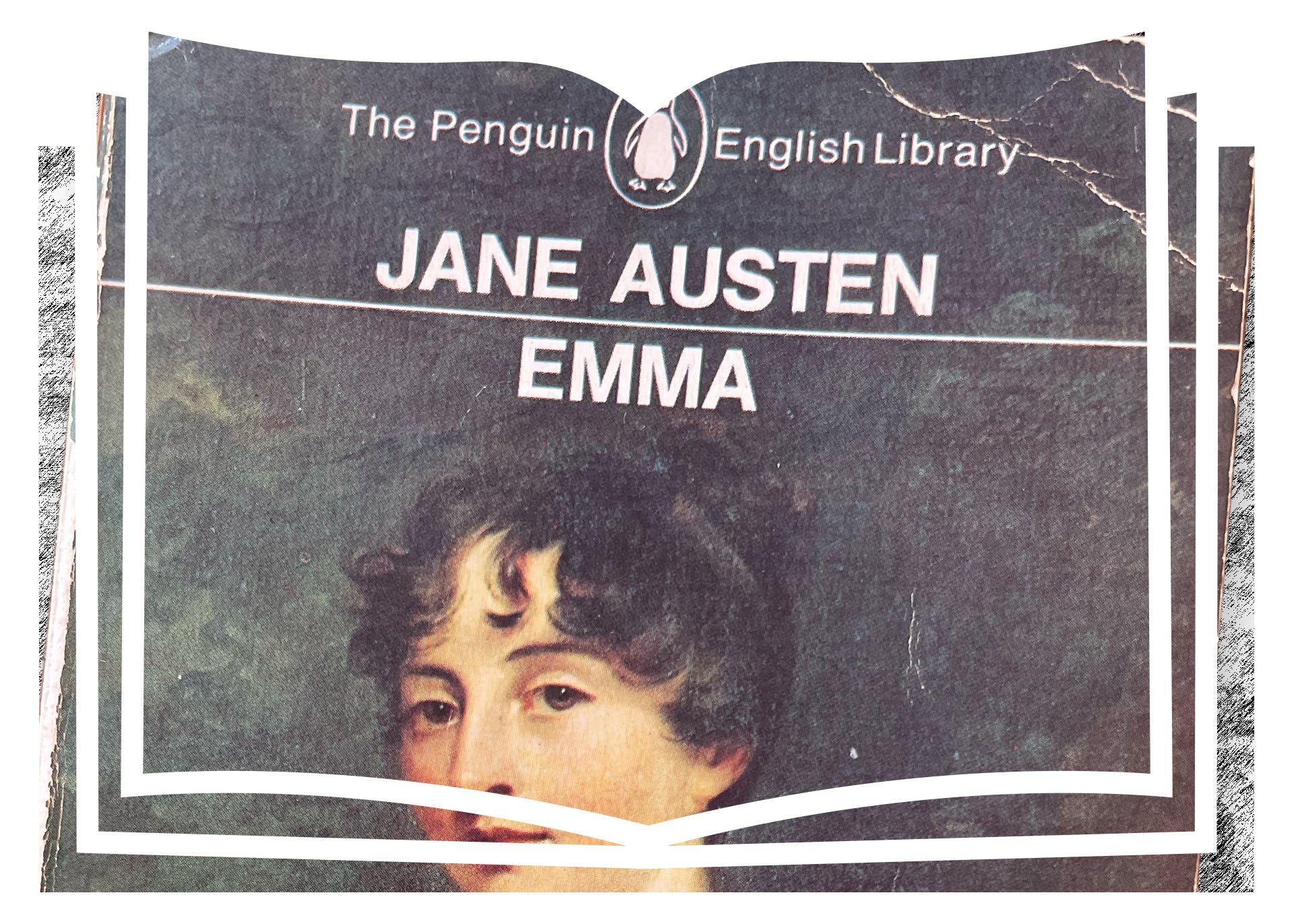
Upper-class nineteenth-century twenty-something Emma Woodhouse amuses herself by concocting matches between her neighbours in the village of Highbury, and most particularly by taking up and grooming Harriet Smith, a girl of uncertain parentage. But while Emma is an enthusiastic fantasist, she is utterly incapable of seeing the reality of the relationships around her, and her efforts are disastrous. Finally she realises that she has been wrong about many things, but most of all about herself; and also that all along, she has been in love with the perceptive and reliable Mr Knightley. Luckily, despite her failings, he has also always been in love with her. Everything ends in marriage, as it should.
The most ludicrous of all my regrettable teenage crushes was the one I had on Emma Woodhouse. For a start, she was getting on for two hundred years old at that point; more importantly, she did not exist. Worst of all, the girl is a nightmare. But, on the upside, she does have some charming qualities, as perceived by me and (more pertinently) Mr Knightley and Jane Austen:
Emma Woodhouse, handsome, clever, and rich, with a comfortable home and happy disposition, seemed to unite some of the best blessings of existence; and had lived nearly twenty-one years in the world with very little to distress or vex her.
But this is Austen, and that ‘seemed’ is doing some heavy lifting, as is that semi-colon. The final phrase is the sting in the tail. Emma Woodhouse, Austen is intimating, is spoiled, complacent and knows little of real life. She is, as Amy Heckerling’s 1995 movie homage puts it, clueless.
The truly tragic thing about my crush was that I had entirely misread the book. And it’s not like Austen was hiding anything; she lays it all out on the first page:
The real evils, indeed, of Emma’s situation were the power of having rather too much her own way, and a disposition to think a little too well of herself; these were the disadvantages which threatened alloy to her many enjoyments. The danger, however, was at present so unperceived, that they did not by any means rank as misfortunes with her.
She is also, in that paragraph, showing the reader how she is going to tell this story: ‘The danger, however, was at present so unperceived, that they did not by any means rank as misfortunes with her’. Those last two words are key to understanding how to read the book, because Austen needs us to understand that when we read events from Emma Woodhouse’s point of view, we are reading them from the point of view of someone who has had ‘rather too much her own way’ and thinks ‘a little too well of herself’. But the narrator, obviously, isn’t going to tell us that out loud. We are required to hear Austen’s hinting tone, and perceive the arched eyebrow and barely concealed sigh of a woman in her late 30s dealing with the next generation. (Austen’s oldest niece Fanny would, incidentally, have been about Emma’s age when Austen was writing the book.)
Once we understand this we can understand Austen’s double tone throughout, her habit of arch intimation and subtle direction. Even the smallest moments start to have multiple layers. Take this moment at the Highbury ball, when Emma realises that Mr Weston has invited other guests with the same urgency with which he invited her:
Emma perceived that her taste was not the only taste on which Mr. Weston depended, and felt, that to be the favourite and intimate of a man who had so many intimates and confidantes, was not the very first distinction in the scale of vanity. She liked his open manners, but a little less of open-heartedness would have made him a higher character — General benevolence, but not general friendship, made a man what he ought to be — She could fancy such a man.
This is not (just) an observation about Emma’s taste in men; it is also an illustration of how she is unable to be honest with herself about her piqued vanity. Austen also wants us to notice that what she is describing as the kind of man she could fancy is Mr Knightley, a man about whom she is equally unable to be honest with herself.
Concealed within all of this there is a little moment of social criticism. Emma sees the other guests as socially beneath her, and in her highly stratified society this is no small thing. This is especially true of the women for whom a ‘good’ marriage is one that will maintain their place in the social hierarchy. Miss Bates, the chatterbox spinster whom Emma humiliates on Box Hill, is a warning; she ‘has sunk from the comforts she was born to; and, if she live to old age, must probably sink more’.
All of this was largely beyond me as a hormonal teenager. This was ironic, because being a teenager was the reason I was reading Emma in the first place: it was a set text. And what a set text it is, an elegant piece of ivory rather than an overwhelmingly intricate clockwork diorama of a Dickens. As well as being very, very funny, Austen’s narrative irony is a delightful way to learn how to read as an adult, how to engage with a text both imaginatively and intelligently. I got over Emma Woodhouse in the end, but I’ve never gotten over Jane Austen.
Sadly, all these qualities are also why the books are very hard to adapt into other media.
Not long after I met Emma Woodhouse and Jane Austen, I met an actual living writer of whom I was also a big fan. More importantly (to me), he pronounced me ‘the second most attractive person in the office’. The office in question was a literary agency where I was spending my summer as a receptionist; the real life person was one of their clients, the delightful Andrew Davies, who was happy to stop and chat with the ungainly young man who brought him his coffee.1
At that point I knew Davies for his sitcom A Very Peculiar Practice (1986--88), which turned out to be excellent preparation for going to university on a brutalist campus. But he was to become properly famous for the ‘Moist Firth’ TV version of Pride and Prejudice (1995), which was totemic for Gen X and helped to propel a new era of Austenalia.
Davies became well known after Pride and Prejudice precisely because Austen is very hard to adapt well. It’s deceptively easy: there’s plenty of repartee, humour, farcical goings on, bonnets, boots and very, very tight britches; and there is splendid romance, with misunderstandings and pent-up emotions and glorious declarations. The difficulty, though, is two-fold.
First of all, Austen has something in common with P. G. Wodehouse beyond home counties high jinks among the lovestruck upper classes;2 the joy in their books is not only in the plots but in the prose. You can cast all the comedians you like, but you’ll never get anything on screen half as exquisite as a P. G. Wodehouse sentence, as jolly and jaunty as a sprung ballroom floor. His greatest jokes are not in his dialogue or his plots, but in the paragraphs in between, the bits that tend to become mere stage directions in adaptations.3
The second difficulty is Austen’s archness. Without the voice of the narrator you are left with only dialogue, and if these adaptations were doing Austen properly you wouldn’t be able to trust what the characters say.
Davies followed up his BBC Pride and Prejudice with Emma for ITV in 1996. It is not the finest Austen television production. Kate Beckinsale is a good bit of casting for Emma herself and Mark Strong ought to be perfect casting for Knightley; but he is cursed with a ludicrous hairstyle that robs him of any gravitas. Far too many of the other cast members are indulging in ‘classic TV adaptation’ acting, over-articulating and waggling their eyebrows like mad.
Even in a sub-par production, though, Davies is a cut above most of Austen’s adapters. He uses some very clever approaches to the problem of the authorial voice; most notably, he inserts cliched fantasy sequences that bring Emma’s romantic imaginings to life and show them to be perfectly ridiculous. There are also some very smart, ‘fair-play murder mystery’ plot shenanigans in which the audience is subtly shown, in the background of scenes, the truths that Emma has thus far failed to notice.
He also introduces some politics. Emma lives with her nervous and worrisome father, who hates change; at the end of the book he only agrees to let her marry Mr Knightley because there are turkey thieves abroad in the local area, and having a young man about the house would be advantageous. Davies adds these thieves to the beginning of the first episode (although they become rustlers of hens instead) so that the series is bookended with brief cameos of the harder world beyond the great houses of Highbury. These scenes also function as commentary on Austen’s marriage market, in which marriage is as much about financial alliances and social structures — and thus political and ethical positions — as it is about love.
Davies’s skill as an Austen adaptor is that he includes not just the action and language of the books, but also their tone and intent. After all, a good deal of the romance (and most of the comedy) comes from social commentary and psychological insight. Without those, adaptations are liable to become little more than ‘just a bunch of people going to each other’s houses’, as the famous one-star Amazon review of Pride and Prejudice puts it; or just a bunch of other people’s regrettable teenage crushes. Although if that means that someone else (like me and the ludicrous Mr Elton) becomes inappropriately enamoured of the marvellous Miss Woodhouse, maybe that’s not such a bad thing.
One thing Emma Woodhouse is not is a ‘good girl’
The trouble with good girls

Nobody wants to be called a ‘good girl’; it is, after all, something you say to dogs. It implies that you are ‘sufficient’, or ‘OK’, or ‘fine’; you are working as advertised. The acknowledged traits of a good girl are those that benefit the people with whom she interacts: reliability, an even temper, an awareness of the rules. Her worst traits, meanwhil…
The most attractive person in the office was, I assume, Bernadette Davis, herself an excellent writer, with whom Davies went on to collaborate on the sitcom Game On (1995—98).
Come to think of it, Emma’s surname is highly appropriate. I can see her as a fierce Wodehousian gel inveigling Bertie into terrible matchmaking schemes that have to be untangled by Jeeves. It would be called Very Well Done, Jeeves (1936), and would later be adapted into a West End musical called Hot Stuff in Highbury.
This is also why we should be glad there are so few Terry Pratchett adaptations.
Very good reading of Emma and context. Although I'm a Janeite, I'm just an admirer and not an analyst. The law and policy commentator David Allen Green, who besides being a constitutional law whiz is a great Janeite, has had some illuminating comments and insights into all things Austen.
I would be keen on reading Very Well Done, Jeeves (2026).