


There wasn’t much Christmas music at the top of US charts in December 1966, but there was a great deal of seasonal silliness. The most popular song was ‘Winchester Cathedral’, The New Vaudeville Band’s parody of a ’20s pop song, packed with perky whistling and quacking muted horns. This was closely matched in foolishness by ‘Snoopy vs. The Red Baron’ by The Royal Guardsmen, a novelty song about World War One fighter ace Manfred von Richthofen into which Charles Schulz’s cartoon dog had been flown, straight out of the sun, as a blatant cash-in. (Ultimately, it didn’t work. United Feature Syndicate, the Peanuts distributor, ended up with all the publishing money after suing.)
Neither of these songs are remembered now as anything more than curiosities – and then, after re-listening, sources of deep regret – but you can hear in both echoes of the hippy underground, a murmuring of stoned nonsense and Wonderland folderol. In their instrumentation and their self-consciously anachronistic delivery, their psychedelic obsession with Victoriana and music hall, they recall The Beatles’ ‘Yellow Submarine’ from earlier the same year.
Official British hippy Donovan had contributed to the lyrics of ‘Yellow Submarine’ and, in return, Paul McCartney can be heard in the background of his contribution to the concluding daftness of 1966, ‘Mellow Yellow’. ‘Mellow Yellow’ is a playground chant of a song, a loose and jaunty hippy march with party horns. It was never supposed to be a single; it was just a joke song that Donovan would sing to his friends, a childish ditty about… is he talking about a fourteen-year-old girl? The ’60s, man.
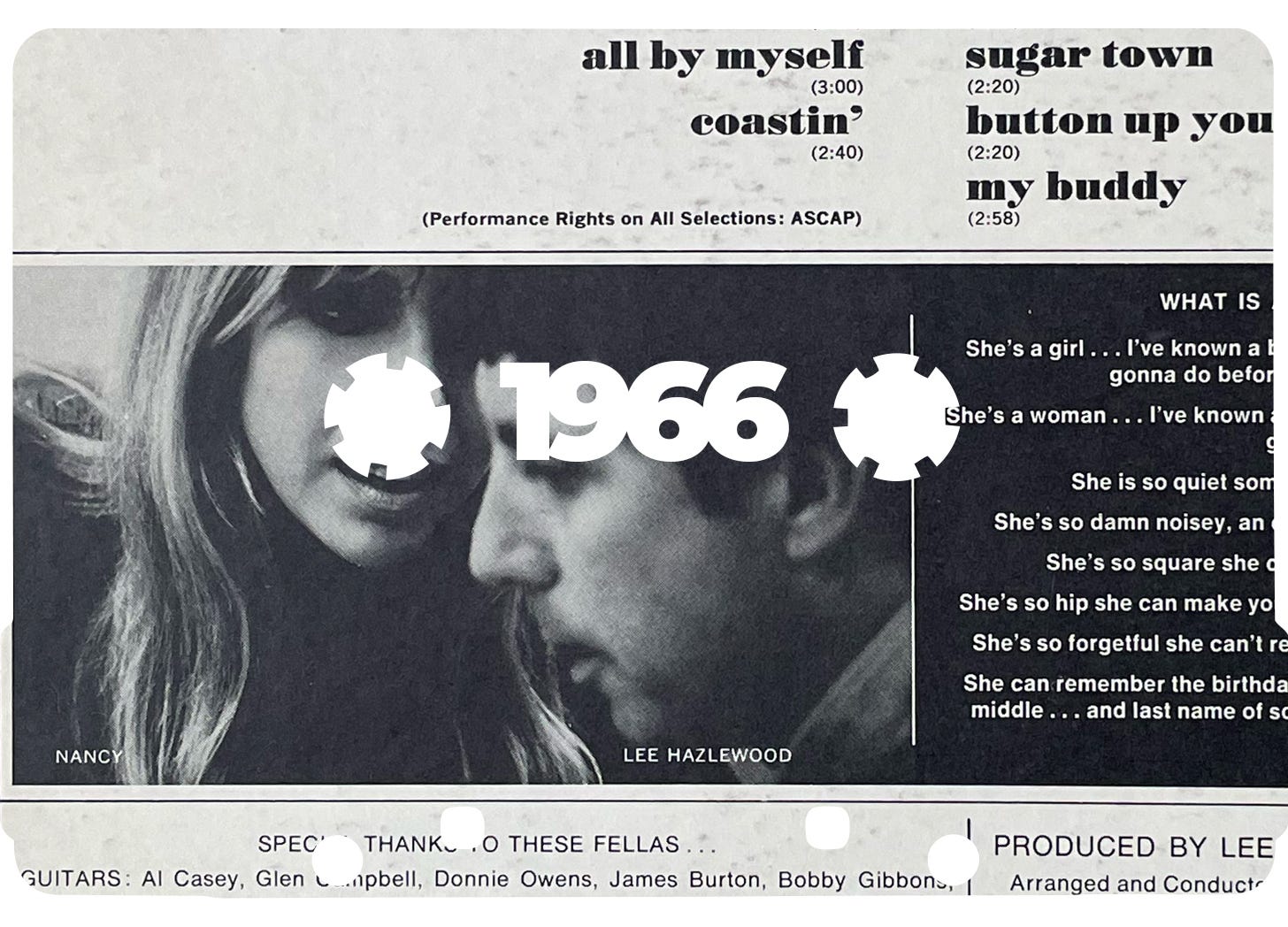
Musically it has much in common with another quasi-hippy hit of the time: Nancy Sinatra’s ‘Sugar Town’. Written by Lee Hazlewood, ‘Sugar Town’ has a similarly ticking rhythmic motor and brass accompaniment. It is a clockwork music box of a song, tinkling along under plangent horns, a rolling jingle to complement Sinatra’s voice, sweet and clear.
It is also, like ‘Mellow Yellow’, lyrically dim: a litany of easy rhymes, with syntax tortured into scansion and non-lexical noodling:
If I had a million dollars or ten
I’d give it to your world and then
You’d go away and let me spend
My life in shu shu shu, shu shu shu
Sh-sh-sh-sh-sh-shu shu, Sugar Town
Hazlewood himself liked to point out that it took a lot of effort to be that stupid. In particular, he singled out the line ‘I never had a dog that liked me some’ as being triumphantly inane.
And, like ‘Mellow Yellow’, ‘Sugar Town’ is a laid-back hymn to idling around and doing nothing, just like two of the bona fide quality pop songs of that December: ‘I’m A Believer’ by The Monkees and ‘Good Vibrations’ by The Beach Boys. Songs full of young love, sunny teenage afternoons and California ease.
This stands in contrast to the Frank Sinatra hit in the charts at the end of 1966, right there alongside his eldest daughter: ‘That’s Life’. ‘That’s Life’ is a typical Sinatra song about adversity, struggle and the hard lessons of experience. A song for the middle-aged and hard-done-by, the grizzled old hands who cannot believe how easy the kids have things these days. I fought the war for the likes of you, you know.1
This is, of course, partly what Hazlewood was getting at with his studied inanity. He was a good decade older than Nancy Sinatra and already into his late thirties by 1966. He’d had his first hit ten years before with ‘The Fool’, a marvellously resonant piece of rockabilly sung by Sanford Clark. (Hazlewood was also a producer, and had used an old storage tank in order to get exactly the right reverberation for Duane Eddy’s twang.) There is a sense in which ‘Sugar Town’ is out of time: it’s a song from the pre-Beatles world, when Frank was still leader of The Rat Pack and pop music was strictly for small children.
But there is always something a little off about Lee Hazlewood songs. He is the king of ‘uneasy listening’, injecting something a little queasy into singable tunes. The best example of this is the disquieting and delightful ‘Some Velvet Morning’, a misshapen duet of cowboy folk-horror. The b-side to ‘Sugar Town’ is ‘Summer Wine’, a weird western song about a young woman who drugs a cowpoke with her wine in order to steal his silver spurs.
‘Sugar Town’ has some of that strangeness, because it isn’t as innocent as it sounds: it is an easy-going, limp-brained pop song about the opening of the doors of perception. Lee Hazlewood always claimed he had ‘seen’ people at a club lacing sugar cubes with acid. He knew nothing about LSD first hand, of course, but the incident inspired the song. The lyrics were supposed to echo the babble of the tripping hippie.
Similarly, Donovan said that ‘Mellow Yellow’ is about a yellow, banana-shaped vibrator that he saw being advertised in a paper. Those perennial ’60s favourites, sex and drugs, were starting to sneak their way into the pop charts in the guise of innocent novelty songs. There at the top of the hit parade are a couple of coded winks to the freaks and longhairs.
But those buried references, only vaguely glimpsed, are probably a truer image of the ’60s than the one Gen X gained through Boomer mythologising. Yes, in 1966, the hippies were rioting on the Sunset Strip, but what they were rioting about were their bedtimes, protesting a curfew imposed by the county authorities. Out there, beyond Sunset, among all those twinkling lights up the hillsides, in all those endless, sprawling suburbs, people were listening to The Royal Guardsmen and The New Vaudeville Band, mainstream TV stars like The Monkees, and popular music royalty like Frank Sinatra. Drugs, sex and rock ’n’ roll were things you only heard about on the news, interspersed with Mantovani and adverts for space-age, drip-dry suits.
In that strange collaboration between the psychotronic cowboy, Lee Hazlewood, and showbiz princess Nancy Sinatra, you can perhaps see the ‘60s clearly: the easy listening, gently swinging mainstream and, just barely detectable, a trace element of psychedelia that was starting to leach into the pop groundwater.
It is this effect that perhaps explains why, when I first heard ‘Sugar Town’ in the ‘90s, it rapidly became one of my favourite songs. One has only to look at the Swinging Simulacrum of Cool Britannia to see quite how marinated in ‘60s culture British Gen X were.
The nuclear bomb may never have dropped on our Cold War childhoods, but they were illuminated by the stark atomic glare of the ‘60s cultural explosion, turning us into ashy shadows on the blank wall of the future. Despite what all those creaky Frank Sinatra fans might have thought, the Boomer generation had pulled themselves out of their stoned stupor and changed pop music, film, TV, society, sex and the world. All Gen X could do was try to build their own parody version, a cargo-cult ‘60s made out of greatest hits albums and twerps.
Which makes it somewhat ironic that I first heard ‘Sugar Town’ on the jukebox in The Good Mixer pub in Camden, North London; because The Good Mixer was the clubhouse for Britpop. I would say in my defence that this was before The Good Mixer was cool, but that just makes me sound like even more of a hipster berk.2
But hipster taste, awakened by that little tang of Lee Hazlewood acid, was undoubtedly why ‘Sugar Town’ was on that jukebox. It recognised something melancholy, something that belies the apparent idiot happiness, something of Hazlewood’s wry attitude to hippies and their hedonism. This was music from a hidden ‘60s: not the age of rebellion, reinvention and rock n’ roll that had become the Boomer mythology, but something straighter and, simultaneously, stranger. It was a voice crying in the wilderness, a heretic alternative to the apostolic succession of Elvis, Dylan, The Beatles and The Velvet Underground.
What’s more, this alternative to the myth of the ‘60s was something that a Gen X slacker could get behind. We’d already figured out that our generation was never going to have the cultural impact that the Boomers had. Indeed, the most we’d managed was to invert their rebellion: getting off your face on drugs and dancing to a light show was mainstream, and thanks to the house price boom of the late ’80s, moving to the suburbs was an impossible pipe dream. Here was a song tailor-made for the Quotation Generation: an obscure song that was itself an obscure reference to drugs, a hymn to sitting back, sparking up and goofing off. What could be more Gen X than that?
I got some troubles, but they won’t last
I’m gonna lay right down here in the grass
And pretty soon, all my troubles will pass
Cause I’m in shu shu shu, shu shu shu
Sh-sh-sh-sh-sh-shu shu, Sugar Town
For more Nancy, Lee and uneasy listening, there’s always our piece on the Easy Listening fad of the ’90s
Uneasy listening

At one point in the early ‘90s a friend and I were turned away from a Soho pub for wearing suits. Suits were for management stiffs or trouble-making wideboys, coked up ad execs in Armani or drunk-fighting estate agents in unfortunate shoes and something shiny off a peg at Next. P…
‘Aren’t you sorry you won?’, as Ringo replies in A Hard Day’s Night.
Further evidence for the prosecution: when I went to a cinema showing of the TV specials Lee Hazlewood recorded when he was living in Sweden, I’m pretty sure I was sat behind Bob Stanley of Saint Etienne. Full hipster nerd accreditation right there.