


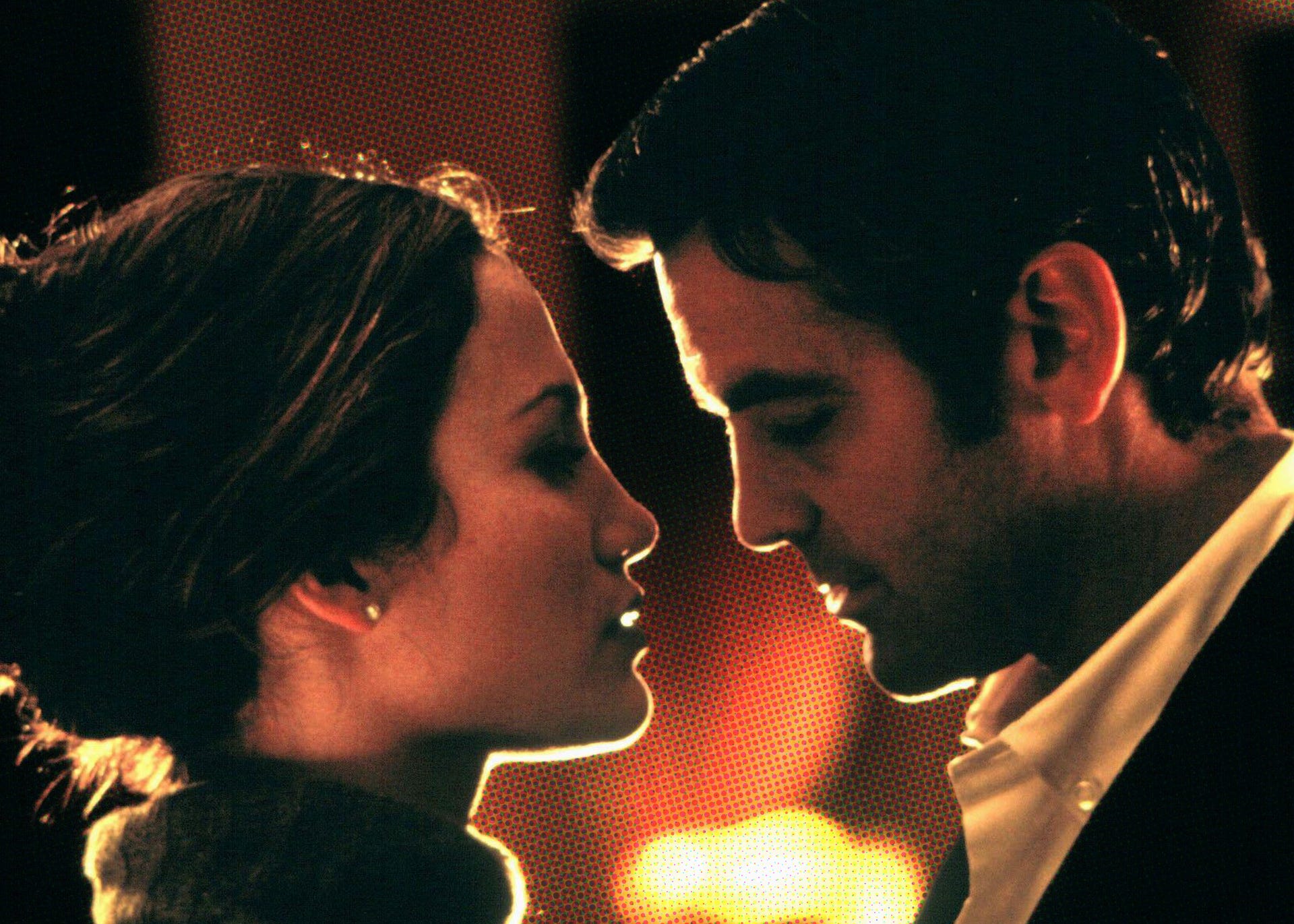
‘A lot of actors who are handsome when young need to put on some miles before the full flavor emerges... Here Clooney at last looks like a big screen star; the good-looking leading man from television is over with.’
I’ve got a lot of time for the late film critic Roger Ebert, so I don’t mean to diss the big guy. But this approbative statement about George Clooney back in 1998 — that ‘the good-looking leading man from television is over with’ — merits some unpicking.
George Clooney was already a huge star before the release of Out of Sight, Steven Soderbergh’s sexy, grown-up crime caper. (If you haven’t seen it, or haven’t re-watched it in a while, you should get on it; it’s still enormous fun.) His turn as Doug Ross in ER from ‘94 to ‘99 had made him as famous as it’s possible for a mid-career actor to be.
And Clooney does nothing in Out of Sight that he had not done in ER. He delivers his lines confidently, looks at you from under his great big sable eyelashes, and doesn’t mess up. He is very beautiful, and has a carefully modulated and charming hyper-awareness of same. (Take that thing where he catches his breath in the middle of a sentence and then chuckles; I always interpret this as him happily remembering what his face looks like.)
This is all good. I like watching George Clooney do these things. But how was any of it a departure? Yes, Out of Sight is a film, not a TV series, but it’s a well-made, romantic slice of cartoonish Americana; it’s not flipping Eraserhead. And nobody argued they couldn’t take James Gandolfini seriously because he was in The Sopranos. So what is the key category distinction here? Could it be that medical dramas are regarded as flippant entertainments for women and children, while sweary dramas about guns and crime are regarded as profound meditations for serious, grown-up boys? Could it be that the anticipated audience for Out of Sight was considerably richer in testosterone than the core ER audience, and was therefore better able to confer distinction?
Anyway: because Clooney is basically movie wallpaper these days (albeit very nice wallpaper from a darling little studio in Amalfi), what you really notice, watching Out of Sight now, is how extraordinary Jennifer Lopez is.
I hadn’t paid much attention to Lopez since Out of Sight was released, but I had a dim impression that she became a mildly tragic figure whose fame-hungry manoeuvres keep the online gossip sites humming. The only things I ‘knew’ were that she was in that film where she said ‘gobble, gobble’, she sang ‘Jenny from the Block’, and at any given moment there’s a 50% chance she’s married to Ben Affleck.
This made Out of Sight a surprising re-watch. Because what Lopez is in that film, most of all, is a giant star; the audiences just didn’t know it when they took their seats. She is likeable, charismatic, slightly mysterious, a little withheld, massively cool, entirely believable and jaw-droppingly beautiful. She is on screen with an array of storied Hollywood talent — Ving Rhames, Michael Keaton, Viola Davis, Albert Brooks, Dennis Farina and even (briefly) Samuel L. Jackson — and it never occurs to us to think that she doesn’t belong there.
I’ve already admitted that I had zero knowledge of what happened to Lopez’s career after Out of Sight, so I will try to keep the thinly-disguised digest of Wikipedia entries to a minimum. But one way of answering the question ‘Whatever happened to Jennifer Lopez?’ is: She has been successful beyond anyone’s wildest dreams. She has starred in dozens of movies, owns a production company, has a streaming deal with Netflix, has made a string of studio albums, sells out enormous arenas, and has a residency in Las Vegas. She also has a consistent record of activism in Democratic politics, especially on immigration. After a speaker at a Trump rally made remarks about Puerto Rico being ‘an island of garbage’, she was one of the people who pushed back; her parents are from there.
What she isn’t, of course, is a critical darling. Interesting directors are not giving her cameos as a hot older woman or a wise midlife CEO or a hardbitten, wisecracking bitch. She’s not being cast by Rian Johnson or Wes Anderson or Kathryn Bigelow. She is not — as Clooney is — relaxing into a warm hip-bath of general acclaim. She is not — as Brad Pitt is — being invited to show her range. Nor is she — as Cate Blanchett is — having fun in Soderbergh’s latest. Maybe she’s ‘difficult’, but I mistrust the media’s reporting on these things; and anyway, have you met actors?
The turning point in Lopez’s career was the gleeful odium that rained down on Gigli, the 2003 rom-com where she first met Affleck. It’s in Gigli that she delivered one of the most brutally reviled lines of all time, the aforementioned ‘gobble, gobble’. As everyone quickly found out — mostly without watching the film — the line is a playful request for cunnilingus. It was delivered by this outrageously attractive woman who was, by the time of the film’s release, going out with the guy to whom the request is directed. He seems to have been the only person who didn’t mind.
I’m going to focus on the guy in question because I think his place in the American imagination explains something about what happened. Ben Affleck the person is a real boy who has some privileges and has faced some challenges. But ‘Ben Affleck’ was, at this time, the prime avatar of a white working class guy from some state where it’s always cold, and where the local plant is always laying people off. ‘Ben Affleck’ suffers the trials of Job, and nothing is ever his fault. ‘Ben Affleck’ turns up late to a job interview because he was nursing his invalid mom, and is told that the position has just been filled. He walks despondently through the snow to a neighbourhood bar where he spends his last ten dollars buying a beer for his brother, whose family — including the little kiddo with the bad chest — is about to be made homeless. In the parking lot of the bar, ‘Ben Affleck’ is set upon by psychotic motorcyclists for no reason. Bleeding from a head wound, ‘Ben Affleck’ stumbles off, trips over a loose bootlace and falls through the window of a local business, which unfortunately turns out to be a bank that is in the middle of taking a cash delivery. Reaching for his ID to calm the security guard, ‘Ben Affleck’ instead pulls out the unlicensed gun he is looking after for a friend. The only thing ‘Ben Affleck’ has going for him is the love of a demure local girl who says she will wait for him until he gets out of prison.
What ‘Ben Affleck’ is not supposed to do is happily comply with sexual commands from a fabulously beautiful and rich movie star lady.
Because of the blithely stupid recursive quality of popular media in the Noughties, the brutality of the critical response to Gigli became a news story in itself. (I don’t think this would happen in the same way now; there are too many people primed to say ‘Well, actually…’) For a couple of months after its release, everyone online in the English-speaking world was making jokes about how bad it was, even though hardly anyone actually saw it. (The ‘worst film of all time’? Do me a favour. I’m willing to bet that Ben Affleck has made worse films all by himself.)
It’s impossible to watch the ‘gobble, gobble’ clip now without cringing, but that’s partly because it’s impossible to separate it from its impact. It’s also very hard, on a female-solidarity level, to watch a woman request oral sex (still a bit of a mainstream taboo-buster at the time, honestly; there’s even a whole sub-plot about this in The Sopranos) while knowing how the request itself, an experimental assertion of ordinary female sexuality, was subsequently weaponised against her.
In fairness, it is also true that no amount of talent or sex appeal can render the phrase ‘gobble, gobble’ acceptable. It was an error to include the words ‘gobble, gobble’ in the script. A better director would have cut the words ‘gobble, gobble’, possibly after throwing up in a small bucket, and a better or more confident actor might have refused to say ‘gobble, gobble’. Mistakes on all sides.
In those few unwitting seconds, Lopez is kissing goodbye to any possible universe in which she becomes a four-quadrant movie superstar. For me, that’s what makes it hard to watch. I at least hope, for J-Lo’s sake, that Affleck was amazing at cunnilingus.
Lopez has said that she found the response to Gigli ‘eviscerating’, as well she might. In 2004, a year after it was released, her performance in another co-star vehicle with Affleck was cut to the bone after test audiences objected to seeing them as a couple (despite enthusiastically consuming media that insistently featured them as a couple). But, incomprehensibly, she chose not to lie down and die in a puddle of shame. She just kept on working in the fields that still welcomed her, becoming extremely popular with audiences that people are sniffy about: teenagers, pop fans, romcom aficionados, Spanish speakers, daytime TV watchers, wedding planners (sorry). (Her work rate is truly extraordinary; you get the sense she thinks everything she has might disappear at any moment.)
Throughout it all she has remained on the front page of the tabloids, all sequins and bikinis and gold hoops. She has been the opposite of demure. I can’t help but feel that part of the ‘problem’ with J-Lo is that she is brassy, not classy. She’s admitted that some parts of her experience have been painful, but she hasn’t shown any goddamned penitence; she hasn’t apologised for rudely continuing to exist and make oodles of money. She didn’t get down and stay down until someone told her she could get up.
Reviewing one of her movies in 2005, Ebert nailed the unreasonableness of her punishment while also encapsulating this sense that Lopez needed to be forgiven. (Forgiven for what, exactly?) He observed that the average reviewer ‘will have no respect for Jennifer Lopez, because she is going through a period right now when nobody is satisfied with anything she does... Give Lopez your permission to be good again; she is the same actress now as when we thought her so new and fine.’
As you watch Lopez now opposite Clooney in Out of Sight, the subsequent mismatch of their career trajectories seems absolutely wild; it bears no relation to what you’re seeing on screen. I’d like to see what she would do now in a big, smart, grown-up movie. It’s only fairly recently that beautiful young women actors have been allowed to age at all; to — as Ebert puts it — ‘develop their full flavour’. I’m still not over the thrill I get every time one of these women pops up with a scraggly neck and a deeper voice: Julia Roberts, Kirsten Dunst, Kristen Scott Thomas, Kate Winslet, Winona Ryder (and yes, none of these actors are women of colour, are they?) I want more; we’re not at parity yet. Think of all the cumulative hours you’ve spent watching John Travolta and Alec Baldwin and Mel I-can’t-believe-I-am-having-to-say-this Gibson.
In her terrifying book Toxic, Sarah Ditum examines the ‘strange, febrile years of the noughties’ in which internet-driven incursions into the physical and emotional privacy of famous women had horrible consequences. Ditum writes: ‘For the public, tearing these women to pieces was both a social activity and form of divination. In the entrails of their reputations, we hunted for clues about what a woman ought to be.’ It’s hard not to hear echoes of Lopez’s experience in that.
I almost hope she fell foul of the complex forces Ditum describes, because the alternative is that audiences diverted the course of a woman’s career because she had the temerity to go out with Ben fucking Affleck. I mean, he’s fine, but he’s no George Clooney.
Speaking of which, here is George being a ‘good-looking leading man from television’ in ER
ER (1994 - 2009)

TV and radio are are little boxes full of many kinds of friends: informative friends, entertaining friends, distracting friends, friends who just won’t shut up and go away. In our semi-regular TV re-watch feature, we take this metaphor and chases it into the ground with deadly intent.
This was an interesting read. I think Ebert’s comment about Clooney was less about Clooney himself, and more about the time when TV actors were TV actors and Movie actors were Movie actors and moving from one category to the other was considered difficult-to-impossible. (There was a whole thing about how the leads in Cheers tried and failed to become proper movie stars.) Clooney made the transition and Out of Sight was the first sign it was going to work for him.
Regarding Lopez, I think it’s difficult to analyse her career trajectory without factoring in her relationship with Sean Coombs. They were such a power couple - massive coverage, designer everything, peak late 90s glamour - and then the gun-in-the-nightclub incident happened and suddenly coverage of both of them really changed and never quite recovered. They split not terribly long after but it’s like that revealed something about both of them that has carried on through media coverage (on both their trajectories) ever since.
This is an un-feminist thing for me to say, which is why I hesitate to say it, but I think J-Lo was - or allowed herself to be - massively overexposed for a long time, and that she’s been made to pay the price for the media’s own frenzied laziness. My memory is that, in the months and years before 9/11, Jennifer Lopez and her bum were absolutely everywhere, I mean EVERYWHERE, in mainstream Anglo-American media. At times, it seemed like she was on the cover of every single magazine and tabloid newspaper, and over and over again, to the point that it was inconceivable that someone could work so hard or bear to be photographed so much. The result was that there seemed to be no mystery about her; she seemed to give herself away too freely, to the point of mutual exhaustion. Maybe that’s what it means to say that she’s deemed brassy rather than classy. When 9/11 happened, I thought American mainstream culture might turn a corner: renounce its cruelty and superficiality, regain its imagination, and give poor J-Lo a break. Lol, it seems that only one of those things happened.