


Midway through The Gold (BBC, 2023), Neil Forsyth’s series about the 1983 Brinks Mat robbery, there’s a truly great parable about British class. Terrifying underworld fixer Gordon Parry (Sean Harris) is talking to the corrupt solicitor Edwin Cooper (Dominic Cooper) while standing on the banks of the Thames in east London:
‘We used to come mudlarking down here when we was kids. Dig around at low tide. We’d find teeth. Bones. Bits of old pottery. One day we thought we’d go up West. Dig around in the mud in Chelsea. Do you know what we found, Mr Cooper? Coins. Jewellery. One lady found a silver cigar box. That’s how deep it goes in this city, Mr Cooper. The divide. It’s in the mud.’
(Apart from anything else, few things are more elementally frightening than the way Sean Harris says ‘teeth. Bones.’)
As this fictional conversation was taking place in the rotting wastes of London’s docks, the real-life bohemian bourgeois of early-‘80s London were heading to the flicks to see Merchant Ivory’s Heat and Dust, an adaptation by Ruth Prawer Jhabvala of her prize-winning novel set in India under British colonial rule. Jhabvala, who worked on more than 20 Merchant Ivory scripts, had an extraordinary life: she was born to a Jewish family in Cologne, fled the Holocaust as a child, grew up in Britain, married an Indian, divided her time between New York and New Delhi, and became a US citizen in her sixties.
As well as being a hugely successful novelist, Jhabvala was a key writer and script doctor at the Merchant Ivory production house for decades. Her experience of overlapping and sometimes fluid national and cultural identities fitted in well there; the producer Ismail Merchant — the professional and life partner of the director James Ivory — described Merchant Ivory as a ‘strange marriage’ between ‘an Indian Muslim, a German Jew and a Protestant American’. Their early films were dramas and romances aimed squarely at Anglophone Indians; Jhabvala had noticed that the elite Indian marriage market had a lot in common with the elite European marriage market as described by Jane Austen, and that it held a similar potential for engaging stories. In other words: if you’ve met one posh person, you’ve met them all.
Within a year of the release of Heat and Dust the Raj was all the rage. (Sorry.) In 1984 the BBC showed HBO’s The Far Pavilions; ITV sacrificed a young Charles Dance to the nation’s housewives in its all-conquering Jewel in the Crown; and David Lean released his final film, A Passage to India, an adaptation of E. M. Forster’s 1924 novel. All round, there was a sudden superabundance of posh white people fainting clean away in the markets of Jaipur. Perhaps British audiences were genuinely interested in reappraising their country’s colonial role in India, but the glamour, romance and class of it all surely didn’t hurt.
Over the next ten years Merchant Ivory ran through Forster’s novels like a dose of salts, and in the process carved themselves a niche in cinematic history. Lean’s seizure of A Passage to India now feels like a bureaucratic misallocation, or a trick question, like George Lazenby’s single appearance as Bond. It also had the effect of leaving Merchant Ivory only Forster’s English and Italian novels; these have simpler politics than Passage, and settings (the Home Counties, Oxford, Tuscany) that were wonderfully familiar to upper middle class people in the ‘80s. The extremely posh casts could have comfortably staffed a large prep school: Helena Bonham Carter, Hugh Grant, Emma Thompson, Vanessa Redgrave, Ralph Fiennes, Maggie Smith, Daniel Day-Lewis. Many of these, you will notice, are the scions of established artistic lines. If experience of British class teaches you anything, it’s that privilege accretes within families over time.
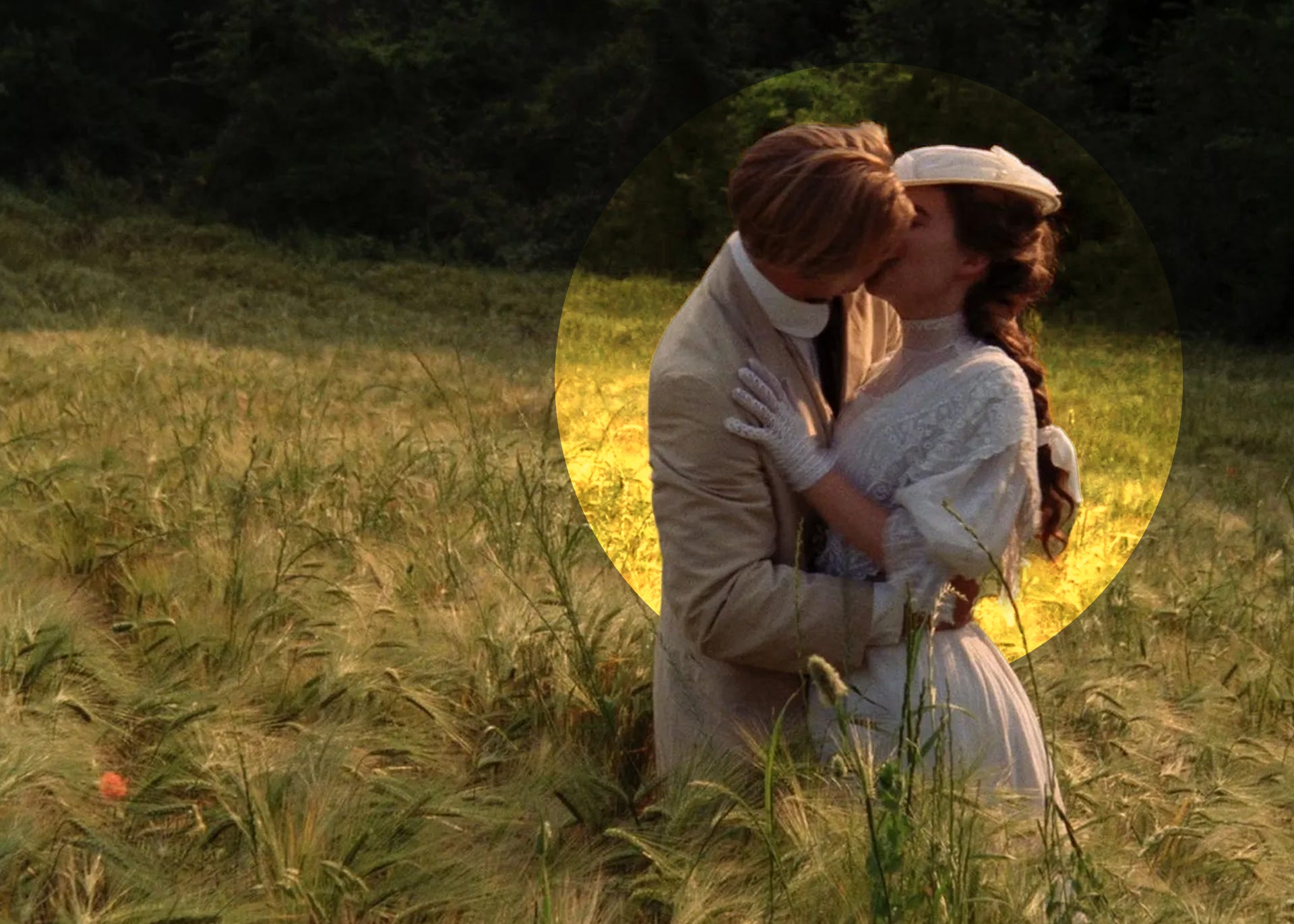
The films were full of people with secure incomes falling in love in beautiful locations, and worrying about what is and isn’t vulgar while looking absolutely stunning. The Merchant Ivory look created for Bonham Carter, in particular, slammed into a certain kind of young English woman with tremendous force. I spent at least a year swanning around in floor-length skirts with a looped section of hair jutting out above my forehead, like a shelf above a basin. And the romance was truly sweeping; girls who were young in 1985 were never the same again after the scene in which the passionate George Emerson (Julian Sands — sadly, in all senses) snogs the face off Lucy Honeychurch (Bonham Carter) in a Tuscan meadow to the strains of O mio babbino caro. Forster was gay, of course, and lots of literary critics have complained that his understanding of heterosexual relationships had no basis in reality, something that is also true of the average teenage girl.
So there’s no massive mystery about why Merchant Ivory’s films were so successful; they were beautiful and romantic and glamorous, they had great ticking Dickensian plots full of coincidence and outrage, and they were satisfyingly moral (bad people get bad things and good people get good things). They would probably have swept the board in any decade, although if they were made now they would have to include a much sterner interrogation of exactly how these rich white people had made their money. But what I find interesting, 40 years later, is what their popularity in the ‘80s suggests about how their audience was thinking about class.
The films are all about class. The story they tell is one in which bourgeois bohemians bump up against vulgar rentiers, cruel capitalists and insensible snobs. To a man and woman, the bobos are clever and warm and pretty and funny; they are the main characters. They fall in love with fervent but unfortunate working-class clerks; George in A Room with a View is a clerk, as is Leonard Bast in Howards End. (Merchant Ivory nevertheless cast exceptionally posh men in these roles. Julian Sands, for instance, is straight out of Compton. That’s Compton in Guildford.) The role of the clerks is to display instinctively noble sensibilities, and to get kicked around by cruel arrivistes until they can be rescued by a bobo in a very nice dress. The children of the unions between the bobos and the clerks eventually inherit England itself — or, at least, its prettiest houses.
This is not just romantic wish-fulfilment; it is also political wish-fulfilment aimed at a very specific section of the middle classes. There is nothing more glorious, for a bobo, than the chance to offer aid and comfort to an unfortunate but sexy poor person while wearing something casually stylish and making great jokes. The Guardian-coded Schlegel sisters in Howards End, had they been born a few decades later, would have deplored the Thatcherite economic transformation of the ‘80s; they would have been putting all their spare cash into miners’ collection buckets, and inviting people from the GLC to speak at their weekly meetings.
But — and this is where The Gold’s parable about the Thames mud comes into it — there was more to the ‘80s than industrial workers having their livelihoods and communities destroyed (although that definitely happened). Something entirely different was stirring in other parts of the country, particularly to the south and east of London; as The Gold puts it in one of its episode titles, ‘There’s something going on in Kent’. Thatcherism was disrupting the relationship between money and status, and some working people were becoming very rich indeed without pausing to pick up a Habitat catalogue, much less ask for anyone’s help. They were ramraiding the barriers around upper-middle signifiers; luxury brands, expensive cars and historic detached houses were, it turned out, highly responsive to cash, not lineage. These people were competing with the ‘80s bobos for status (as well as other scarce resources), and the bobos did not like it one bit.
Faced with working people who had real agency and real power and real money, the supposed bobo values of compassion and fellow-feeling completely collapsed. As Merchant Ivory films were raking it in, Harry Enfield (who is objectively posh) was regaling the Saturday Live audience with his ‘Loadsamoney’ character, a canonically Essexian grotesque who had committed the hilarious sin of being both rich and loud. And every year, even now, supposed lefties titter behind their fans as working class women rock up at Ascot in their tight skirts and fake tans.
The opening sequence of Howards End follows Vanessa Redgrave’s Mrs Wilcox — a bobo matriarch — as she walks through her rural garden at Howards End in the long midsummer twilight. The sequence is a tribute to the delicate, restrained glories of the English countryside, captured at the most beautiful time of the day at the most beautiful time of the year. The Schlegel sisters and Mrs Wilcox think they have a unique appreciation of Howards End; and they think this means they are morally qualified to own it. Merchant Ivory, with its truly international perspective, instead presents the English landscape as its mute riposte to Margaret Schlegel’s famous assertion that ‘England has no true mythology’; cultivated landscape is the English mythology, they argue, and the beauty of a midsummer garden belongs to humankind through the medium of film. But I think they’re both wrong. The garden at Howards End belongs to anyone who has enough money to buy it; and England’s true mythology — its explanatory taxonomy of power and fate, ogres and fairies — is class.
Lucy Honeychurch and George Emerson was the only forbidden Edwardian romance making bourgeois teenage girls hot under the Laura Ashley collar in the ‘80s.
Friends

I didn’t know many boys in 1984. I was at an all-girls school, so that was no use, and my extended family - which included the usual proportion of boys - was 200 miles away in Wales. At the weekends my dad coached the boys’ under-15s rugby team at London Welsh, which brought him into regular contact with the then-Labour leader Neil Kinnock whose son Ste…
Worth reflecting, I suppose, that Forster had grown up in the late 19th century and first found success in the Edwardian era when you also have the upper strata of society facing a tension between breeding, if you like, and wealth and power. It’s the time of aristocrats looking for American heiresses to marry so that they can repair the east wing: Consuelo Yznaga married Viscount Mandeville, later Duke of Manchester, in 1876; her god-daughter Consuelo Vanderbilt married the Duke of Marlborough in 1895, the same year Mary Leiter married Lord Curzon of Kedleston, and her sister Margaret Leiter married the Earl of Suffolk in 1904. But you also have the uncomfortable challenge of rich male outsiders, not least Jewish ones like Sir Ernest Cassel, the Prussian-born banker who became such good friends with Edward VII that he was nicknamed “Windsor Cassel”.
“Julian Sands, for instance, is straight out of Compton. That’s Compton in Guildford.)” Oh, behave!