


These are the voyages of the starship Enterprise. Its 5-year mission: to explore strange new worlds, to seek out new life and new civilizations, to boldly go where no man has gone before.
Or, to put it another way: Star Trekkin’ across the universe, on the Starship Enterprise under Captain Kirk. Star Trekkin’ across the universe, boldly going forward ‘cos we can’t find reverse.
The Legend
In 1987 a group of record producers working out of some studios in Walthamstow released a single called ‘Star Trekkin’ under the nom de berk of The Firm.1 ‘Star Trekkin’ is the sort of witless novelty song that leads you to doubt your patience, the fundamental decency of humanity and the entire concept of music. It is a string of misquotations from Star Trek dialogue chanted over a Bontempi accompaniment of increasing hysteria, the song speeding up verse by verse, until the lines are being screeched at a pitch liable to upset dogs. Humans will have been upset right from the beginning.
To be fair, not all of this is the fault of The Firm. The song actually originated with folk singer Rory Kehoe, who took the mid-nineteenth-century German folksong ‘Ich bin ein Musikante’, from which comes the structure of repetitions of increasing speed, and wrote new lyrics about a science fiction TV show.
As well as being a fan of Star Trek, Kehoe was also a member of The Sealed Knot, a group dedicated to recreating the battles of the English Civil War. He and his friends would sing his song while sitting around the campfires on the eve of battle, a gaggle of stern Roundheads and foppish Cavaliers, united at last by the one belief that could overcome their sectarian politics and religious schism, serenading the night with their Brothers Grimm-era roundelay of Klingons and transporter beams.
This was, after all, the image of Star Trek in the ’70s and ’80s, the business of misfit men with strange beards and obsessions, nerds who liked science fiction. And this was also the story of Star Trek itself. Creator Gene Roddenberry pitched it as ‘Wagon Train to the stars’, referencing a successful Western TV show that was also a series of self-contained stories within a longer journey. However, network NBC was initially equivocal, rejecting the original pilot as too cerebral. Fortunately production company president Lucille Ball2 allowed the filming of a new pilot, with a new crew and a new approach, and the Enterprise was finally launched.
But ye cannae change the laws of broadcasting. Despite pulling in a devoted audience of ‘upper-income, better-educated males’,3 the ratings consistently declined over the first two series and it was almost cancelled before a letter-writing campaign by fans encouraged a third series. Even then, though, NBC shoved it into a graveyard slot4 and the show was finally scrapped in 1969.
However, Brits of a certain age will have barely taken in anything from the last few paragraphs, since they will have had ‘Star Trekkin’ going around their heads ever since I first mentioned it and will no doubt be already setting their phasers to ‘ow!’ and vowing to hunt me down in revenge. Because ‘Star Trekkin’ was absolutely inescapable in the UK in 1987. It was number one for crying out loud. For two weeks! It knocked Whitney Houston’s ‘I Wanna Dance with Somebody (Who Loves Me)’ off the top spot.
It was huge, and I’m willing to bet that that wouldn’t have happened to a novelty song about Lost in Space, for example, or Land of the Giants. The reason ‘Star Trekkin’ was able to become such a significant blight on the national psyche was because Star Trek itself was not an obscure nerd obsession, it was mass culture. Everyone recognised the impressions (of varying quality) that the voices were doing on the record, everyone had heard of Captain Kirk and ‘Beam me up, Scotty’ and Klingons (even though one of those things never actually appeared in the show).5
This is partly because, having finished production, Star Trek then entered syndication and international distribution and started to find a whole new audience, but it only found that audience because NBC had been wrong. It was good.
NBC had been right about one thing, though, it was also ‘cerebral’. Star Trek is one of those sci-fi shows that is as concerned with the ethics of colonialism or the human propensity to violence as it is with discovering strange new worlds or going pew-pew-pew at the Romulans. In ‘The Enemy Within’, a transporter accident splits Kirk into two versions of himself, one all rationality and empathy, the other all impulse and action. Instead of being a battle between the valiant Captain and his sinister twin, the episode, written by Richard Matheson, becomes a meditation on the fact that rather than being simplistically ‘good’ or ‘evil’, these aspects of a personality are both needed to make it whole and functional. This is the real appeal of Star Trek, that it is pulp with brains, entertainment with a purpose.
It is a product of its time, a New Frontier science fiction. A show full of a post-war confidence, a Cold War democratic boosterism and a Space Age optimism. The Enterprise has not just a multi-gender crew, but a multi-racial (and multi-species) one too, famously featuring an inter-racial kiss between the white Captain Kirk (William Shatner) and his black communications officer Lieutenant Uhura (Nichelle Nichols) just one year after the US Supreme Court struck down state bans on interracial marriage. And Star Trek was never really just the preserve of strange, bearded men. The show was initially script-edited by Dorothy “D. C.” Fontana, and that letter writing campaign that brought the third season, for instance, was spearheaded by female fan Bjo Trimble. Even Dr Martin Luther King was a fan, urging Nichelle Nichols to stay on the show when she thought about leaving, and he didn’t have a strange beard, just a very neat moustache.
Meanwhile, the villains in Star Trek are often megalomaniacs or oppressive states, and they are almost always brought down by collaboration and moral decency. In the episode ‘Space Seed’, the crew accidentally revive a eugenically enhanced twentieth century tyrant Khan Noonien Singh6, who proceeds to take over the Enterprise and torture Kirk. But when they finally defeat him (through team work, naturally), they don’t take revenge: they put him on trial. And reach a reasonable verdict, sending him into exile. The rule of law is paramount.
Maybe it wasn’t so strange that all those English Civil War re-enactors were singing Star Trek filk (the term for science fiction folk) around their pottage. It was in that political maelstrom that an autocratic monarch was judged (however ineptly) in a court of law, The Diggers pioneered a politics of proto-socialism and ‘Freeborn’ John Lilburne first articulated a theory of universal human rights. In other words, the moment those guiding principles of Star Trek’s Federation were born.
Star Trek took that ‘wagon train’ of Roddenberry’s pitch not as a vector of colonialism, exploitation and genocide, but as a metaphor for discovery, civilisation and engagement. In ‘The City on the Edge of Forever’, Kirk tells social reformer Edith Keeler (Joan Collins) that the three most wonderful words in English might not be ‘I love you’ but, instead, ‘Let me help’. Not a command, you’ll notice, but a request, and a request not to change but to nurture.
This is the legend of Star Trek, that it is not just another sci-fi show full of lumpy-headed aliens7 with silly names, ludicrous special effects and impenetrable fictional lore. That it is intelligent and politically engaged, a show that proposed that by combining our capacity for empathy, our ambition to excel and our ability to rationally rise above our base instincts, humanity might boldly go into a bright and hopeful future.
The Reality
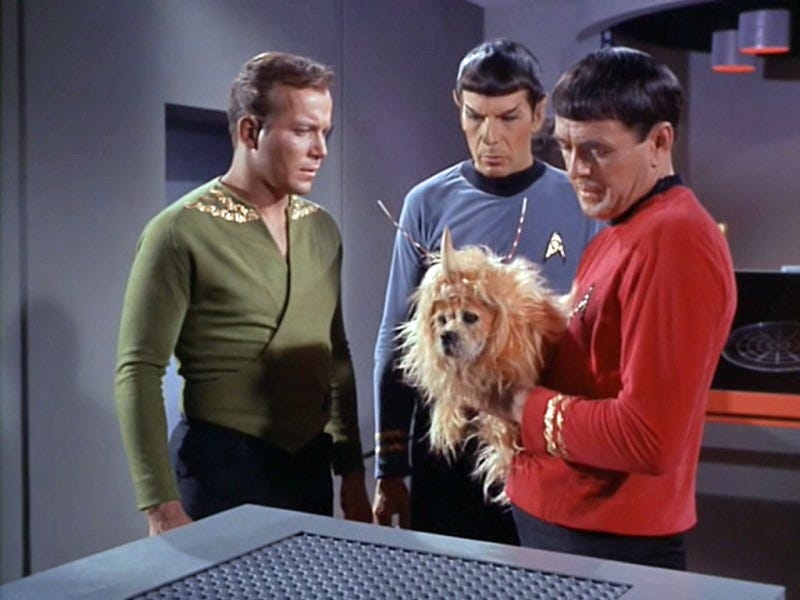
And silly. A frequently very silly future indeed. In the episode ‘The Enemy Within’, the crew figure out that Kirk has been duplicated because the same thing happened to an alien creature they beamed aboard. This creature is, in fact, a thoroughly befuddled dog with one of Shatner’s wigs draped over it and a cardboard horn glued to its forehead.
Star Trek has mid-’60s production to with its mid-’60s politics. The spaceships are chipboard and plastic, the alien planets are foam rocks and painted backdrops. The dialogue is frequently hokey and thick with technobabble (a term that originated with a later Star Trek production team), and as for the actors who mouth it, well, let’s just say that there’s a reason why, whatever his profile on the Canadian Shakespeare scene, William Shatner was primarily known at the time not as a star but as an actor who answered the phone, learned the lines and hit the marks.8
On the other hand, you only have to see him cradling that adorable monocerine canine and emoting seriously about his divided self to know that he was perfect casting for Captain Kirk, if for no other reason than his ferocious commitment to the bit. All of them do it: Leonard Nimoy shrieking with pain as Spock mind-melds with a pulsating rock creature, George Takei’s Sulu stripped to the waist and glistening, waggling an épée with unhinged glee, the splendid eyebrow work of DeForest Kelley and James Doohan, forever tasked with bending the laws of nature to their Captain’s will. They all commit admirably, delightfully, to the bit.
The show is not just engaging despite its silliness, committing to the seriousness of its themes, even as it forces the cast to interact with cardboard and bubble-wrap aliens. It is also engaging because of its silliness. Even when the reach of the production department exceeds its grasp, the ludicrous effects act as a call to the suspension of disbelief, a spur to the imagination. Most of all, like its British contemporary Doctor Who, it is silly and engaging simultaneously. One may delight in the primary-coloured period design, the pop uniforms and Day-Glo landscapes even as one takes seriously the themes of this week’s episode.
Not that those themes were always handled in the most subtle way. In the episode ‘Let That Be Your Last Battlefield’, Kirk and the gang come across two aliens who are piebald, each one-half white and one-half black, divided in a straight vertical line down their bodies. Crucially, though, they are divided in opposite directions: one is white on the right-hand side, the other on the left, and they hate each other for this difference, one ‘race’ oppressing the other, the oppressed then committing acts of retaliatory terrorism.
The futuristically diverse crew of The Enterprise find their racism confounding, Chekov (Walter Koenig) finally dredging up a fact from a history lesson that humans were once prejudiced like this, hundreds of years ago. The thumpingness of this lesson is even combined with a mission which involves ‘decontaminating’ a planet infected with a bacterial pandemic, just as Kirk is trying to ‘decontaminate’ the visitors of their unreasoning bigotry. It is hardly the most delicate treatment of the subject.
On the other hand, Kirk does not succeed. The two Everton-mint-striped aliens remain locked in their mutual hatred. The episode ends with the reveal that their original civilisation destroyed itself in civil war but they remain unmoved by this warning. ‘To expect sense from two mentalities of such extreme viewpoints is not logical,’ concludes Spock, as the show essentially arches a pointy eyebrow at the audience. Mm? Geddit? A lesser show would have attempted to solve bigotry in 50 minutes, or at least have drawn a lesson for the crew. Star Trek has a higher opinion of its audience and a sense of responsibility to the themes it raises.
Of course, one might look at the well-meaning mid-Sixties politics of the show and wince. After all, one of the reasons that Nichelle Nichols was considering quitting was that, as Galaxy Quest’s Gwen DeMarco (Sigourney Weaver) puts it, her job was to ‘repeat the computer’. And wore a miniskirt while doing it. Indeed, all the female crew members wore miniskirts, whether they were practical in Engineering or not. Mind you, given that all they were likely to be doing was screaming and fainting, maybe they didn’t need anything too practical. Equality aboard The Enterprise only went so far.
But Martin Luther King insisted Nichols stay because what other show featured a black female officer as a lead character? A professional cynic like Harlan Ellison, disgusted with the changes made to his script for ‘The City on the Edge of Forever’, might have decried Gene Roddenberry’s ham-fisted utopianism, but at least it was utopian. At least the show was willing to think about how politics might progress and hope for something better.
Ultimately, it is this commitment to making something better than it needed to be that explains the longevity of Star Trek. Because its story — an enthusiastic crew of skilled professionals set out to try and make the lives of complete strangers a little better — is also the story of the making of the show.
I have only to hear those first four notes of Alexander Courage’s Star Trek theme and I get a giddy thrill of excitement. Not just because it’s a great theme, not just because it’s going to be accompanied by the iconic opening monologue, but because of the anticipation of delight. Here it comes. Silliness and seriousness. Starships and philosophy. Kirk and Spock. Adventure. Mystery. Delight. Star Trek.
A: Three. A left ear, a right ear and a final front ear.
Star Trek is the only piece of classic ‘60s TV sci fi that we’ve covered. As you’d expect from a newsletter by British Gen X, we’ve also been doctorin’ the TARDIS:
The Beatle Invasion of Earth

The first in an occasional series looking at Doctor Who, a peculiarly British kind of TV hero, and the cultural contexts that have influenced the ever changing character and stories.
Author’s log: one of the members of The Firm was called ‘Grahame Lister’ - one for the Vic Reeves fans.
Author’s log: Yes, that one.
Author’s log: Tag yourself.
Author’s log: one of the few things I have in common with Gene Roddenberry. Ask me about ‘FightBox’ one day.
Author’s log: Go on, guess.
Author’s log: Khaaaaan!
Author’s log: not discussed with outsiders, of course
Author’s log: of course, there has been a captain of the Enterprise who was already known as one of the finest Shakespearean actors of his generation. Alas!