


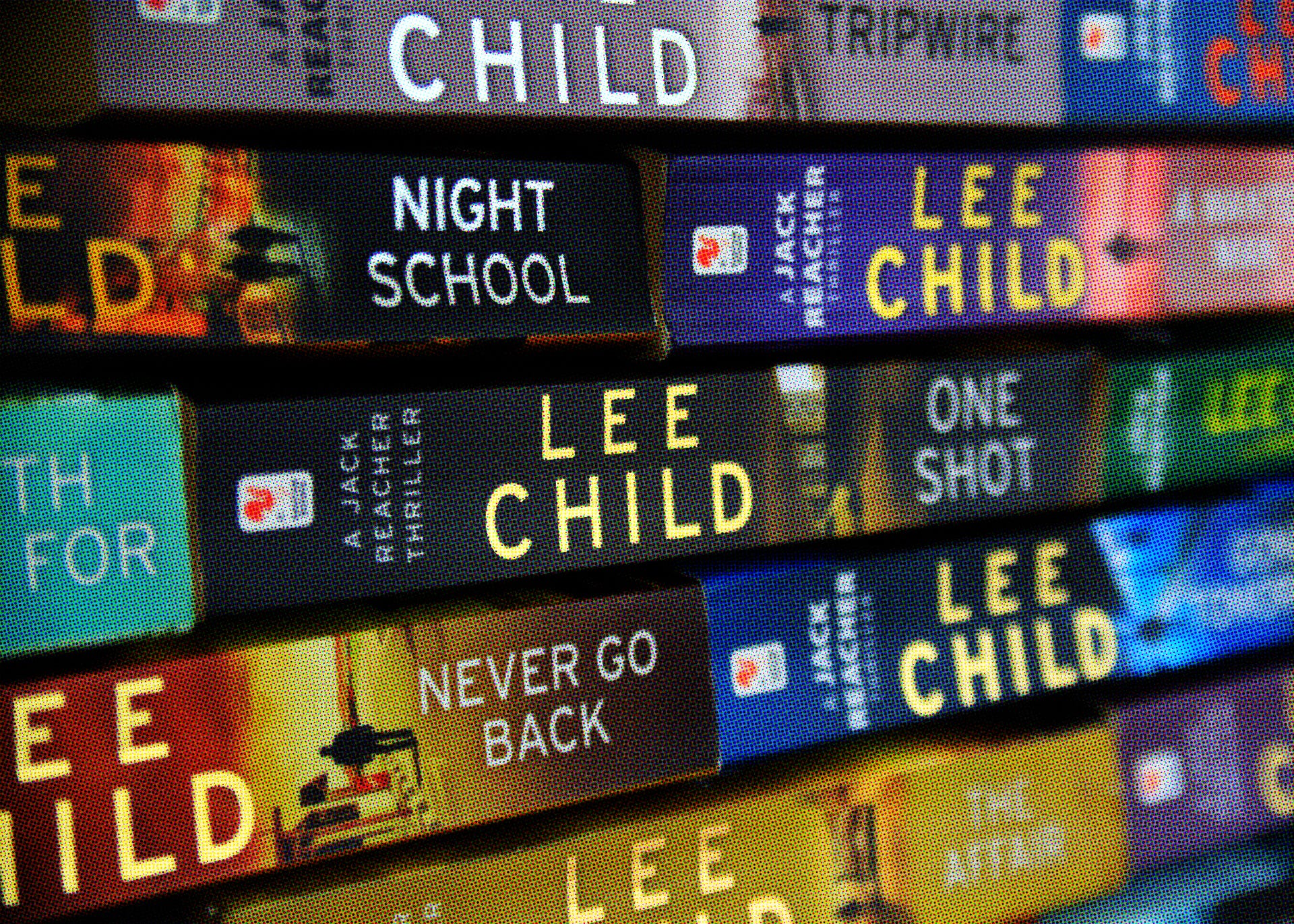
You can get a bit exhausted, sometimes, by the complexity of real life: the weight of people’s experiences and difficulties, and the way that absolutely everything, globally speaking, seems to be speeding towards disaster. Which is why, every now and then, I read all the Jack Reacher books in sequence.
The opening sequence of Lee Child’s first Reacher book, Killing Floor, is like a parody of ‘manly’ writing: flat, terse, repetitive sentences, subject-verb-object.
‘I was arrested at Eno’s diner. At twelve o’clock. I was eating eggs and drinking coffee.’
There are no feelings in the first paragraph, just material facts: the most Reacher will admit to is being ‘wet and tired after a long walk in heavy rain.’ And it has that little choppy non-sentence — ‘At twelve o’clock.’ — which suggests that Reacher sees communication as a form of artillery, like the boring guy at the bar who prevents you from leaving by telling you more and more about his experience of the ULEZ. Essentially, in the first couple of sentences Reacher comes across like someone recuperating from a heavy blow to the head. (Which, to be fair, he often is.)
This air of lumpen masculinity extends into the rigorously consistent Reacher marketing: the screaming yellow capitals; the lone butch silhouette in jeans and Timberlands; and the titles, each of which is a two- or three-word variation on ‘VERY SINISTER SITUATION’.
The thing about Child, though, is that he is not, in fact, a boring guy at a bar. He isn’t making an incompetent grab for your attention. He is unfolding his big, steady hand to show you the beginning of a story. Which, in the case of Killing Floor, continues:
‘I was in a booth, at a window, reading someone’s abandoned newspaper about the campaign for a President I didn’t vote for last time and wasn’t going to vote for this time. Outside, the rain had stopped but the glass was still pebbled with bright drops.’
By this point, halfway down the first page, we have already ticked off several of the elements in the periodic table of Reacher: the hour of the clock (has a character ever been so hell-bent on telling you the time?); the nature of the weather; coffee and food; exertion, privation; a brush with authority. And there are other, more technical tells. The presidential election, so briefly mentioned, plays a subtle part in the book’s central mystery; its casual establishment is very, very smooth. And the lively descriptions and plain but assonant word choices, like ‘pebble’.
Child is particularly pleasing when he writes about cars and driving, which is what he does next:
I saw the police cruisers pull into the gravel lot. They were moving fast and crunched to a stop. Light bars flashing and popping.
(Significantly, Reacher doesn’t have a car, and has never passed a driving test. Unusually for an American, he prefers to walk.)
We’re about two short paragraphs in at this point, and the plot is about to roar into action. Soon the Reacher landmarks are speeding by: his curiously significant shoes; his immense physical handiness; his investigative flair. His women (smart, mouthy, competent, violent and ‘lithe’ or ‘athletic’, which are polite words for ‘thin’). His complex family relationships; his preference for assembling a team, and then walking away alone.
‘Walking away alone’ is important. The set-up is that Reacher is the world’s most stacked, competent and self-sufficient hobo. He is ‘a giant, six five, heavily built, close to two hundred and fifty pounds’, and he spent a couple of decades in the US Army. He knows that he can ‘do anything. First his mother had told him, then his father, then the quiet deadly men in the training schools.’ People assume he’s a thug, and stay out of his way; that’s the way he likes it. Having deliberately divested himself of all possessions, he sets off to wander aimlessly across America.
(This aloneness, incidentally, is one of the reasons screen adaptations of Reacher struggle so badly. Reacher has all the hallmarks of an extremely juicy franchise, with the stubborn exception that the franchise model demands recurring characters. The other reason adaptations struggle is that Reacher’s enormous body is allied to a keen analytical mind, a combination that is both critical and incredibly unusual. So you end up with either the scuttling Tom Cruise in the movies, giving us Reacher as a surprisingly violent figure-skater; or the massive, baffled Alan Ritchson in Amazon’s TV adaptation, giving us Reacher as Scooby-Doo.)
At many levels there is absolutely nothing special about the Reacher books. They are cathartic wish-fulfilment with crazy, unrealistic plots; they are incredibly repetitive; they are rarely funny (although Reacher is hilariously Pooterish at times: ‘Piet Mondrian was his favourite painter of all time, and this exact painting was his favourite work of all time. The title was Composition with Red, Yellow and Blue. Mondrian had painted the original in 1930 and Reacher had seen it in Zurich, Switzerland.’) But, like many other weedy metropolitans, I absolutely love them. And I think one of the main reasons is that they cause me absolutely no anxiety whatsoever — not even, thanks to Child’s talent, anxiety about bad prose. The reader is at times bewildered; but she is never worried.
The entire series is an outstanding example of ‘competence porn’, the wonderful sensation that there are people out there who know exactly what they’re doing, leaving you free to burble along in your happy little rut. This goes for Child itself, and it also goes for the characters he writes. Reacher is the product of professional specialization; he brings a lifetime of brawling and military training to situations that would stun anyone else. (Child addresses Reacher’s competence and exceptionality frequently: ‘there was a portion of his brain developed way out of all proportion, like a grotesquely overtrained muscle.’ At the same time Reacher is shown to be explicitly bad at many other typically ‘masculine’ things, like sports and driving.) Reacher prepares for the worst, because that’s his training; but, like an aircraft pilot or a deep-sea engineer, his ideal outcome is that nobody gets hurt. If you read enough Reacher books you start to develop the comfortable belief that you too could win a bar fight or aim a rifle; his unbounded agency bounces right into your consciousness.
In the secondary characters you perceive Child’s evangelism for the American religion of ‘service’: baddies aside, they are thoughtful and quietly upright public servants, and each performs his or her job with a gratifying excess of skill. Incompetence is explicitly equated with evil, and is usually to be found among the top brass. (In the Reacher universe, executive authority is deeply suspect.)
Importantly for the reader’s relaxation, Reacher’s own survival is never in serious doubt, not least because you know there are always more books coming. This is not a modish TV series in which major characters get killed; it is a determinedly ‘70s-style airport thriller series, and killing Jack Reacher would simply cost too many people too much money. In 2025, when Child stopped writing the books and passed them over to his brother, Reacher joined Jason Bourne and Jack Ryan in the thriller hero Valhalla; he became an IP immortal, released from his creator and too valuable to die.
When he began writing Reacher in the mid-’90s after being made redundant from his job at ITV, Child didn’t know he was embarking on a thirty-year blockbuster spree. In Killing Floor and the three books that follow, Child writes Reacher as a developing character, a person whose circumstances might change; Reacher forms serious relationships with women, he inherits a house, he develops ties to a locality and considers settling down. If this had been a five-book series -- still an enormously successful run, in publishing terms -- Reacher’s story arc might have ended with wedding bells. But, instead, Reacher sold millions. To sustain a long-running series, Child had to reset the clock to zero at the end of each book. In the fifth title in the series, Echo Burning, the newly-single Reacher has been banished to the scorched wastes of the Texan desert, as alone as alone can be. Each subsequent book adheres to the infinite-Reacher formula: he blows into town, stumbles across trouble, metes out justice, and leaves without a backwards glance.
The clockwork predictability of the Reacher formula contributes to the overall sense of complete relaxation. Part of the deal with series like this is that you want to be surprised, but you don’t want to be genuinely unsettled. It’s good to know where it’s all going. With Reacher you always know where it’s going; you just don’t know exactly how it’s going to get there. And he’s good company: his comfortable, well-boundaried and courteous masculinity is incredibly restful. Like any romantic hero he is invested with huge reserves of potential energy held in mindful abeyance. The books emphasize his patience and good manners, his avoidance of drunkenness and his instinctive self-reliance. Even when provoked, he remains in control.
The reader’s comfort is elevated by the discovery that Reacher (presumably, like Child) holds the attitudes of a fairly standard urban, British, liberal Boomer (Child worked in broadcasting, for god’s sake). Sure, Reacher grouches about ‘the government’ despite living off a comfortable institutional pension. But he holds none of the prejudices associated with previous generations of action heroes, and evinces an instinctive respect for the ordinary people around him. Like Aaron Sorkin, his sexuality is that of the big-bush ‘70s, in an endearing sort of way (attractive women are introduced arse-first, and they are forever ‘forgetting’ to wear underwear). But that aside, there’s nothing that really makes your hackles rise; you don’t have to flinch in anticipation of what he’s going to say about women and minorities. These characters never question their own worth or their capacity to cope, and neither does Reacher.
Once the Reacher formula is established and the reader has understood the bargain — you tell me a story, I don’t have to worry about anything — Child begins to complicate Reacher’s character. His happy solitude, we learn, isn’t always so happy; his need to keep moving is born of an obscure fear. Both prevent him from living a functional adult life. Even when he is an insider, he is an outsider: his own American-ness — handily for a British author — was learned second-hand on foreign US Army bases.
But by the time we learn all this, we also know that these things are back-engineered to explain authorial choices made 15-odd books ago. Whatever his oddnesses, Reacher can look after himself. These are books you can read with a very bad cold, or while being pummelled from behind by a toddler on a long-haul flight; we are actively relieved of any responsibility, for Reacher’s wellbeing or for anything else. He is, quite simply, not our problem to solve.
For a very different — but just as reassuring — kind of ‘competence porn’, there’s the utterly reliable film making and baseball competence of Moneyball
Moneyball (2011)

Welcome back to our ongoing, structurally unsound and largely uncalled-for series in which we re-watch the complete works of Aaron Sorkin in timeline order. You can find earlier entries here. Technically Moneyball isn’t entirely an Aaron Sorkin script, at least not from scratch; he was brought in to rewrite the previous script (by Steve Zaillian) after director Steven Soderberg left the project. However, it appears in his IMDb listing and it is available on UK streaming platforms, so it appears in our Aaron Sorkin watchalong. Thems are the rules.
This is genius: “So you end up with either the scuttling Tom Cruise in the movies, giving us Reacher as a surprisingly violent figure-skater; or the massive, baffled Alan Ritchson in Amazon’s TV adaptation, giving us Reacher as Scooby-Doo.)”
Great, except for calling Child "it" at one point. Love the characterisation of Tom Cruise in this role.