



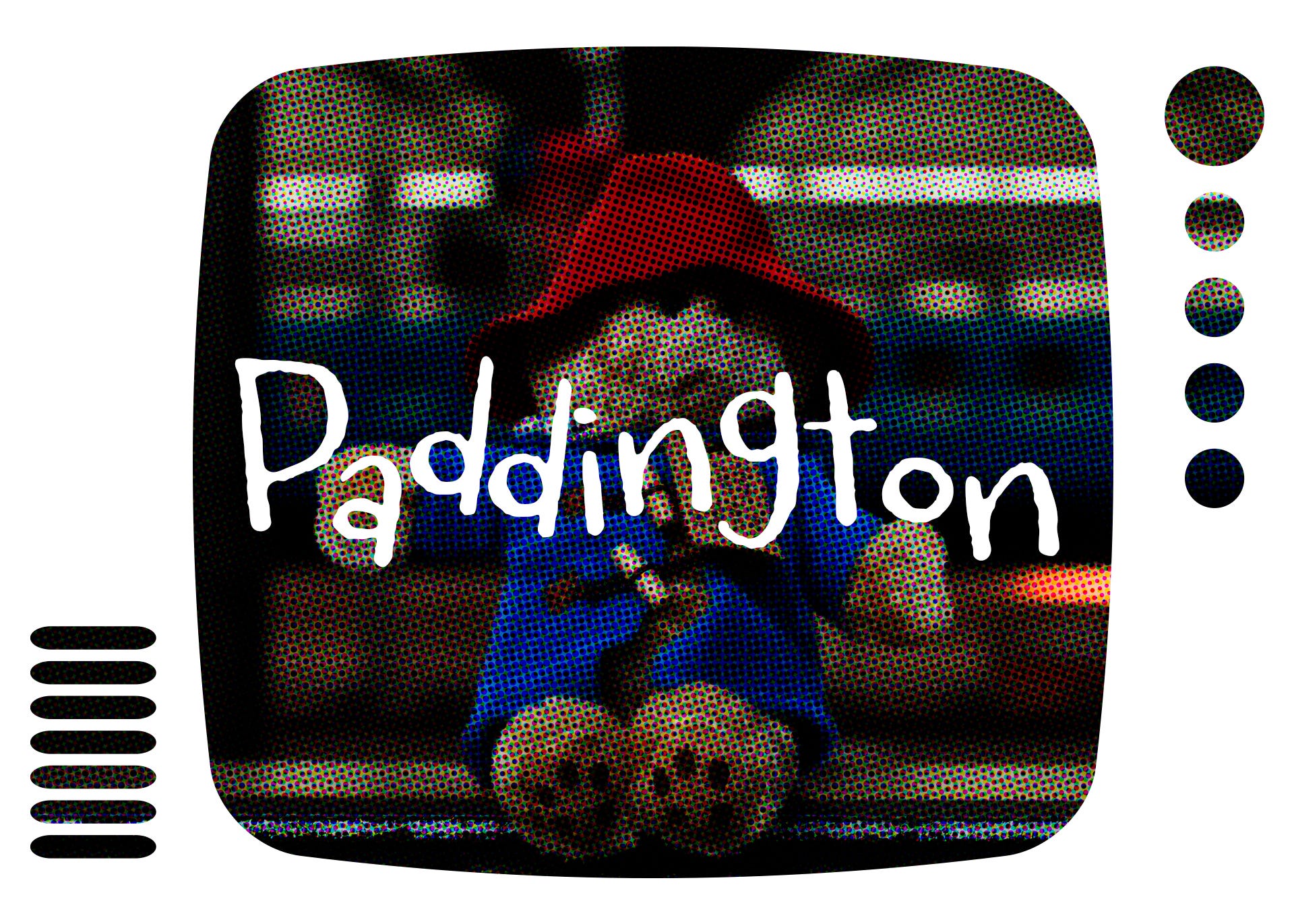
Some years ago I was trying to explain to a younger animator the style I wanted for a piece of work. After quite a lot of back and forth I ended up showing him an episode of the ‘70s children TV series Paddington. He watched, rapt, and, at the end, shouted: ‘What was the brief for that? “Make the most fucking awesome thing you can”?’
We have to assume that that wasn’t actually the brief. But they did it anyway.
Like Oliver Postgate and Peter Firmin at Smallfilms, the animator Ivor Wood quietly moulded the impressionable minds of Gen X without us ever really knowing who he was. So let’s get into that first. Wood was born in Leeds but he was half-French, and he was working in Paris when he met the French animator Serge Danot and was hired to work on Danot’s children’s series Le Manège enchanté (1963—67) — or, as the Brits know it (thanks to the genius of Eric Thompson), The Magic Roundabout. Wood then came back to England to work with the production company Film Fair, where he collaborated with the author Michael Bond on The Herbs (1968), The Wombles (1973—75) and Paddington.
Each of these series has a distinct style, allowing us to observe the evolution of Wood’s approach. The Magic Roundabout has stop-motion puppets in a stylised setting with iconographic, two-dimensional trees and foliage. The Herbs keeps the puppets, but makes the settings more three-dimensional and less stylised. The Wombles has similar settings (if slightly less fantastical), but the characters are much more like animated plush toys.
For Paddington, however, Wood made an entirely different, and brilliant, choice. He did away with the settings entirely, replacing them with simple black ink drawings on white card. Most of the world is monochrome; important humans get coloured in, but only Paddington himself is three-dimensional. Not only is he operating on all dimensional axes: he also has a texture (furry). This differentiation is carried through to the animation of the characters. Where Paddington is thoroughly — and charmingly — animated throughout, the humans are much more limited in their movements. Sometimes their animated heads or arms are attached to a static body; sometimes they simply adopt a series of static poses. Only Paddington and his belongings, the things he interacts with, are real. Everything else is a suggestion, or a series of snapshots.
Wood suggested that his visual choices were economically motivated; Paddington is set in London, and it would have been overwhelmingly difficult to use traditional stop-motion animation for busy streets and crowds. But you get the impression Wood also just loved the idea of animating Paddington in this way. (After all, it created just as many problems as it solved; lighting all that reflective white card proved to be a nightmare.) And thank goodness for that.
There is not even any lip sync, mostly because there isn’t any dialogue. As with Postgate and Firmin’s The Clangers (1969—72), there is just a narrator, who doesn’t even do ‘voices’ for the characters; the splendidly wry and warm Michael Hordern refused to do them, which was the correct choice, because he already had one of the best voices in the world.
All of this had the happy result of focusing the production on the visuals. This is animation boiled down to the sparest parts: a single stop-motion character, a monochrome sketched-in world, a lone voice telling the story. But this is not paring away: it is distilling. The result is pure and intoxicating, an abstract ideal of animation.
The amazing thing is that Ivor Wood went to these experimental, extraordinary lengths for a five-minute animation for kids’ TV. It is a textbook example of being better than you need to be. As Michael Bond — no creative slouch himself — said of Ivor Wood: ‘if genius is the infinite capacity for taking pains, then Ivor certainly qualified for the title.’ The audience wouldn’t have known any different; we barely knew anything at all. Sure, Paddington looked different to Bagpuss (1974) and Roobarb (1974), but then both of them were extraordinary works too. As far as we knew, as we sat on the living room carpet in the mid-70s, all cartoons were that good.
As is often the case, the magic ingredients were the constraints: the limits of budget, the editorial demands of the channel, the lack of options. In a world of three TV channels a lot depended on the taste of Monica Sims, the BBC’s head of children’s programming. (She was renowned for her devotion to public service broadcasting, and also for her idiosyncratic opinions: she once decried Sesame Street for its ‘indoctrination and a dangerous use of television.’) But these constraints just allowed Ivor Wood to escape convention and make something no one else had ever thought of. And, as ever, we return to the distinctive genius of the BBC, because one constraint Wood wasn’t working under was the pressure to be commercial, which in this context meant marketable.
Other than being economical, Wood had two jobs: to tell the stories, and to make something as good — indeed, as fucking awesome — as possible. Telling the stories, of course, was non-negotiable. Wood’s visuals aren’t there just to be arresting; they’re also integral to the drama. Paddington is an outsider: he is an anthropomorphic bear in a human world; he is a Peruvian in London; he is an earnest childlike innocent interacting with the strange adult world; he is an (illegal) immigrant to whom the native customs are foreign and confusing. By distinguishing him visually and physically from his surroundings, Wood doesn’t just distinguish the central character; he emphasises his difference. Paddington literally stands out, three-dimensional in a flat world.
As you’ve probably already realised, Wood isn’t just dramatising Paddington’s world; he’s dramatising the viewer’s world too. It is significant that as well as Paddington himself being three-dimensional, everything he touches is three-dimensional. He and the things he uses are ‘real’; everything else is just backdrop. Paddington’s outward behaviour is very much that of a small child, and so is his egomania, the intense focus on himself and his little world. These points of audience identification are created through characterisation, but also through Wood’s visualisation.
This is what makes the show stand out, even now. The innovative animation is specifically suited to the stories; it not only captures Paddington’s own experience, but also signals to the audience that this is an alternate view of the world, in which the mundane is revealed as bizarre and the ordinary upended, tipping the extraordinary out from inside.
There’s something about Paddington that makes creatives try that little bit harder. Perhaps it’s his earnest desire to help other people; perhaps it’s Aunt Lucy’s label entreating them to ‘look after this bear’. Paddington (2014) and Paddington 2 (2017) are extraordinary examples of nostalgia-bait movies that are actually good, just as their TV predecessor stood out against all the imported-toy-commercial cartoons that have themselves now spawned throwback movie franchises.
Paddington (the character) has now become a sort of national psychopomp, summoned by the British popular imagination whenever a celebrity dies; in this new incarnation he is the embodiment of an emotionally reserved neighbourliness, and a carefully hidden but bone-deep sentimentality. To a Gen X audience who grew up with Wood’s cosily idiosyncratic versions of the stories, this new universality — this ascent from character to symbol — feels surprising; after all, egomaniacal pre-schoolers aren’t the most obvious candidates for universal adoration. But this benediction has happened, of course, because of the movies, in which Paddington’s character has become considerably less self-involved. (Indeed, Paddington 2 ditches Bond’s stories entirely for something far more ludicrous and uproarious.)
The films also don’t have Wood’s visual inventiveness (although it is referenced in the design of the pop-up book that features in the plot of Paddington 2). Nevertheless, their production design is stellar, which feels like a tribute from a production team that is certainly old enough to have been awed by Wood’s vision at an impressionable age. And the screenwriting is, of course, fucking awesome. (We have not seen Paddington in Peru, which seems to have disappointed a lot of people.) It just goes to show quality is not uncommercial; it is not unpopular. Equally, the popular and commercial are not undeserving of quality. If you make something good enough, and take enough pains, you can make something that noticeably distorts the culture. And you can blow young people’s minds fifty years later.
The Paddington films are very much a shining example of something that is ‘better than it needs to be’:
Better than it needs to be

As you’ll know if you read our Mixtape at the end of October, Tobias and I didn’t enjoy the BBC’s new cosy-crime series Ludwig. Our frustration with it has become disproportionate; we went on holiday recently and about 5% of our conversation was about
Strangely, I have no recollection of the Paddington animation, although I must have seen it at the time and had all the books, without which I was for years unable to go to sleep at night. On the other hand, even five decades later I can still play back every note and texture of the Roobarb theme tune in my head, with the perfect recall of a Karajan conducting a Beethoven symphony.
What a wonderful piece, I love Paddington. The original animation with its simple cut outs and graphics was amazing. Maybe I am showing my age :) Lover your piece, thanks for sharing.