


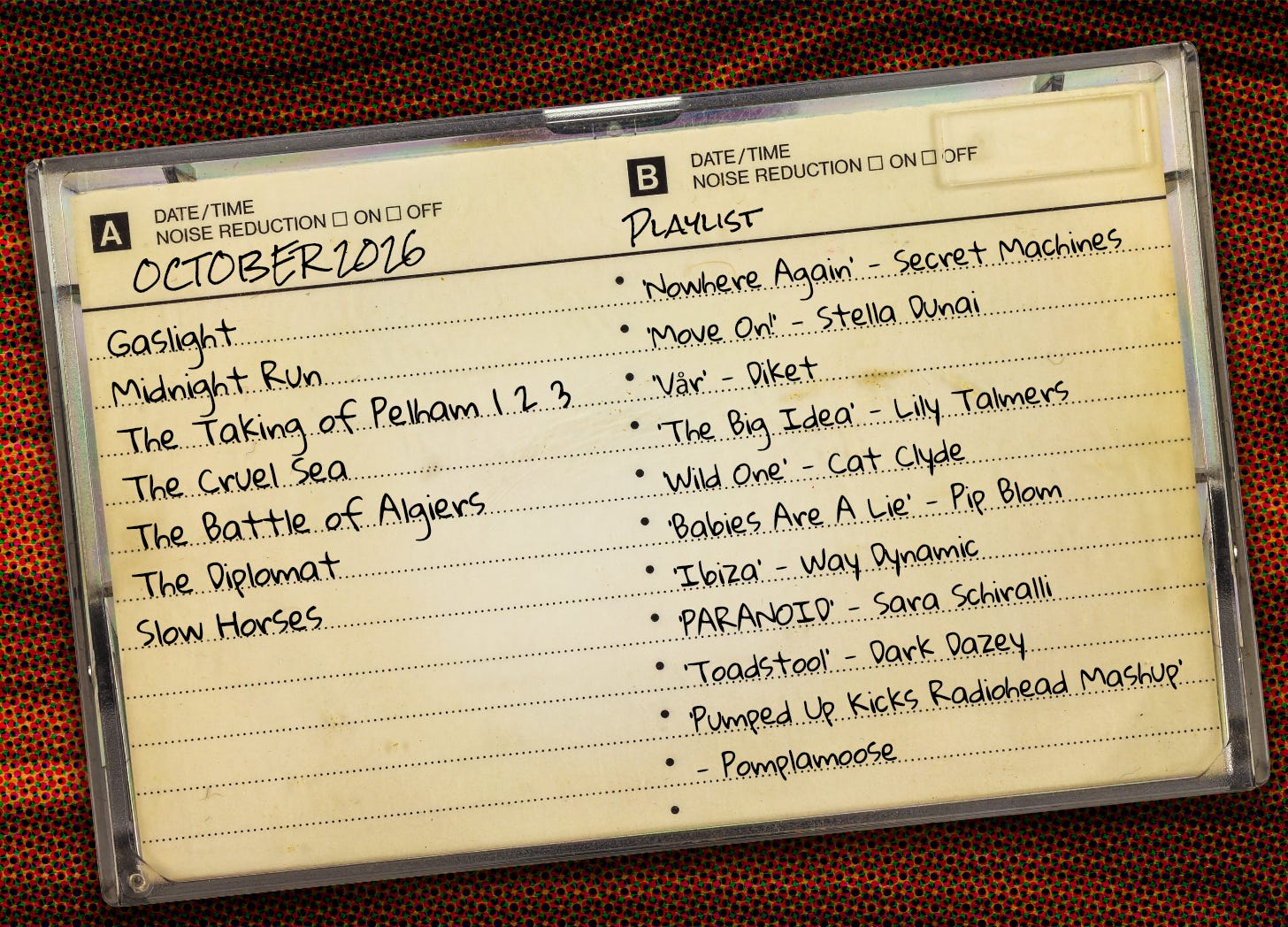
Letterboxd Diary
What Tobias Sturt has been entering into his Letterboxd account.
Gaslight (1944) ★★★★
The closest I’ve come to obligatory spooky season viewing this year and not technically spooky, although it is very, VERY sinister. So sinister that the title itself has become a by-word for the kind of psychologically abusive and controlling behaviour that drives the plot.
In the movie, the gaslighting isn’t primarily an assertion of power; it is perpetrated in the service of a labyrinthine criminal scheme. [SPOILERS, just in case.] Gregory Anton (Charles Boyer) has only married Paula Alquist (Ingrid Bergman) so he can find the secret jewels that Paula’s late aunt hid in her London house, which Paula has inherited. He is actively trying to drive Paula mad – by convincing her she is forgetting and imagining things – so he can put her in an asylum and search the house at his leisure. The dimming of the titular gaslight, which Paula is convinced she is hallucinating, isn’t deliberate on Anton’s part; it is the by-product of Anton turning up the gas in the attic while he searches for the jewels.
Nevertheless, Boyer is incredibly good as the ruthless and sadistic Anton, simultaneously ‘love bombing’ and ‘negging’ his wife; and Bergman is great at showing how this behaviour makes her increasingly dependent, even as it undermines her sanity.
Above all, director George Cukor does an amazing job of ‘opening out’, or rather, ‘closing in’ the source play. The bulk of the movie, like Paula, is confined to the London house, and Cukor makes it simultaneously claustrophobic and fugitive, full of shadows and horrible possibilities. There’s an amazing shot in which the camera just rests on an empty landing as characters go in and out of bedrooms, leaving the audience in Paula’s position of trying to understand what is going on from noises off.
Part of the reason that there haven’t been many horror movies this month is that we’ve had Ro’s Dad to stay and so have been trying to find films that we can all happily watch together. This time round we lighted, largely accidentally, on the tactic of watching really good films (thrillers and war films, to be fair), which went down surprisingly well. Who could have guessed?
Midnight Run (1988) ★★★★ 1/2
The apex of the ‘80s comedy action movie, featuring barely a wasted line or moment and a lot of actual laughs. Ex-cop bounty hunter Jack Walsh (Robert De Niro) has to escort mob accountant Jonathan Mardukas (Charles Grodin) across the entire USA, pursued by the Mafia, other bounty hunters and FBI agent Alonzo Mosely (Yaphet Kotto). Grodin is splendid as the simultaneously infuriating and terrified Mardukas; Kotto’s massive presence makes his increasing exasperation even more hilarious; and this is quite possibly De Niro’s best performance (fight me). He brings a genuine depth to Walsh that a more conventional action hero might not manage, but also has a level of hard-man credibility that comedians typically don’t.
It’s a measure of Midnight Run’s quality that its ‘80s stylings and prehistoric communication methods don’t stop it going down well with younger adults. Indeed, one of the Metropolitan children has been obsessed with making chorizo and eggs ever since he saw it several years ago.
The Taking of Pelham One Two Three (1974) ★★★★
Another great example of a perfectly lean action movie. Mr Blue (Robert Shaw) – this is one of the sources for Tarantino’s Reservoir Dogs schtick – has hijacked the eponymous subway train, and it’s up to Lieutenant Garber of the transport police (Walter Matthau) to both negotiate with and try to foil him. This is another case of great casting. The film particularly benefits from being a ‘70s movie, a period in which Matthau could conceivably be cast as a leading man, and it pays off as he radiates what can only be described as a sort of ‘hangdoggedness’, both world weary and tireless. Shaw is perfectly steely in his military approach to crime, with just the right glint of homicidal insanity underneath. Director Joseph Sargent does an amazing job of making the film feel tense and propulsive, even though it’s mostly about people trapped in a subway car and the staff of a railway control room talking to each other on the radio.
The Cruel Sea (1953) ★★★ ½
At first glance this Second World War film, following the exploits of a merchant navy captain (Jack Hawkins) as he becomes a seasoned Royal Navy commander, seems like typical British stiff-upper-lippery, all cocoa and duffle coats and ‘Damn the war’. But it’s really a prime example of what I think of as ‘What the fuck just happened?’ war films: films of the late ‘40s and early ‘50s, made largely by people who served in some capacity or other, and watched largely by people who served or waited terrified at home, all of whom are trying to wrap their heads around the last few years of death, glory and terror. It’s full of grit and fear and true bravery, and you almost don’t notice because of all the silly accents and stiff linen.
It was thrown into stark relief by the film we watched next: The Cockleshell Heroes (1955), a precursor of what I instead call ‘Ak-ak-ak-ak-ak Die Nazi Scum!’ movies, in which the Second World War is merely a useful setting for an action movie. This was the genre that was to dominate the Sunday afternoon TV film slots of my childhood.
Interestingly, The Cockleshell Heroes was produced by Cubby Broccoli, who went on to produce that other Bank Holiday movie stalwart, the Bond films. And you can absolutely see the germ of the Bond films in it: a maverick hero, gadgets (limpet mines and diving gear), broad humour and jarring wisecracks. This is, though, the only interesting thing about The Cockleshell Heroes, which might be one of the worst films I have ever seen. I would gladly have attached a limpet mine to it and let it go down with all hands. Especially Anthony Newley.
The Battle of Algiers (1966) ★★★★★
On the other hand, one of the best movies I have ever seen. And, while the results of the battle itself might be doubtful, a definite victory in my attempt to convince Rowan that not all the black and white European films I watch are pretentious rubbish.
Pontecorvo’s pseudo-documentary account of the FLN uprising in French-occupied Algiers in the ‘50s is so convincing that the advertising in the States had to insist that none of it was actual newsreel. More significantly it is so good and so renowned that there’s very little to be said other than: if you’ve haven’t seen it, see it.
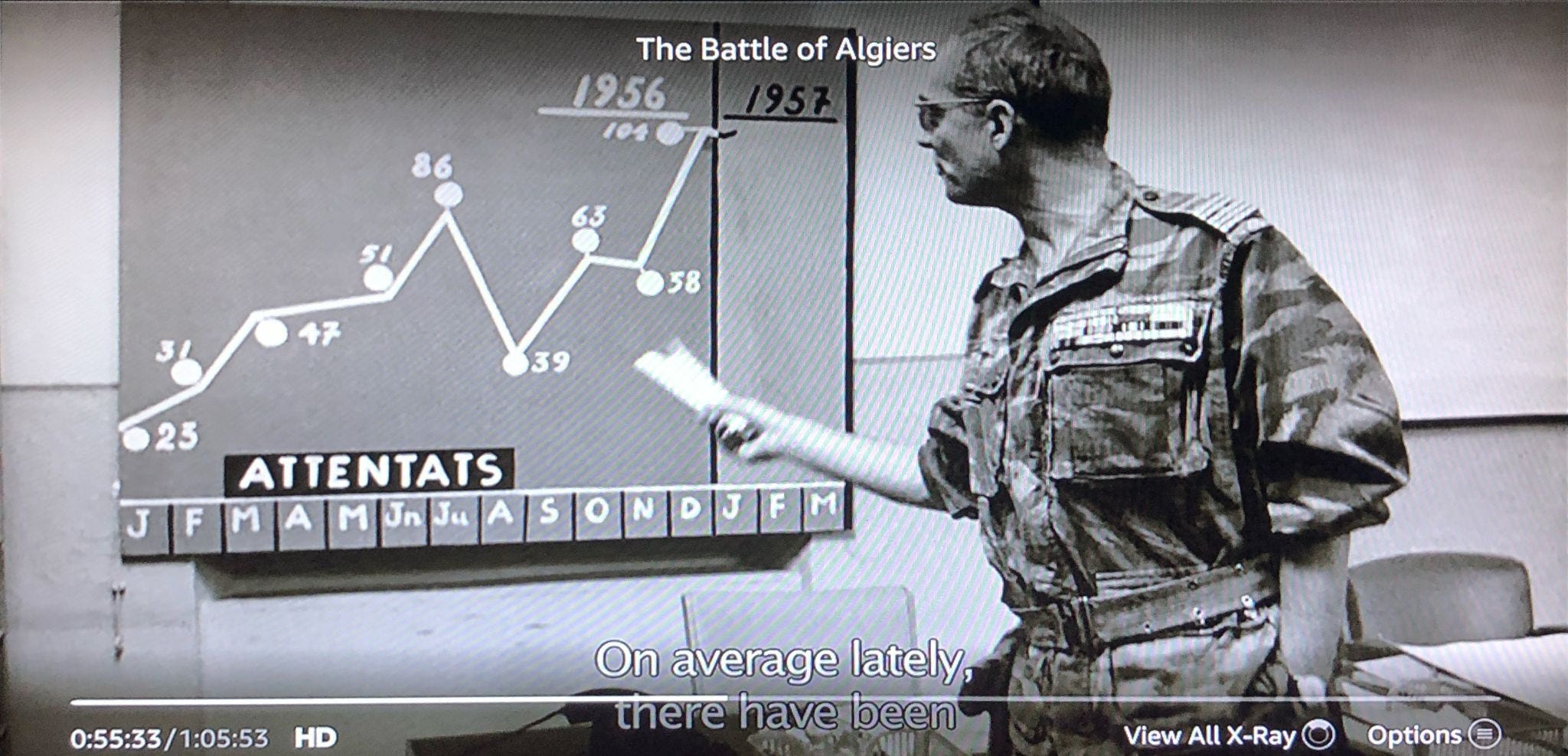
Regular readers will know that in my professional life I do a lot of data visualisation so, instead of anything like a review, here’s Lieutenant-Colonel Phillippe Mathieu’s nice little line chart of FLN attacks. I was so impressed that I paused the movie and took a photo for reference purposes.
TV nonsense
What Rowan Davies has been goggling at this month from underneath the electric blanket
The Diplomat
I was very excited for the return of Netflix’s high-end froth show, in which the glorious Keri Russell (one of those beautiful-yet-steely grown-ass women actors, a la Keeley Hawes) plays a hard-edged foreign service professional who’s been ripped out of her preferred setting (war-torn humanitarian disaster zones) and shoehorned into position as the US Ambassador to the Court of St James. But having watched the first three, I’m beginning to worry that it’s entering ‘blah’ territory; I’ve been putting off watching the fourth episode.
It’s still got a lot of the things that made it great: a generally amazing cast, with Rufus Sewell and Rory Kinnear having the time of their lives (seriously, how brilliant is Rory Kinnear?); the glorious reunification of Allison Janney and Bradley Whitford, playing a hellcat of an American politician and her bozo husband; absolutely gorgeous clothes and sets; and an interesting premise - especially for UK viewers - in its central focus on the ‘Special Relationship’, and how that plays out between presidents and prime ministers.
If this was a once-a-week show back in the days of linear TV I suspect I’d still be watching the heck out of it, but Netflix’s practice of dumping all the episodes at once makes me watch too many at a time (what are you expecting, self-control?) and this season quickly gave me the feeling I get when I eat an entire box of Milk Tray. Showrunner Deborah Cahn used to work on The West Wing and you can see the Barlett bones in the show’s mildly grown-up attitude and the wish fulfillment of its clever, funny and ethical central character. But it lacks the commitment of Sorkin-era West Wing; for my taste, there’s now too much soap opera and not enough politics.
Slow Horses Season 6
I don’t think I’m saying anything new here, but this most recent season has been quite the disappointment. The writing is a lot less funny, there were far too many action sequences, many of the most eerie scenes from the source material were written out, and someone took the glaringly silly decision to cram two of the original books into one plot, resulting in total confusion and massive please-don’t-think-about-it plot holes.
At the risk of sounding prissy, the farting and the personal abuse never was actually funny (a problem that stems from the books). The original showrunner Will Smith and his writers (including the peerless Morwenna Banks) seemed to have worked this out, and drew humour from the performances and the characters. But Smith has now gone elsewhere and on this evidence the new production team doesn’t quite know what to do, other than churn out yet another action series studded with low-effort ‘banter’.
Playlist
Tobias Sturt : Here’s my favourite ten tracks for this month.
‘Nowhere Again’ - Secret Machines
I have no idea why Spotify chose to dig this up for me this month, but I’d completely forgotten about it and was very glad to hear it again.
‘Move On!’ - Stella Dunai
This is a nice little propulsive piece of indie folk rock.
‘Vår’ - Diket
Scandinavian folk here - I’m not even sure what language this is being sung in, but it sounds like the kind of song I imagine Snufkin writing and that’s good enough for me.
‘The Big Idea’ - Lily Talmers
This is a charming video of the song being performed in the back of a camper van in the middle of a field somewhere, which is pretty much how I imagined it when I heard it, tbh
‘Wild One’ - Cat Clyde
Shades of Mattiel in Cat Clyde’s big, strident voice - I like the time changes in this too.
‘Babies Are A Lie’ - Pip Blom
We’ve had Pip Blom, as part of Long Fling, but here she is in her own right. This has the sort of big indie chorus that I really treasure.
‘Ibiza’ - Way Dynamic
There’s something a little Talking Heads about this slice of indie funk.
‘PARANOID’ - Sara Schiralli
This sounds like the sort of thing that Jeunet and Caro would play in a DJ set
‘Toadstool’ - Dark Dazey
Psychedelic lo-fi hip-hop jazz about amanita toadstools. For what more can you ask.
‘Pumped Up Kicks Radiohead Mashup’ - Pomplamoose
The title says it all. I’ve never really got Radiohead (I’m too old, too cheery & too square), so mashing them up with something that has a tune seems like an admirable idea.
The whole playlist is on Spotify as usual:
Speaking of war films & movie Nazis:
Nazis. I hate these guys.

At school in the early 1970s we sometimes played ‘Cowboys and Indians’ in the playground. But even as kids, we knew there was something unsatisfactory about it; not so much the racism, of which we were unaware, but the absence of a properly nasty antagonist. My grandmother liked a man in a ten gallon hat, read Zane Greys and watched John Ford movies. I …