



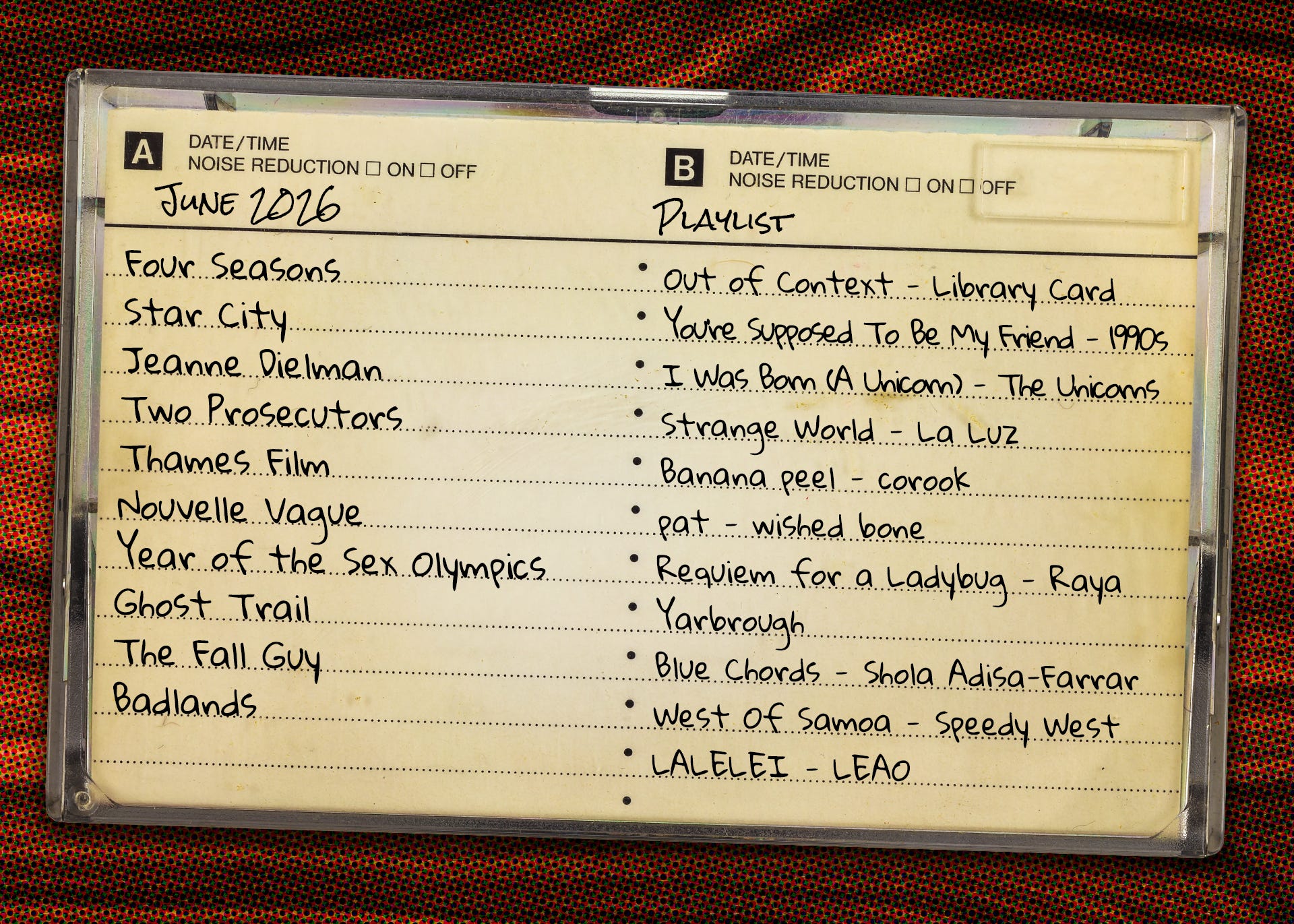
Four Seasons (2026)
Tobias Sturt : Tina Fey is about my age, so I assume she saw the Alan Alda / Carol Burnett film Four Seasons (1981) as a teenager, as I did. Which just makes her contemporary remake all the more delicious. Watching the original was, for teenage me, a tantalising window into a sophisticated, funny, grown up world, which makes the contrast with being a not at all sophisticated and frequently ludicrous grown up all the more hilarious.
One thing that struck me is that the Boomers in the Alda film are all in their forties while Fey’s Gen Xers are all in their fifties. I guess they have to be in order to have kids who have left home, but have we delayed our midlife crises the same way we delayed having kids?
The first season of this was great, so a second season was inevitable, but it was also pretty much inevitably going to be an anti-climax. It’s not as good, BUT it still has actual laughs in it, which is remarkable enough.
Star City (2026)
We have to admit we kind of lost interest in the alternate history version of the space programme in the original series For All Mankind (2019 to the present), but we’re very much enjoying this spin-off set in the USSR of the ‘60s—’70s, in which the Russians try to capitalise on reaching the Moon first, while dealing with an oppressive state and American spies.
It is, inevitably, a somewhat cartoony version of Soviet Russia, but it is very entertaining. In order to contrast it with the American original it’s full of British and colonial actors, include Anna Maxwell Martin being splendidly sinister as a KGB officer and the always-welcome Adam Nagaitis being as weird and shifty as only he can be.
Letterbox Diary
What Tobias Sturt has watched this month:
Jeanne Dielman, 23 Commerce Quay, 1080 Brussels (1975)
*****
So, I finally got around to watching the greatest film of all time and it turns out to be pretty good. But perhaps not at the time.
Chantal Akerman’s film is ‘slow cinema’, full of long takes with an unmoving camera, as the title character peels potatoes or has a bath or sits in an armchair, thinking. This is one of the reasons that this has been hailed as a feminist masterpiece, foregrounding unseen ‘women’s work’. And also highlighting, not coincidentally, just how dull it is.
That monotony becomes monotonous for the viewer as well, but gradually you start to realise that it is performing a narrative function. By teaching the viewer Jeanne Dielman’s routine in excruciating detail, the film sensitises you to its eventual unravelling. You start to see Jeanne’ mental anguish in her moments of inaction or wrong action. Going into rooms for no reason, starting and abandoning a series of tasks, making and remaking coffee and never drinking any of it.
Hitchcock always held up the terrifying cafe bomb sequence in The Battle of Algiers (1966) as the epitome of tension: the audience knows there is a bomb under the table even as people laugh and dance around it. Jeanne Dielman is an equal but opposite illustration of tension: not a dramatic irony, but a psychological, internal tension, a tension the audience feels build without being able to see the bomb. Not until it is too late.
I was very sorry that I had read, somewhere, the ending of the film. I wish I had seen it without that knowledge, so I’m not going to repeat it here. But I will tell you that part of Jeanne’s monotonous grind is doing sex work to keep herself and her teenage son. That sex is merely part of her rigid and unsatisfying routine is another part of the ‘70s feminist reading. It is also another task that begins to come unstuck. The eventual conclusion is a shock but, crucially, not a surprise. Having seen Jeanne slowly, quietly break apart over the previous three hours, it comes as almost inevitable.
The ‘slow cinema’ style makes for an interesting watch. At first it is a curiosity, then a bore, then, finally, a kind of deep immersion in the fiction. Meditative and engaging. The fact that it is also a gradually developing narrative of psychological insight creeps up on you, opening like a flower, with a motion you don’t see but are delighted by when you finally notice it.
This also means that the film stays with you. You absorb it while watching and then digest it over the following days. It was four-and-a-half stars when I finished it and gained half a star in retrospect for being, well… at least one of the best films ever made.
Two Prosecutors (2025)
***½
More ‘slow cinema,’ but here the metaphor is the unseen unsettling of the state, rather than the self. A newly appointed prosecutor in 1937 Stalinist Russia discovers the truth about the NKVD’s use of systematic torture and murder, and tries to do something about it.
The slowness of the film-making dramatises the inexorability of the outcome. In Hollywood’s hands this would have been full of tension and energy and personal risk. The novice prosecutor would have been angrily seeking the truth, and would have come out with at least his integrity intact. Here, instead, he is just quietly dogged in his naive quest for justice; and the state is equally dogged in its quest to see injustice done.
The wheels of the bureaucracy grind slowly and smally, but they catch up with him just as they catch up with everyone else. As the prison governor’s joke has it: ‘Do you know what Radek said when they asked him what he’d been doing before the Revolution? “I was waiting in prison.” And when they asked him: “And after the Revolution?”... “Prison was waiting for me.”’
Thames Film (1986)
*** ½
A slow documentary this time. A meditative study of the Thames mixing film of the ‘80s river with footage from the early twentieth century, and illustrations from the 18th and 19th centuries, creating an image of the Thames as living things, connecting London not just through geography but through history, too. Space and time.
With John Hurt’s narration, it inevitably brought to mind Patrick Keiller’s London (1994), but it lacked the latter’s impish sense of humour and simultaneously parodical, fantastical and insightful psychogeography.
An ‘80s seriousness in the face of the Thatcherite future, rather than the ‘90s hollow laughter from the Britain it created. And worth it for all those glimpses of ‘80s London where the nineteenth century still clung on, before it was all built over with concrete and money.
Nouvelle Vague (2025)
****
The Sight and Sound critic’s poll that ranks Jeanne Dielman as the greatest film of all time quite rightly has Cleo from 5 to 7 (1962) as the best of the Nouvelle Vague French films of the ‘60s (right there in my Letterboxd Four, folks). Jean-Luc Godard’s À bout de souffle (1960) is at number 38. It’s not as good a film as Cleo, but it is important. It is the opposite of Jeanne Dielman, which is a still window into the internal world. From Belmondo’s Bogartisms to the famous jump cuts, À bout de souffle is a film about film, a film by cinephile for cinephiles, by a critic for critics; it is a film in which the making, the physical and experiential object of the film itself, was more important than the plot.
And now a film about a film about film: Richard Linklater’s dramatisation about the making of À bout de souffle, which puts the Hollywood back into the film that deconstructed Hollywood. It has none of the brio or radicalism of the original, but it does have a plot, and some splendid performances. It simultaneously pokes sly fun at the pretentious critical posturing and communicates just how inventive, imaginative and innovative the movement — and Godard in particular — was.
The Year of the Sex Olympics (1968)
***½
Nigel Kneale knew the deal.
While Rowan was watching a lot of ‘90s reality programming for her piece on Big Brother, I went away and watched Nigel Kneale’s ‘60s TV play The Year of the Sex Olympics, in which he managed to predict twenty first century TV with unnerving accuracy.
It’s set in a future Britain where the populace is kept docile with a steady feed of pornography, including a sort of competitive OnlyFans in which different couples compete to appear in the Sex Olympics. When the Sex Olympics show is disrupted by an artist the producer starts to doubt his job, and volunteers for a new kind of show in which he, an old flame and their child will be marooned on an island, broadcast live around the clock as they try to survive without modern conveniences. The production is extremely period, with a lot of daft costumes and ludicrous future slang. But it does feature a young Brian Cox and a slightly less young Leonard Rossiter, so there are some splendid performances. (I have been inoculated by watching slightly too much early Doctor Who, and so can bear more of this stuff than most.) And it is fascinating to see how obvious it was where stuff was headed, even in 1968. It is particularly perceptive in seeing how reality TV would inevitably become a drama, a heightened and structured form of reality, always pushing towards greater shock and extremity.
There’s a reason why Nigel Kneale is worshipped by a certain kind of writer.
Ghost Trail (2024)
****
A Syrian refugee searches Europe for the man who tortured him while he was imprisoned. The film is particularly notable for the depiction of oppression and the refugee experience in the context of a spy thriller, which gives it a new urgency and immediacy. Themes of justice and revenge are complicated by the themes of identity and belonging that come with immigration. It features a tremendous performance from Adam Bessa as the driven but conflicted protagonist.
The Fall Guy (2024)
****
Not one of the greatest films of all time, but a lot of fun. It’s an adaptation of the 1980s TV show of the same name, but it reminded me much more of a different one: Moonlighting. It has exactly that sense of knowing precisely what kind of entertainment it is and leaning into doing it as well as it can, using the rumpled Gosling charm and Emily Blunt’s smart ease intelligently. And it has the same meta approach to the material. Set around the making of a terrible sci-fi movie, the film is a stunt-heavy action movie about stunt-heavy action movies, full of jokes about films and film-making.
The Metropolitan couldn’t help but wonder whether its lack of box office success might also have something to do with the fact that it also felt like a very Gen X film in its references, its crew — writer Drew Pearce and director David Leitch were both born in the ‘70s — its media literacy, and its meta instincts.
Badlands (1973)
****
We rewatched Terrence Malick’s The Thin Red Line (1998) recently and I was really struck by how the voiceover ruins it. The cod-philosophising and adolescent poetry just make the characters seem less likeable and more stupid, where the acting and direction were already having the desired effect. This is not true, however, of Holly’s (Sissy Spacek) voiceover in Badlands, which effectively complements the action and direction, adding a whole new layer to the film.
The full list is on Letterboxd
Playlist
Tobias Sturt: Here’s my favourite ten tracks for this month.
Out of Context - Library Card
Members of the Metropolitan household have started their first internship at a big corporation this week, so here’s a track about the insanity of corporate life to soundtrack it.
You’re Supposed To Be My Friend - 1990s
A friend of mine once had a gig and I got talking to a chap in the audience about how I was really there not to support my friend but to see the headline act, The Yummy Fur, because I thought they were just incredible. Anyway, that chap turned out to be Jackie McKeown, the lead singer of the Yummy Fur and now lead in the 1990s. He’s still great, too.
I Was Born (A Unicorn) - The Unicorns
Here’s a slightly more summery slice of indie pop so we can pretend we’re having fun in the sun. Which we’re not. It’s dreadful.
Strange World - La Luz
A grunge little track slightly better suited to what we are doing with our summer, which is cowering in the dark with the fans on.
Banana peel - corook
This is a lot more summery, though - musically, at least, in a delicious counterpoint to the lyrics.
pat - wished bone
Something very ‘60s singer songwriter about this one
Requiem for a Ladybug - Raya Yarbrough
Some sultry jazz for some sultry weather
Blue Chords - Shola Adisa-Farrar
A little more summer jazz
West Of Samoa - Speedy West
In case you haven’t guessed yet, the UK is having a heat wave, and this kind of weather always makes me turn to weird easy listening for comfort.
LALELEI - LEAO
And having had the easy listening version of Samoa, here’s the real thing.
The whole playlist can be found on Spotify:
There’s a lot of Soviet Russia in this month’s viewing, so here’s a link to Rowan’s piece about growing up during the Cold War:
Good branding

‘Miriam works at a public radio station. Recently, she was asked to make a program on Ostalgie parties - where if you show an East German ID you get in for free, everyone calls one another ‘Comrade’ and the beer is only DM1.30. She says, ‘Things like this feed into a crazy nostalgia for the GDR…. Most of the people at these parties are too young to reme…
I watched Jeanne Dielman after reading this and I completely concur with your analysis. I was a little confounded by the fact that I wasn’t bored and that the time actually passed quickly. Watching Jeanne peel potatoes was a lot more gratifying than most extended fight sequences I’ve had to sit through over the years and I agree, it’s the waiting that creates anticipation and tension. I thought it was great and, like you, it has stayed with me. I can’t stop thinking about it!
The Docklands backdrop of The Long Good Friday is brilliant: filming was completed in 1979 but it wasn't released until 1981, the year that the London Docklands Development Corporation was set up, so it *precisely* captures that final time of decline before regeneration.