


La France Profonde
As you may have been beginning to suspect, The Metropolitan has been on holiday for the last two weeks. We’ve been away not only from Substack, but also from the UK, noise and light pollution, and, largely, people; we’ve been in a tiny hamlet halfway between Poitiers and Angoulême, where there was nothing to do but agonise about which cheese to have for lunch and discuss the class taxonomy of French supermarkets.
The closest supermarket to us was a Super U, which (like the Co-op in the UK) has its origins in the co-operative movement, but which felt a degree more middle class than British Co-ops. With its big chiller cabinets of handmade ready meals, pseudo-market-stall layouts of fruit and veg and local produce, and understated and elegant own brand stylings, it felt somewhere between a Sainsburys and an M&S Food Hall. The local Intermarché, on the other hand — more cramped, more scruffy, more utilitarian — came across as a little bit Asda. I’m only sorry that we didn’t get a chance to visit a nearby E.LeClerc to get a fuller picture. One thing you really notice about all French supermarkets, though, is their hyperfocus on French produce: there are literal walls of cheese, nautical miles of fresh seafood and acres of pork (SO MUCH pork), but nary a lime leaf or a pot of fresh pesto. The only foreign food the French really dig, on this evidence, is Emmental. Also, it was weird (although entirely appropriate) to find Marmite in the ‘weird forrin stuff’ aisle.
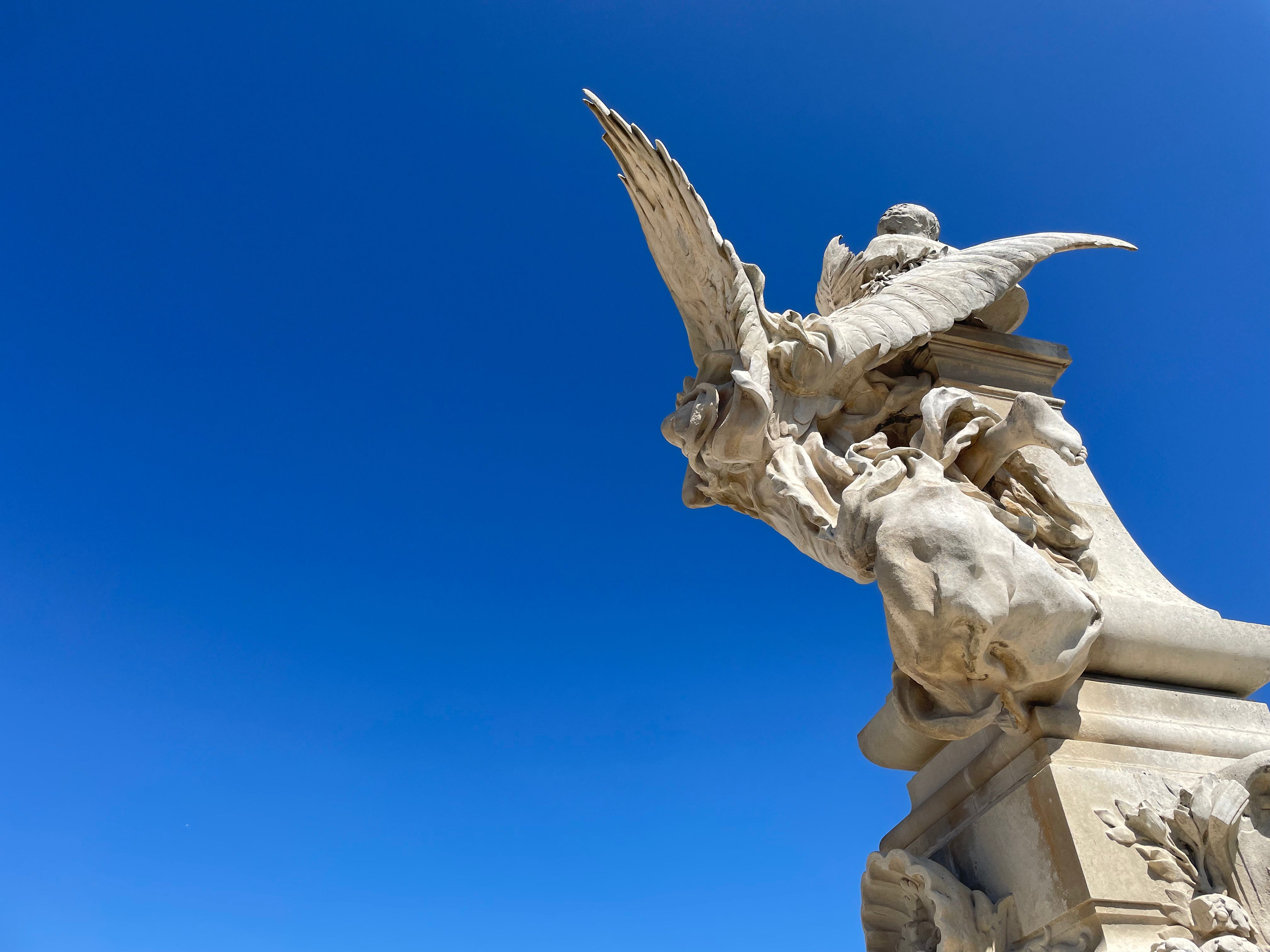
There hasn’t been any film watching (pretty sure they’re not really interested in films in France) so there’s no Letterboxd diary this week. Instead we went to look at a lot of historically significant religious sculptures, like this statue of a mighty Gallic warrior:

If you know anything about Angoulême, you’ll know precisely what I did while we were there, because Angoulême is known for this stuff: that’s right, I visited the Musée de Bande Dessinée (the Museum of Comics). It was an absolute delight. Can you imagine how excited I was to see original Hergé pencils?
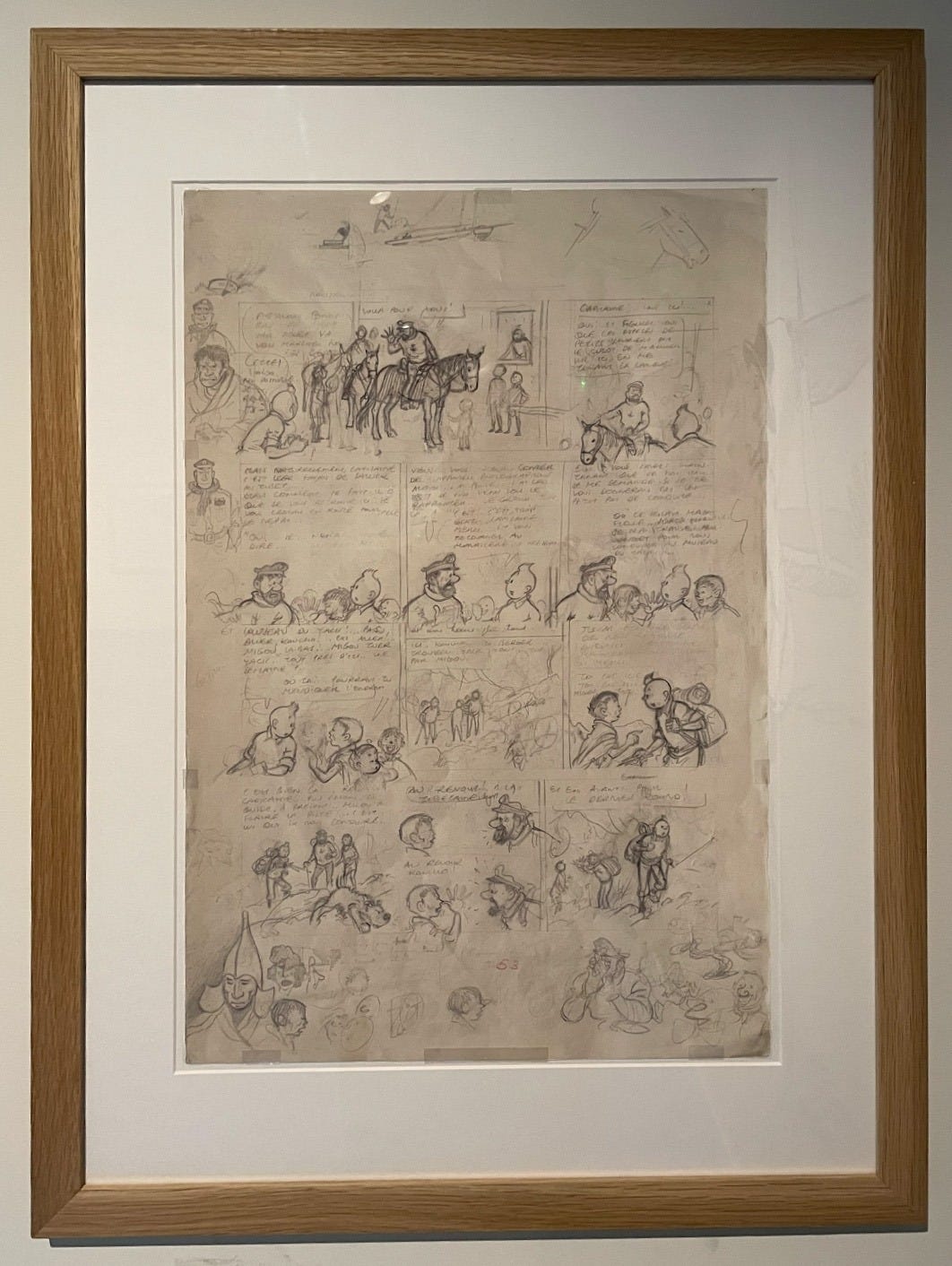
They had a big show about comics publisher Editions Delcourt which made me think that we still don’t have much of a national comics tradition beyond classic kids’ comics like The Beano and the hallowed institution of 2000AD. (At some point I’m going to write my piece about how 2000AD created the pop culture of the 21st century, I promise.) This is despite the fact that British comics writers and artists have had a massive international impact through their work in American comics (particularly from the late ‘80s onwards). It’s a shame the form isn’t celebrated here in the way the French celebrate their comics. That said, we do have the splendid Cartoon Museum in London, although it doesn’t have the space or prominence of the museum in Angoulême. And we also have the amazing new Quentin Blake Centre for Illustration, housed in a restored eighteenth century water works (largely courtesy of the architect Adam Goodfellow, who just happens to be a friend of The Metropolitan).
Anyway, that wasn’t the only visual storytelling we saw.
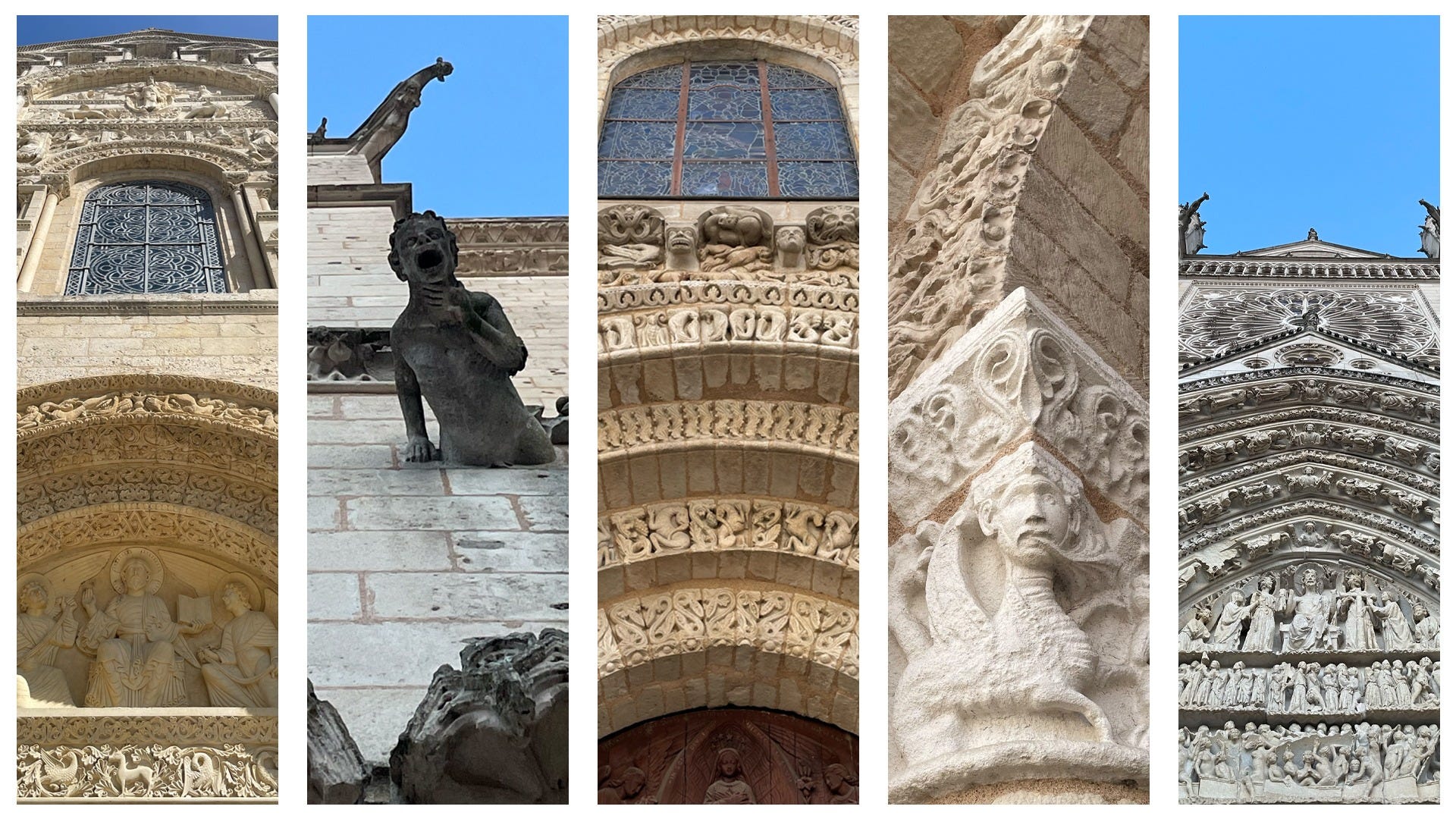
The area between Poitiers and Angoulême was on the ancient pilgrimage route to Santiago de Compostela in northern Spain. (Probably for similar topological reasons, this area — which was on the border between Occupied France and Vichy-controlled France in the Second World War — was also very active in Resistance efforts to smuggle downed Allied airmen into neutral Spanish territory.) It is thus full of particularly rich medieval churches in the Angevin Gothic style. Their faces are covered in intricate, graphomaniac sculptures: a riot of escalating martyrdoms, miracles and monsters. (Pictured above: mad stylings in Poitiers, Angoulême and Ruffec.)
Which made a splendid accompaniment to what we did do, which was read:
The Greatest Knight (Thomas Ashbridge, 2015)
The biography of William Marshal, a medieval Zelig who started life as a child hostage during the Anarchy — the devastating twelfth-century civil war between King Stephen and Empress Matilda, during which it was said that ‘Christ and all his angels slept’ — and ended it as the most powerful man in England, the regent for the young Henry III. Over the course of his life he knew and/or worked for somewhere between five and eight English monarchs, depending on whether you count Matilda, Young Henry and Eleanor of Aquitaine. (As the street sign in Poitiers had it: ‘Reine de France, et alors Reine d’Angleterre.’)
Among other things Marshal was threatened with being dashed against his father’s castle walls from a catapult, played ‘knights’ with King Stephen round the throne, saved Eleanor of Aquitaine from being captured, became a star of the tournament circuit with the Young King Henry, palled around with the Templars in the Holy Land, fought alongside Richard the Lionheart in France, rebelled against King John in Ireland and was instrumental in framing Magna Carta.
This was particularly relevant to our holiday because the house we were staying in is on Rue du Bois Ricard, the Ricard in question being Richard the Lionheart (or Coeur de Lion, I guess). It was also not far from a village called Montjean, which is thought to be named after Richard’s younger brother and canonically the worst English king ever: John. We weren’t very far from where Eleanor’s party was surprised by the troops of Guy de Lusignan and Patrick, Earl of Salisbury and William Marshal had to fight a desperate rearguard action to give the queen a chance to escape. Angevin lands, in other words.
Because Marshal didn’t live in a world of neatly delineated nation states. There were places called ‘England’ and ‘France’, but they weren’t exactly the same geographical places we think of now, and they certainly weren’t the same conceptual places. Marshal grew up in a world as close to the setting of Beowulf as it was to Agincourt and Joan of Arc. His world was defined by the proto-feudal structures of Northern Europe and its post-Roman barbarian peoples: Franks and Angles and Saxons and, most of all, Northmen. He wasn’t a citizen of a country; he was a subject of his King, who (from Henry II to John) was the ruler of the Angevin Empire.
By the time Marshal died he was Earl of Pembroke, which meant holding marcher castles in an independent (and very Wild West) Wales. He also held colonized lands in Ireland, and owed fealty to the King of France for his lands in Normandy. Historians sometimes call the Angevin Empire ‘a composite monarchy’, and Marshal was something like a modern multinational corporation: a string of local branches, licensed brands and subsidiary holdings, with multiple allegiances and operating in many different roles.
But he also lived at the exact moment all of that was changing.
I spent an awful lot of the book looking up from the book and exclaiming to Rowan: ‘John was absolutely the worst’. His epithets at the time were ‘Lackland’ and ‘Softsword’, both of which also describe how instrumental he was in the end of that early medieval world. You’ll note, for a start, that being a ‘hard’ sword wasn’t a bad thing; a king was supposed to be martial and violent. That was the feudal bargain; that chain of fealty from the king downwards was one of mutual dependence and defence. John’s real crime, though, was that he lost the Angevin lands in France. This had bigger implications than just the shrinking of a tax base. Like Hrothgar in Beowulf, a king was supposed to be generous. In losing land John lost the ability to share treasure and bind his nobles to him. Not that he would have anyway, because he was paranoid, selfish and cruel. (Again, cruelty wasn’t necessarily bad, so long as you were performing it on the Welsh or the Jews or thousands of nameless peasants; but you weren’t supposed to hide noble rivals in dungeons and murder them in secret.)
‘Softsword’ and ‘Lackland’ led directly to Runnymede and the original Magna Carta. And while that was more about the barons trying to protect their own interests than it was about anything as ghastly as democracy, it was the beginning of a legalistic constitutional politics. It was the moment when the Sword and the Land started to give way to the Statute and the Law. It was the end of that feudal world and the start of the modern one.
And William Marshal was there for it.
I would say I want someone to dramatize his story, because it would make for amazing TV. But they’d only cock it up, wouldn’t they?
Hyperion (Dan Simmons, 1989)
Rowan has been reading George R. R. Martin’s A Song of Fire and Ice, which I have tried and failed at. I suspect I am too big a fan of both medieval European history and J. R. R. Tolkien and hence find his pallid mix of both too little of either.
It did make me want to read some swords and sorcery, though, as I haven’t recently. I tried something ranked very highly on lists of the best fantasy books of all time and the writing was so terrible that I had to stop after a page and a half. It’s amazing what you can get away with if you start your book with a map and insert a few apostrophes into some of the names.
Next on the list was Dan Simmons’ Hyperion, which is science fiction, but of a space opera mode that scratched the itch. To start with he very sensibly does not use silly made up names for things, instead repurposing conventional terms or picking words from the poetry of Keats, just as Tolkien raided Anglo-Saxon epics and Frankish king lists for his language and names. More importantly, it was much better written and a much more gripping story.
Notably to me, it’s very reminiscent of Iain M. Banks’ science fiction novels, the first of which, Consider Phlebas (1987), was published at more or less the same time. Both of them feature diverse, democratic, more or less post-scarcity, technologically advanced meta-civilizations who find themselves at war with militaristic and religiously extreme cultures.
Interesting that both books were being written on the eve of the first Gulf War, as a diverse and democratic meta-civilization unleashed their technologically advanced weaponry on a religiously distinct militaristic dictatorship.
Yet more evidence that science-fiction tends to predict the present, rather than the far future.
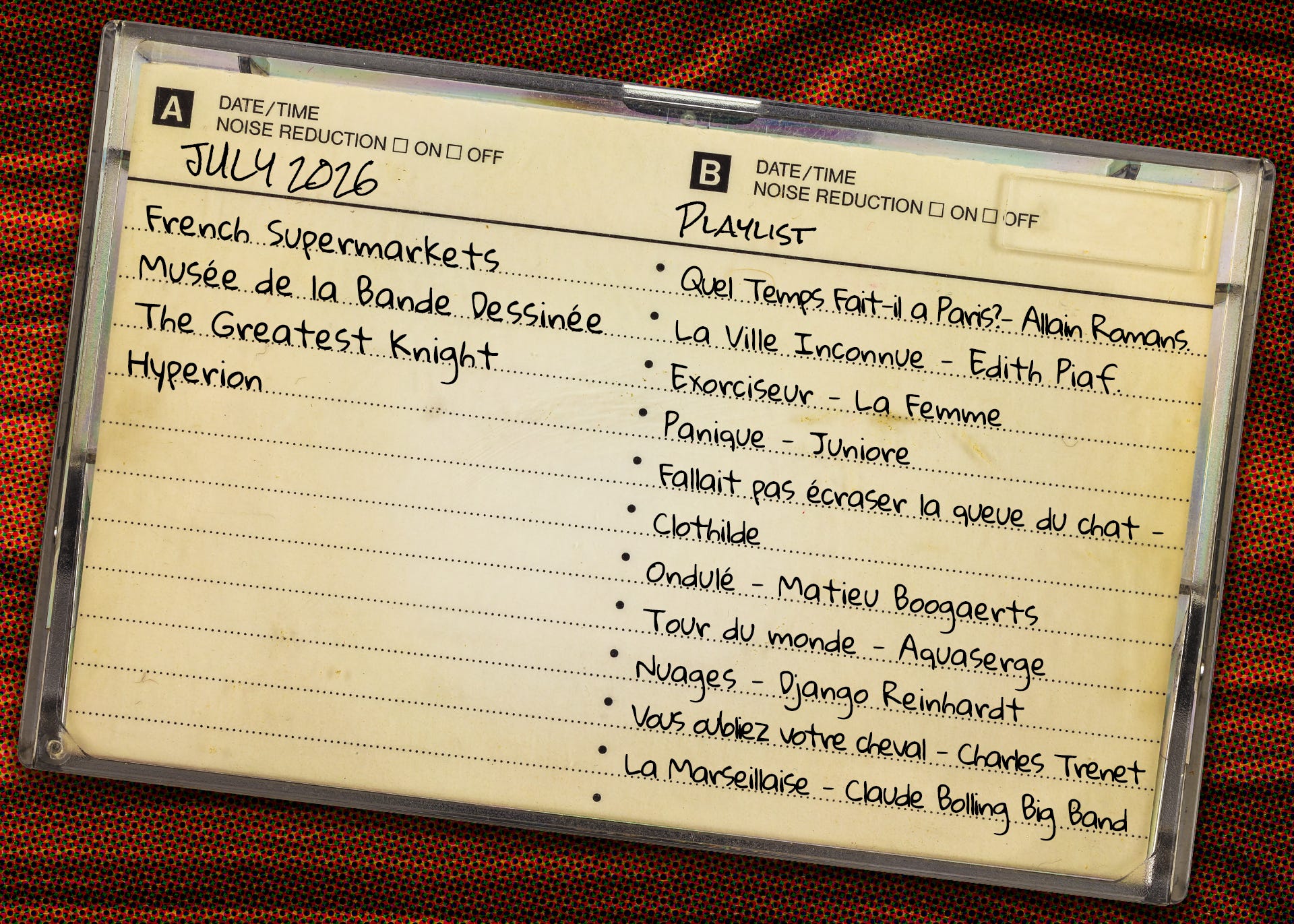
Playlist
Tobias Sturt : Since we’ve been thoroughly franked for the past couple of weeks, I thought a French playlist might be in order.
How Is the Weather In Paris — Allain Romans.
The theme from Jacques Tati’s Les Vacances de Monsieur Hulot (1953). I once went to a showing at the BFI on a weekday afternoon thinking that a cinema showing a largely silent black-and-white ‘50s French comedy would be empty. I hadn’t realised it was half term and the place was full of grandparents and their grandchildren, all of whom, aged 9 to 99, were in hysterics throughout. One of those great communal cinematic experiences that you absolutely don’t get watching a film alone in the living room with the curtains closed.
La Ville Inconnue — Edith Piaf.
An eerie and stifling song that absolutely sounds like a hot and dusty French town on a deserted and somnolent summer’s afternoon. Which was exactly what Angoulême was like when we stopped there.
Exorciseur — La Femme
Another spooky track, a sort of psychedelic, psychobilly hip-hop.
Panique -- Juniore
I’ve seen Juniore called ‘yé-yé noir’, which sounds about right: a sort of surf pop with a catchy doominess.
Fallait pas écraser la queue du chat — Clothilde
Speaking of ‘yé-yé’, the distinctly French ‘60s pop, here’s Clothilde with something slightly unhinged.
Ondulé — Matieu Boogaerts
This is a lovely little track, thirty years younger but still with a yé-yé poppiness.
Tour du monde — Aquaserge
A sort of garage jazz, chugging and brassy.
Nuages — Django Reinhardt avec le Quintette Hot Club de France
Speaking of French jazz, one cannot do without the great Django
Vous oubliez votre cheval — Charles Trenet
The perfect song for when someone has forgotten their horse.
La Marseillaise — Claude Bolling Big Band
If the World Cup made anything clear, it’s that France has, indisputably, the greatest national anthem of them all.
We travelled to Poitiers by train, which meant crossing Paris from the Gare du Nord to the Gare Montparnasse by… subway
Subway (1985)

Revisiting the films that thrilled you as a youth can be a bittersweet experience. What horrifying things will they reveal about the teenager you once were, to the teenager on your sofa? Forewarned is forearmed…