


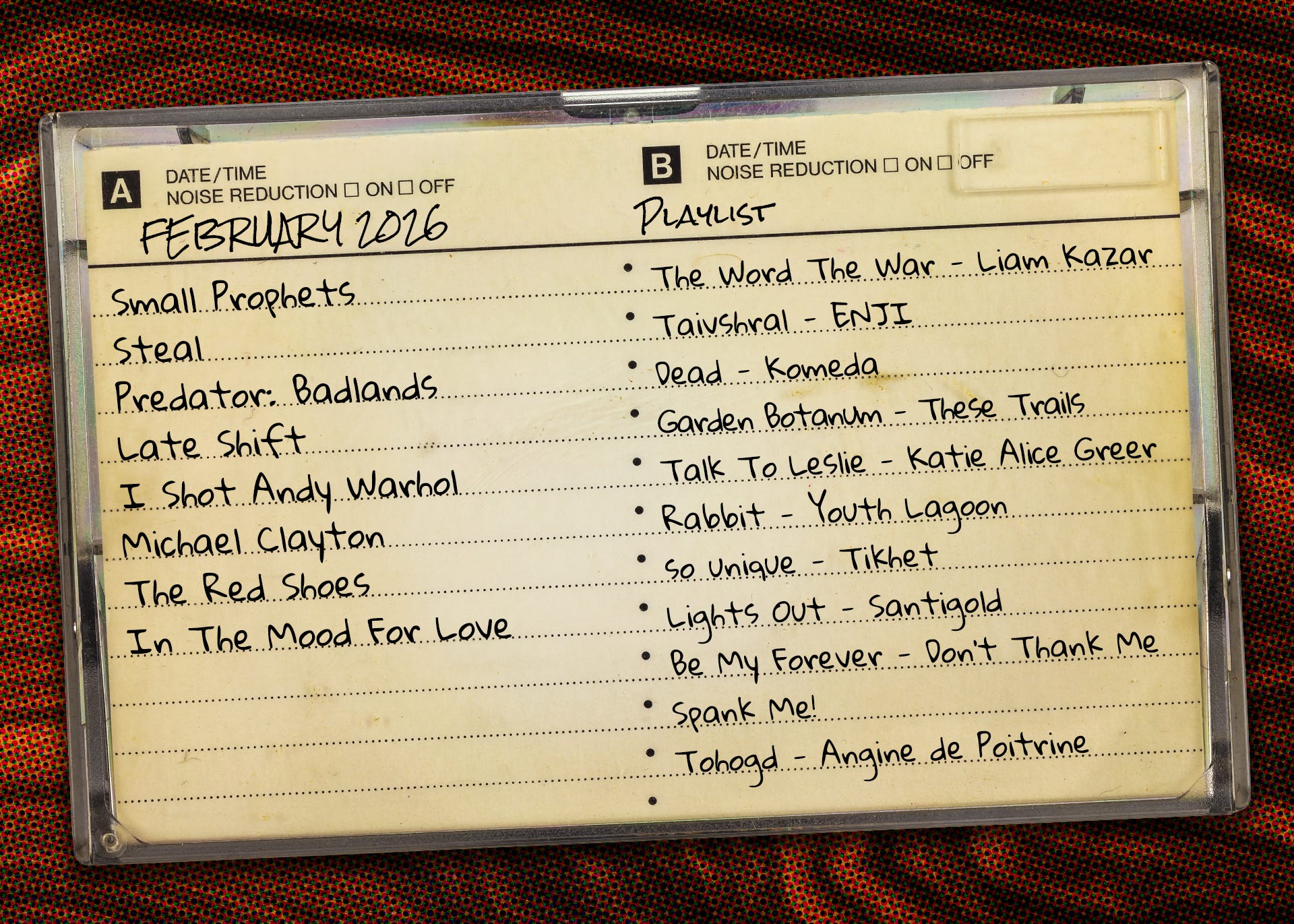
Small Prophets (2026)
The BBC’s hit du jour, Small Prophets is a comedy drama that differentiates itself using comedy that’s actually funny and drama that isn’t grindingly predictable. As with his previous hit The Detectorists, it feels like Mackenzie Crook is trying to make up for being integral in Ricky Gervais’ rise to fame by making shows that are kind and human. (Crook recently told The Guardian that ‘after The Office, I wanted to write something that wasn’t cruel.’)
The closest the show gets to a villain is the protagonist’s next door neighbour Clive, an athleisure-wearing Millennial whose house is devoid of decoration or personality, and whose life is a stew of status anxiety and militant normality. He is the villain because the protagonist, Michael Sleep, is a slacker. (It’s right there in his name. He is a Sleep; dreaming through life.) Michael is a Gen X man in late middle age with an extravagant white beard and a vintage French artisan’s jacket; he spends his time on whimsical projects for his beloved, and he hoards ‘70s ephemera. I am in this picture, and I’m delighted by it.
The story is appropriately oneiric too, incorporating a little ancient Egyptian magic, rare books and a flock of folklore signifiers: birds and hares and the titular homonculi. In an even more laser-targeted Gen X feature, these supernatural beings are stop-motion animated, rolling in a little Ray Harryhausen to go with the Action Man helicopter and the Modest Mouse t-shirt.
Oh yes, the homonculi. At one level, the weird little creatures that <spoiler> prophesy truthfully </spoiler> act as a metaphor for contemporary technology: a magical Polymarket, a stop-motion AI. They are strange intrusions from imaginary worlds that threaten to completely upend the way we think about the real one.
Small Prophets tell us that magic is everywhere, even in the back alleys of an anonymous town; at one point an adult mugger mistakes Michael for Father Christmas. In a typically excellent piece on why fantasy is appealing, Frances Spufford inadvertently outlines most of the reasons why it works in Small Prophets. Most particularly, it insists that the world is full of small wonders. As Spufford puts it, fantasy is ‘a kind of necessary realism, arising in response to qualities of the contemporary world that we couldn’t properly attend to, couldn’t narrate, any other way.’
The whole thing has left me deeply torn about the prospects of Crook making a sequel. I’d love to see more of this quietly magical world; and yet I’d rather leave it as it is, a remarkable little jar of wonder. Just lovely.
Steal (Amazon Prime, 2026)
Top subscriber Oliver Johnson (we recommend his Substack if you like elegantly waspish missives about maths) requested our views on this one, and who are we to refuse to watch a big dumb thriller? Sophie Turner is Zara, a frustrated back-room staffer at a City hedge fund who has a terrifying day at work when armed robbers break into the office. There’s a twist at the end of the first episode that sets the narrative ticking, and then we’re off.
Turner is fabulous, but you probably already knew that. There should be a compound noun for ‘thinking you’ve discovered a promising actor, then finding out that they have been globally famous for a decade because they were on Game of Thrones.’ This has happened to us about five times now. (We are not watching Game of Thrones and you can’t make us.) What can we say? There’s a reason our strapline is ‘no hot takes’. Anyway: the downside of Turner being so convincing and understated is that you really notice when the actors around her aren’t. The romantic interest is flaccid, and one major character is so persistently whiny and helpless that it’s a surprise when he calls his own Uber. There are some great little turns though: Ellie James should have her own ‘tough London detective’ show, and Anastasia Hille is absolutely terrifying as Zara’s mother.
Professor Johnson (passim) said he thought Steal was good but was missing something, and that’s the TL;DR. As with Turner’s performance, it’s one of those shows where some things are done so well that the less successful aspects stand out all the more. It’s sharply written: the dialogue is cracking, and the exploration of Zara’s background is much more interesting and nuanced than you might expect. The police simply do their jobs, which is always a relief; investigative incompetence is overused as a plot-driver. As with The Diplomat, this is a show that actually understands London’s geography, and allows a realistic amount of time for a character to travel from the City to Hackney. It isn’t afraid to show finance jobs as mostly very boring, which is a departure for a financial thriller. And it’s pleasing to see these young, not that well paid support workers living in realistically nasty, poky London flats. (The realism has its limits, though; Zara’s one-bed in the Leopold Building on Columbia Road would be worth somewhere north of half a million.) All in all it feels like a show written by an intelligent, witty person who understands the world it’s set in.
But there’s an underdeveloped political angle that gets jammed in uncomfortably right at the end; and the actual plot, if you focus on it, is nuts. It felt like a show that’s 80% of the way there but needed a little bit longer to cook. Maybe there’s something about the financial imperatives of streaming that forces creatives to push things out the door before they’re quite ready. That said: we watched it all the way to the end.
Letterboxd Diary
What Tobias Sturt has enjoyed watching this month.
Predator: Badlands (2025)
A Predator (an alien species known in-universe as the Yautja) arrives on the galaxy’s deadliest planet to prove his prowess and finds himself up against the most dangerous prey of all: man. Well, man-made androids, which, as we’re all discovering, are worse than actual humans.
The Predator originated in 1987 monster flick that put one down in the Colombian jungle to hunt a special ops team headed by Arnold Schwarzenegger. The idea is that these aliens are the ultimate killers, devoted solely to hunting and gathering trophies. The mythos has evolved a little since then, we’ve learned more about their simplistic language, culture and homeworld, but the core idea is pure and, equally, simple.
All of which makes me wonder: if they’re these vicious murder monsters with claws so long they can barely press their computer buttons, where did they get all their terrifying toys from? Their invisibility cloaks and absolutely-not-lightsabres and laser traps? There appear to be no scientist Yautja, or engineers or writers of instruction manuals. Who invented and designed and built those faster-than-light engines and anti-gravity generators?
I realise, of course, that I am taking this all too seriously. The point of the Predators is to be a brute force that highlights human ingenuity and intelligence, but that also makes them a metaphor for precisely those special ops types that Arnold played in the original film. The ‘tip of the spear’ that so conveniently forgets the long haft of science and culture and technology that supports them. All the people who know how to make big fucking guns and run supply routes for food and ammo and still remember that the proper name for the shaft of a spear is a ‘haft’.
On the other hand, there’s something there. Such stupid questions often open up new clever answers and more ideas for more story. The Predator franchise was reinvigorated by Dan Trachtenburg with the very enjoyable Prey (2022), which starred Amber Midthunder as a Comanche woman facing off against a Yautja in nineteenth century America, a film that made the colonial metaphor aptly monstrous. Badlands is not quite as enjoyable but Trachtenburg at least seems interested in trying to do interesting things with the concept.
What’s noticeable is how much more adaptable and pliable a silly movie like Predator is than a genuinely brilliant and artful film like Alien (1979). The two franchises are often yoked together as sci-fi movies full of homicidal monsters, but the original Alien film is simply too good to sustain good sequels (I know, I know, Aliens (1986) is jolly good fun, I grant you, but it can’t hold a flamethrower to the original). Start somewhere stupid and you have somewhere to go.
Late Shift (2015)
A single late shift in a Swiss hospital as nurse Floria (Leonie Benesch) is faced with mounting stress, panic and exhaustion.
The Metropolitan Editors have been Leonie Benesch fans since seeing her much put-upon naïf Greta in Babylon Berlin (2017—). She is an absolute master of wide-eyed distress and barely contained anxiety, and brings it all to Late Shift. Indeed, there’s a striking moment of relief in which Floria jokes with a colleague and I think that may be the first time I’ve ever seen Leonie Benesch laugh on screen.
The film ends with text highlighting the shortage of nurses in Switzerland, although I’m afraid that British viewers may greet that with a hollow laugh. Compared to some NHS hospitals, Floria’s seems remarkably well supplied, staffed and funded.
I Shot Andy Warhol (1996)
This is Mary Harron’s ‘90s biopic of Valerie Solanas (Lili Taylor), the writer of the militant feminist S.C.U.M. [Society for Cutting Up Men] Manifesto and the woman who tried to murder Andy Warhol.
The film is remarkably even-handed. It details both the hideous and routine abuses that Solanas suffered at the hands of a misogynous patriarchy, and her mental health issues that – while socially exacerbated – may also explain the violence of her reaction. It also takes a long, curious but not cynical look at Warhol and the Factory movement. At its heart is a consideration of sexuality, gender and biology that takes in every angle and remains admirably inconclusive.
Two things stood out on this rewatch, having not seen the film in thirty years. One was how fascinated my friends and I used to be with the Warhol New York scene; how desperate we all were to be Factory workers. Not only were so many of the Warhol crowd so dissolutely, stupidly cool, but also they represented an alternative to the more legible ‘60s legends that Boomers couldn’t stop making films and albums about during their ‘80s midlife crises: Beatlemania, Woodstock, Chicago, Vietnam. A less mainstream alternative ‘60s ancestry runs from Warhol to the YBAs, from the Velvets to the indie charts, and from Solanas to Riot Grrl.
The other thing that stood out was that we had to watch this on YouTube, because it isn’t available for streaming. Which is a shame, because it’s good: thoughtful, spacious, affecting, political, insightful, compassionate, complex. Just as the Factory disappeared from the mainstream mythology of the ‘60s, so there was another, more interesting ‘80s and ‘90s that is missing from the retro recreations like Stranger Things (2016-25).
Michael Clayton (2007)
We have been catching up on the latter half of the second season of Poker Face (2023—25). The first half got bogged down in some complicated story arc business that caused us to give up for a bit, but after that was all wrapped up Poker Face gets back to the cases-of-the-week stuff that it does so well.
Anyway, in one episode characters kept going on about how much they loved Michael Clayton, and we realised that we could remember nothing about it. So we went and rewatched it and discovered why: it’s not in the least memorable.
You know, it’s fine. Everyone apart from Sidney Pollack overacts a bit, but only Tom Wilkinson goes too far. The plot is almost knotty, but is full of loose ends and not at all believable. It’s the sort of thing that the Coen Brothers would have played for dark laughs, and it might have worked better that way.
So why do I keep reading things by Americans who seem to think it’s an all-time classic? I recently read something comparing it, as a perfect Hollywood product, to Casablanca (1942), which is befuddling. For a start, it doesn’t have ‘Cuddles’ Sakall or a rousing rendition of ‘La Marseillaise’.
My theory is that the corporate thriller has more relevance and bite in the States than it can do here. The typical British corporation is a bunch of chinless wonders in drip-dry suits who play golf and musical chairs with board memberships. The typical American corporation is a quasi-nation state that destroys environments, runs politics and grinds up lives for no greater motive than making the line go up and to the right.
The corporation driving the plot of Michael Clayton – a chemical manufacturer fighting a class action lawsuit over its toxic products – is all too believable. However, the subplot – in which Tilda Swinton’s in-house counsel hires some assassins to do away with troublesome lawyers – seems slightly too cartoonish from this side of the pond.
It is noticeable that writer/director Tony Gilroy’s Star Wars contribution Andor (2022–2025) was able to take a fundamentally silly sci-fi setting and use that to create a persuasive, chilling and gritty story of fighting oppression in a way that the apparently realist Michael Clayton doesn’t quite manage. Perhaps the ludicrousness of the sci-fi genre allows you to build thriller-level stakes without sacrificing the realism of the politics.
The Red Shoes (1948)
In The Mood For Love (2000)
Two tales of doomed love for Valentine’s Day. Well, not quite, but I’ve been meaning to watch Wong Kar-wai’s In the Mood for Love for years, and so was delighted to find it had appeared on streaming. And now I’m going to have to buy it on DVD because it is utterly magnificent.
The Red Shoes, on the other hand, is the great masterwork by my favourite film-makers Michael Powell and Emeric Pressburger, and I rewatched it solely because it was on iPlayer. It’s a good deal more histrionic than the achingly restrained In the Mood for Love, but the films have two things in common: they are not only very good but they are also extraordinarily beautiful. In the middle of a dull and rainy February I inadvertently created a little island of beauty, Wong Kar-wai’s cool greens and Michael Powell’s saturated red as an antidote to the endless grey of a British winter.
This might have to become a habit. Perhaps I might try the beautiful ‘half-asleep’ grainy midcentury colours of Ozu’s Late Autumn (1960) or Tati’s Mon Oncle (1958). Kubrick’s masterpiece of entrancing tableau Barry Lyndon (1975), or Wes Anderson’s sugar frosted dioramas of The Grand Budapest Hotel (2014). Classic technicolour musicals, perhaps: the jewel colours of like The Umbrellas of Cherbourg (1964) or Cecil Beaton’s stunningly monochrome Ascot of My Fair Lady (1964). The magical scenery of Hayao Miyazaki’s Kiki’s Delivery Service (so perfectly cosy for late winter), the luminous black and white of Cocteau’s La Belle et la Bête (1946). All that visual delight and untrammelled beauty in which to luxuriate while outside it rains.
Playlist
Tobias Sturt: Here’s my favourite ten tracks for this month.
The Word The War - Liam Kazar
This is a nice chugging groove to bring us into March, just a hint of warm weather to come.
Taivshral - ENJI
This is a woozy piece of lyrical jazz pop, I think Enji - Erkhembayar Enkhjargal - is Mongolian by birth, although I’m not sure what language she’s singing in.
Dead - Komeda
I was quite a fan of Komeda in the ‘90s but somehow I’d never heard this track before.
Garden Botanum - These Trails
Here’s a delicate piece of ‘70s hippie folk to carry us into the new green of Spring.
Talk To Leslie - Katie Alice Greer
I’m rather fond of these lyrics where you can tell that there’s a story there, but what it actually might be is left carefully opaque.
Rabbit - Youth Lagoon
This is a beautiful, elegiac piece of music that has ear-wormed me for days.
so unique - Tikhet, Sepalot, Angela Aux
This has a nice lo-fi hip hop tone to it, with a touch of Motorik driving it along (appropriately for a German outfit).
Lights Out - Santigold
I’d somehow managed to forget all about Santigold and this track until Spotify reminded me, and it’s still great.
Be My Forever - Don’t Thank Me Spank Me!
There’s a band name guaranteed to make middle-aged Dad-adjacent listeners uncomfortable.
Mata Zyklek - Angine de Poitrine
My new favourite band. It’s ‘Tohogd’ on the Spotify playlist but there’s no video of them playing that live on YouTube and if you’ve never seen them before, it’s not to be missed. The Mighty Boosh plays Battles. They’re not just weirdo costumes though, it’s also incredible music. The perfect combination.
You can find the whole playlist on Spotify, as usual:
Here’s our piece on Andor, to make up for being mean about Michael Clayton:
Nazis. I hate these guys.

At school in the early 1970s we sometimes played ‘Cowboys and Indians’ in the playground. But even as kids, we knew there was something unsatisfactory about it; not so much the racism, of which we were unaware, but the absence of a properly nasty antagonist. My grandmother liked a man in a ten gallon hat, read Zane Greys and watched John Ford movies. I …
I like this