


The Legend of Zelda: Breath of the Wild (2017)
There are not many movies in the Letterboxd Diary this month because I have suffered a relapse of an old addiction: I have gone adventuring in Hyrule again.
For the uninitiated, The Legend of Zelda: Breath of the Wild is a videogame. It is, more specifically, an ‘open world’ role playing game — that is, a game in which you can explore the fictional world as you like, going anywhere and interacting with anything. (In this respect, open world games are much like conventional table-top role playing games.)
The Zelda games started being released in 1986, so Breath of the Wild was more or less the thirtieth anniversary version. As in (most of) the others you play as Link, a hero adventuring through a fantasy world on his way to (inevitably) rescue the Princess Zelda. The plot (such as it is) and the lore of the setting are even more ludicrous than you might be imagining; but as games, they are terrific. There are very good reasons why Breath of the Wild is rated as one of the best videogames of all time.
Many of these reasons have to do with how innovative it is within the ‘open world’ genre. Breath of the Wild’s approach to this genre has been hugely influential, changing the way other games now approach it.
But these innovations have also been incredibly useful for me. For a start, I am terrible at video games. I have awful hand eye coordination and consequently find most of them incredibly difficult to play. I want to enjoy video games, but I have, in the past year, bounced off sci-fi epic Mass Effect, cowboy saga Red Dead Redemption, and the grey and gritty Batman Arkham series, all of which required me to have split-second timing and a voluminous memory for button combinations, all of which are beyond me.
Nintendo, on the other hand, have a long history of trying to be inclusive with players and consequently have control systems that even a klutz like me can handle. And the game is incredibly forgiving. Even though, in the middle of a fight, as I struggle with the buttons, I will accidentally crouch down, or whistle for my horse, or start climbing a wall, the game is lenient enough that I won’t die too often.
More importantly, Breath of the Wild’s emphasis on player agency means I can play in a way that suits my ability: sniping enemies from a distance, or simply avoiding them altogether, playing not as a hard bitten adventurer but as a happy wanderer, exploring the wilderness stopping to chat with passers by.
And what passers by! This is the true delight of Breath of the Wild. In the tradition of Nintendo’s inclusiveness, the game is largely free of the adolescent grim n’ gritty histrionics that make the worlds of other games so tiresome. It is, instead, a little cartoony, a little whimsical, even a little funny. It is full of odd delights, strange discoveries and a constant appeal to play further.
There is a lot of discussion of how games need good writing and good plots, and goodness knows that’s true, but Breath of the Wild has neither and while it may be inventive in their application, uses the basic structures of a million other role playing games. What it does do is create a world of staggering and engrossing wonder, and invite the audience to make it their own, a thing that only a game can do and possibly where games truly constitute the new popular art of the twenty first century.
Breaking containment
It’s been a rough few weeks in the Metropolitan household: our beloved communal spaniel broke his leg, and has to be immured in confined spaces with no running or jumping while it heals. This is pretty much a spaniel’s idea of hell, although — and this is one of my most impactful learnings from this entire experience — it turns out you can get dog tranquilisers.

Worse, we twice had to leave him in the care of more competent strangers while he had surgery, and the second time we did this he gave us a look of such distress and betrayal that I don’t think Toby and I will ever recover. So in an act of self-soothing — and speaking of lapsing into old addictions — I’ve spent a lot of the last couple of weeks re-watching the early seasons of ER with one hand on a disorientated dog. My takeaways are:
So much under-the-duvet rustling followed by people popping their heads out and saying ‘hmmmm!’ Absolute pet hate of mine.
The ‘90s went big on cool-toned lipstick and blusher, and I’m sad we don’t do this any more. For the past ten years all lipsticks have been orange, which makes me look like a cadaver.
It’s literally closer to being a ‘70s show than a 2020s show, and sometimes you can really see it. Several outro sequences are shot in slow-mo, and one ends in a sudden freezeframe, a practice that should have been killed dead ten years earlier by the Police Squad epilogues.
However much we try, it’s really hard for us Gen Xers to comprehend how sexist the ‘90s were, even when we were on the sharp end of that sexism ourselves. Pat yourself on the back if you lived through it and didn’t kill anyone.
The medics are incredibly judgemental about their patients, and use medical procedures as moral punishments. At least once per episode, someone deliberately does something that ought to be career-ending.
On a related note: Dr Doug Ross is an absolutely massive wanker.
The casting was astonishing: so many then-unknowns who dripped with charisma. Lots of them were gifted comic actors as well, and it’s a lot funnier than The Pitt. (Mind you, many major diseases are a lot funnier than The Pitt.) Like Casualty and The Bill in the UK it also operated as a funnel for new talent, meaning that the extras are spectacularly good value too: there’s a very young Kirsten Dunst, and lots of people who went on to star in The West Wing. At one point Toby Ziegler turns up having ill-advisedly used an entire tube of performance-enhancing cream on his schlong.
There: that’s not likely to upset anyone, is it? Last week’s essay about ER’s unacknowledged (and legally murky) successor The Pitt, on the other hand, provoked big feelings in a lot of people. Several days later there was still a full-blown row going on in the comments, and for the first time we were sent a report about a comment requiring moderation (although thankfully it was just spam). It has been a reminder that we break our ‘no hot takes’ rule at our (and your) peril.
The Metropolitan is a small-ish newsletter. We didn’t intentionally plan it that way (we hoped to make money out of this, lol). But it turns out our audience is self-limiting by virtue of being discerning, highly intelligent, and unusually attractive. That’s just the way it is. Then, every now and then, a piece breaks containment, as happened with our piece about The Pitt. Mostly this is very gratifying because it brings in new people (hello! We’re not usually this self-referential, honest). But, because this is in the internet, a few of the drive-by comments were jarring.
As I remarked to Toby at one point this week: ‘I don’t like it when people read the things I’ve written.’ Obviously I’m being a precious little hothouse flower, and I don’t literally mean this. But while talking to people on the internet is one of my favourite things, absorbing random hostility from strangers on the internet (or seeing our subscribers having to absorb it) is one of my least favourite things. It’s a conundrum alright.
So for what it’s worth, and in case we mistakenly publish something popular again, it turns out you can report posts in the comments. If you find someone in there being an unmitigated dick, let us know. I’ve moderated before and goddammit, I will moderate again if I have to.
Letterboxd Diary
What Tobias Sturt has enjoyed watching this month.
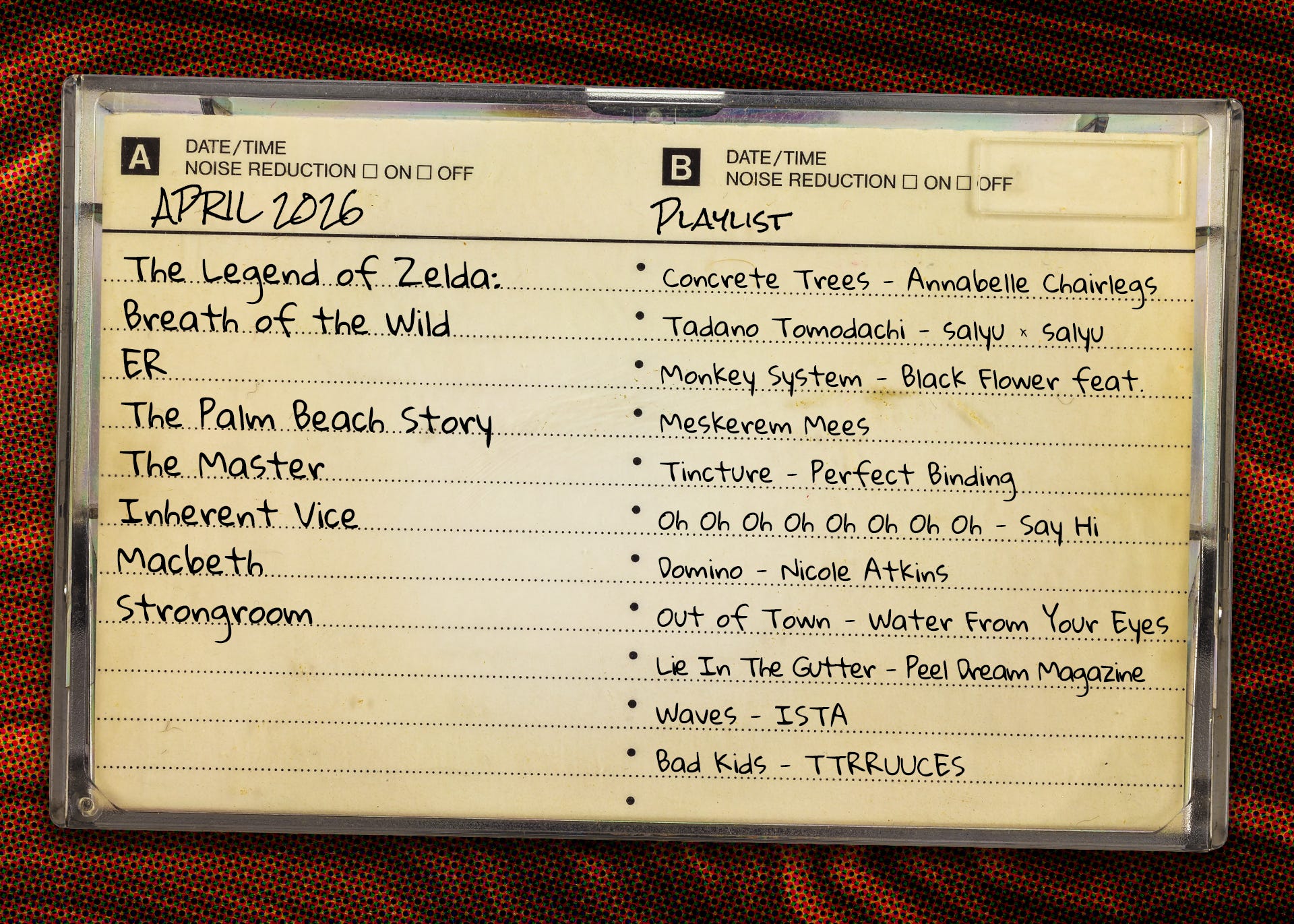
The Palm Beach Story (1942)
I know, I know, a film I should have seen by now, especially since Metropolitan co-founder Nettie Richardson has been urging me to for years, but OH MY GOD, what a dollop of incomparable delight, what a joy, what a movie.
Gerry (Claudette Colbert) is convinced that she can better help her inventor husband Tom (Joel McCrea) by marrying someone richer, so she heads to Palm Beach to acquire a divorce. On the way she falls in with millionaire John D. Hackensacker III (Rudy Vallee) and his husband-hungry sister the Princess Centimillia (Mary Astor). But husband Tom is in hot pursuit, and when he catches up with them the highest of jinks ensue.
I haven’t even mentioned the Ale and Quail Club and their splendid spaniels, the hard of hearing Wienie King, or Toto, the incomprehensible hanger-on. You can see why the Coen Brothers love Preston Sturges so much.
Sullivan’s Travels (1941) was already one of my favourite films, so I should have known, but the moment this finished I found a Preston Sturges boxset on eBay and bought it immediately, not least because so few of his films are available to stream.
This is not altogether surprising. Much has been made, recently, of the Netflix model of movie making, where the plot is explained in words of one syllable in every other scene, in which characters must clearly enunciate their every motive and emotion, and in which exciting action must be regularly included to keep audiences watching. This is all done on the assumption that viewers aren’t viewing: they’re looking at their phones and simply have the TV on as some customisable wallpaper.
The Palm Beach Story is the anti-Netflix film. Look at your phone even for a second and you will miss two plot points, three jokes and some great performances. It is fast talking and fast moving - and, like so many ‘30s and ‘40s movies, surprisingly fast living; stimulatingly adult about relationships and life.
Tom’s invention is a sort of chainmail landing strip that could be suspended between skyscrapers to make an airport in the middle of a city. The film is a similarly ludicrous construction of filigree complexity and surprising strength. Unlike the regulated structure of modern movies, it has a habit of darting off in odd directions, filling itself with mad details and delightful decoration. This is never more evident than in the way the movie begins where other romcoms end: with a wedding. We open with a madcap marriage that seems to feature two Joel McCreas and two Claudette Colberts, something which isn’t explained until the very last scene of the film, leaving the audience in a fevered state of anticipation and confusion throughout.
Unless they look up a synopsis on their phones, of course.
The Master (2012)
Paul Thomas Anderson’s thinly veiled portrait of L. Ron Hubbard and the founding of scientology. Joaquin Phoenix is Freddie Quell, an alcoholic Navy veteran who falls into the orbit of Philip Seymour Hoffman’s Lancaster Dodd, a self-aggrandising writer who is in the process of building his own cult.
I’ve always been fascinated by the Hubbard story, particularly since I came to it through reading about Jack Parsons, the rocket engineer who was also an occultist and a follower of Aleister Crowley. Parsons engaged with the young Hubbard in a magical working, and then Hubbard conned Parsons and ran off with his ‘wife’. These are the bare bones of an utterly unhinged story that someone absolutely has to adapt some day.
The Master is not that story, but it did make an interesting coda to all those war films we watched last month: it is the story of what happened next, the search for stability and identity in post-Second World War America after the chaos and regimented service of wartime.
More specifically it’s about visions of masculinity, captured perfectly in the two central performances. Phoenix’s performance is one of intensity and tightly wound energy, perfect for a man who is being burned from the inside by his own addictions and impulses and who cannot quite comprehend what is happening to him. Hoffman’s performance, in contrast, is one of huge but contained charisma, an avuncular facade on a monumental ego.
These are two models of being a man for the post-War generation. On the one hand you have the tortured masculinity of a Brando or a Dean, an extreme physicality which masks a damaged spirit. On the other hand you have the patriarchal gravitas of a Welles or a Wayne, the expression of extreme and furious control. In some ways these represent the opposition of underground with the mainstream, the son and the suburban father; the opposition, that is, of the Baby Boomers and the Silent Generation, the dynamic that did so much to determine the American culture of the latter part of the twentieth century.
Inherent Vice (2014)
The Master led, inevitably, to another PTA/Joaquin Phoenix collab, a loose adaptation of Thomas Pynchon’s Inherent Vice. The movie is appropriately baggy, free-associating and incomprehensible, although it never quite captures either Pynchon’s lyricism or his delightfully terrible sense of humour.
It does, though, capture something of that vision of mid-century California, a very Jack Parsons combination of esoteric culture and cutting edge technology: ashrams and chip fabs, hyper consumerism and alternative lifestyles, suburban sprawl and off grid cults. It’s the setting of so much of my adolescent reading: Pynchon, a lot of Philip K. Dick, Hunter S. Thompson, William S. Burroughs and trace amounts of William Gibson and Neal Stephenson. It’s an hallucinatory landscape, a Fata Morgana of the World of Tomorrow quavering in the heat haze between the sea and the desert.
It makes Inherent Vice something of a hangout movie for me, albeit an odd one, with its trippy disjunction and doper’s paranoia, in much the same way I found David Fincher’s Zodiac a comfort watch during the pandemic.
Macbeth (1948)
Speaking of Welles, I finally got around to watching his 1948 adaptation of Macbeth, which he described as a cross between Wuthering Heights (1943) and Bride of Frankenstein (1935). What it most reminded me of, though, is a Warner Brothers or UPA cartoon of the same period (congratulatory), most particularly the backgrounds.
The settings of Macbeth have the same sense of gigantic minimalism and stylised decoration as the modernist backgrounds of a Gerald McBoingBoing film, or Chuck Jones’s masterpiece What’s Opera, Doc? (1957). It is a theatre set grown to movie proportions, full of sound and fury and, to be fair, signifying a great deal in this case.
I wasn’t too sure about Welles’ ‘Scottish’ accent, which is better than Christopher Lambert’s in Highlander (1986) but not by much; but I did like his crown, even though he dismissed it as making him look like the Statue of Liberty.
He ended up with it because he had virtually no budget, and so had little choice in costuming. But this probably also accounts for the brutal, brooding sparseness of the sets. Ultimately the film is an excellent example of what can be achieved with little money but a huge amount of ambition and, more importantly, inventiveness.
Strongroom (1962)
And speaking now of low budgets, I stumbled across this no budget British thriller on the BFI channel, which has listed it with a recommendation from Quentin Tarantino.
It’s the story of a carefully planned bank robbery which, like all carefully planned bank robberies, goes awry and ends with two of the bank staff - the manager and his secretary - trapped in the air tight vault.
The film then cuts back and forth between the two of them trying to find a way out, and the robbers realising that if the trapped staff die it will be murder, which at that point was a hanging offence in Britain. Slowly the robbers realise they are going to have to break back in to save the people they have robbed.
It’s an amazing little set up, but what’s fascinating about it is how much time it makes for the characters, even the ramrod straight and efficient early ‘60s movie police.
There’s a lovely example of this in the scene where, struggling for air in the vault, the manager and secretary are talking about how they ended up there. He reveals that he always wanted to be a printer but his parents wanted him to go into a managerial profession. A printer! An apparently odd little gracenote but absolutely spot on for the character, a man who would have been happier racking up lead type into perfectly kerned lines. The film is full of these odd moments and is all the better for it. (Insert here the rant above about the Blake Snyder mandated movie structure and its failings.)
Playlist
Tobias Sturt : Here’s my favourite ten tracks for this month.
Concrete Trees - Annabelle Chairlegs
Some garage power pop to start us off in an appropriately enthusiastic spring mood.
Tadano Tomodachi - salyu × salyu
Off kilter Japanese pop that sounds like it was made to accompany speeded up footage of flowers bursting into bloom like fireworks.
Monkey System - Black Flower feat. Meskerem Mees
This, on the other hand, is quite shadowy and slinky with a nicely quirky jazz rumble behind it.
Tincture - Perfect Binding
There’s something quite dark about this, too, but in a more valve driven, garage rock style.
Oh Oh Oh Oh Oh Oh Oh Oh - Say Hi
Big fan of the horns on this track, fitting alongside the lo-fi indie guitars splendidly.
Domino - Nicole Atkins
Lovely piece of noirish soul with a splendid chorus.
Out of Town - Water From Your Eyes
I am somewhat partial to this kind of quirky indie accompaniment to a lyrical pop tune.
Lie In The Gutter - Peel Dream Magazine
Stereolab meets Yo La Tengo - not that surprising a meeting if we’re going to be honest.
Waves - ISTA
Some psychedelic rock to match the coming sunshine.
Bad Kids - TTRRUUCES
I was thinking that this sounded reassuringly late ‘00s to me (a little bit stomp! clap! hey!, a little bit Go! Team) and then discovered that they formed in the teens in Broadway Market, where I was living at time, and realised why it sounded so friendly and familiar.
The whole playlist is on Spotify as usual:
For more Shakespearean kings on a low budget, there’s always the Hollow Crown sequence of history plays:
