


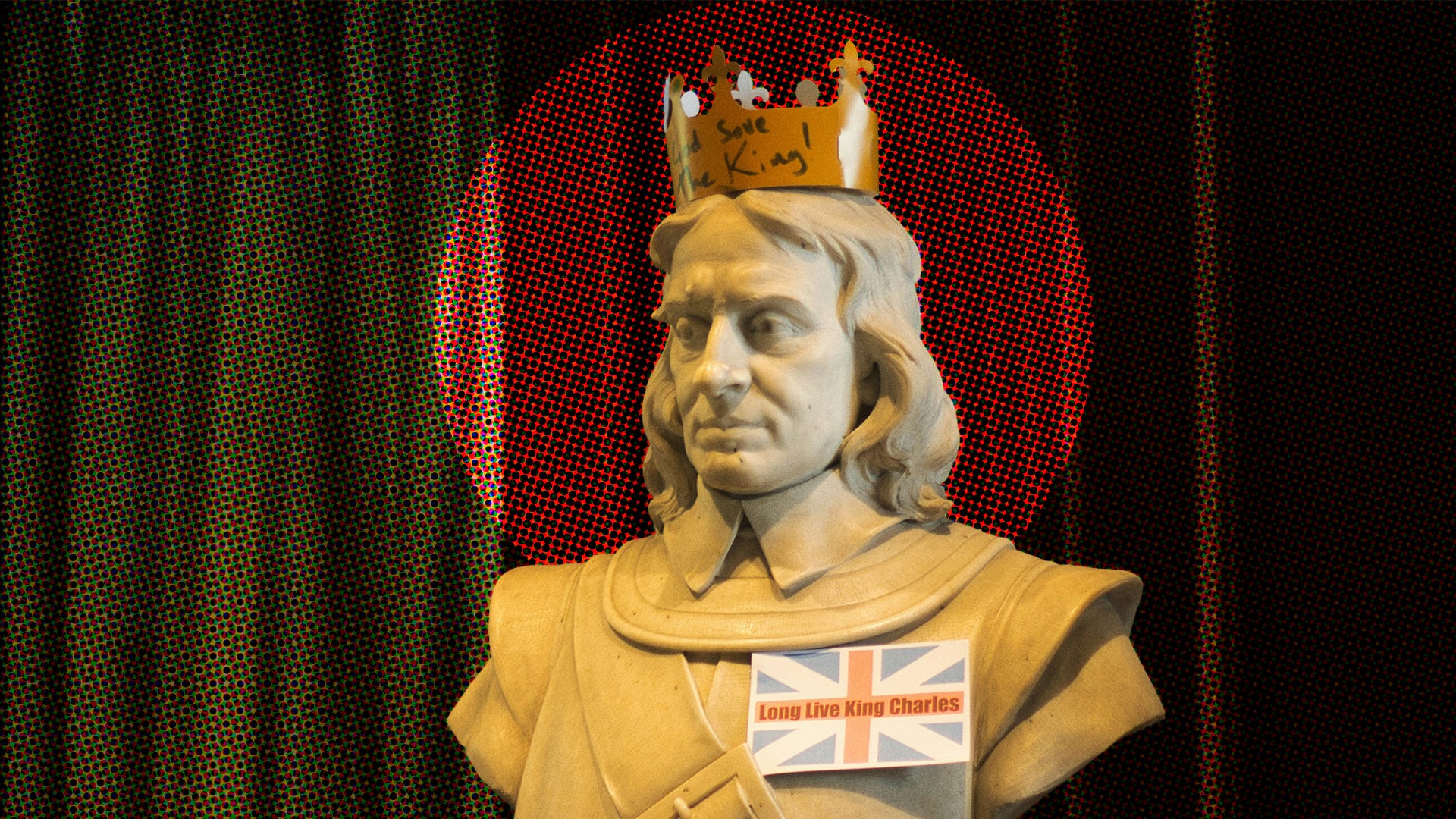
There’s a thought experiment (most often associated with a short story by Ursula K. Le Guin) that runs like this: Imagine a perfect state. Nobody is hungry, lonely or unfulfilled; all needs are met, and everyone lives in a perpetual state of serene delight. But the price of this perfection is that one child must be kept in total isolation and darkness from the moment of her birth. She lives in filth in a dark cellar, and she eats survival rations of bread and water delivered through an air-gapped door. If she were ever to know the sun on her face, or any sense of human comfort, the perfect state would dissolve. (This proposition doesn’t make any sense. That’s why it’s a thought experiment.)
And the question is: do you think this is a defensible bargain? Or not? On the one hand: without this child’s sacrifice, many people would be hungry, unhoused, unhappy, or treated with cruelty. On the other hand: Christ on a bike.
This thought experiment pops into my head quite often when I think about the British royal family. Not that the UK offers a perfect existence to its people (insert your own hollow laugh); but that, at some level, us Brits are happy to exchange one family’s happiness, their fundamental freedom to thrive, for a broader political settlement.
What we’re avoiding, in this bargain, is putting too much power in the hands of our fellow voters. We’re avoiding an elected head of state: a President Farage, a President Vorderman, a President Corbyn or a President Martin Lewis (the last one is thought to be the most probable). You might truly believe, as a matter of sheer principle, that President Farage would be preferable to a hereditary monarch. But you have to accept that President Farage (or President Corbyn) would have the power to open and close Parliament, appoint Prime Ministers, direct the armed forces and sign (or refuse to sign) laws. Be honest: if you’d been President in January 2020, would you have signed the European Union (Withdrawal Agreement) Act without the slightest hint of fuss or grandstanding?
If nothing else, the heirs to the throne — with a few notable exceptions — have been trained all their lives to keep their hands where we can see them, and not make any sudden moves. Which is more than you can say about the British electorate right now.
So we keep the Windsors where they are, trapped under glass. And we never admit to ourselves that we’re doing this for us, not for them. We make them rich, and give them really ugly mansions to live in, and then we scream at them to be more grateful and more entertaining; in any other context we would call the dynamic abusive. One moment we are making reverences to their magic blood; the next moment we are enraged because they’ve tried to exert the most basic rights to privacy over their pregnancies, their kids, their divorces or their terminal illnesses. Witness the way Kate Middleton (I know that’s not her name) was forced to release a hostage video after taking some time off to have chemo. No wonder so many of them are completely cracked. Andrew Mountbatten-Windsor tests this sympathetic position nearly to destruction; but even he, dreadful little shit that he is, has endured a context of emotional and personal madness that few would emerge from intact.
One of the odd things about the royal family is that their most fervent persecutors are the people who claim to support them most. Those wet, empty weirdos who press up against the police cordons and buy the commemorative partworks are the same people who cannot imagine that the members of the royal family deserve ordinary human kindness. They certainly don’t accept that the royals are entitled — in the words of Article 8 of the European Convention on Human Rights — to ‘privacy and family life’. Those of us who are ambivalent about the royals are much more likely to think they should be left alone to perform ordinary human functions in private.
It all went wrong, of course, when the royals made the tremendous mistake of re-introducing good-looking outsiders. When I was growing up in the 1970s, not one of the Windsors would have drawn a second glance in the average high street disco. The Queen and Prince Philip were in their 50s and their kids were in their 20s and 30s, and there wasn’t a pretty face to be found anywhere. As a unit, they were as jauntily compelling as a bollard in the rain. They had exactly the same valence as Sunday afternoons; they dragged on, and they had to be endured. By the time Prince Philip conceived an epochally disastrous scheme to marry Charles to a posh virgin, my fundamental opinions had already been formed; these people were square. I was required to watch the wedding of Charles and Diana in 1981 — they put it on the big projector screen in the assembly hall at school — and even as a ten year old I couldn’t get excited about it.
There is, admittedly, a strong strain of snobbery among those of us who aren’t impressed by the royals. If you’re posh enough, it’s just classic-brand snobbery; there are plenty of old English and Scottish families who think the Windsors are laughably bourgeois. More commonly, though, the snobbery of un-royalists (who are not always outright republicans) is cultural and intellectual. It is the snobbery of the Guardianistas and the grammar school kids (let’s face it, it’s quite funny that all the elite schooling in the world couldn’t produce three decent A Levels from the Queen’s children collectively, let alone individually.) We are quite capable of our own kind of nastiness; faced with the frothing irrationality of the royal fans, we respond with personalised abuse of the principals.
But our emotional detachment— and, honestly, our mild contempt — also enables a certain amount of empathy. It’s because we don’t think these people are magic that we are able to recognise them as people.
In early September 1998, just after Diana’s death in Paris, my flatmate and I had a spare room that we needed to fill. We had put an ad in Loot, as one did in the late ‘90s, and needed to decide which of the respondents we might be happy to see when making our way to the bathroom for the first piss of the day. We invited the candidates over, one by one, for a chat in our living room, and we kept the rolling news coverage on in the background as a test. This was during the ‘WHERE IS OUR QUEEN, WHERE IS HER FLAG?’ mania, after the death but before the funeral. The main story of the day was that the police were asking people to stop leaving bouquets outside Buckingham Palace, because the rotting foliage was becoming a health hazard.
Only one of our prospective room-mates — and it’s probably not a coincidence that he was Swedish — pointed at the telly and said, as an ice-breaker, ‘Can you explain to me what the fuck is going on with all this bullshit?’ Reader, we offered him the room. I suspect some of the other ad respondents had thought the same thing, but had bitten their tongues (it was a mansion flat at the top of Brixton Hill with a massive garden).
The public response was certifiable, but what was worse was the way those small boys were required to follow their mother’s coffin through the streets, and to not cry. They were 15 and 12. It still makes me angry to think about this. The usual excuse, now that everyone recognises it was a cruel shitshow, is that ‘the Firm’ insisted on it and nobody else felt able to intervene. Who knows if that’s true; during this period in particular, Downing St and the tabloids didn’t seem to have much trouble getting the Firm to do things it didn’t want to do.
There certainly wasn’t any widely expressed public discomfort that these traumatised boys were being forced to participate in the festivalisation of their own grief. The frothers wanted them there, and their tearful reluctance only made it more delicious. Like a sex aid or a lemon reamer, they enabled viewers to squeeze out something gratifying. There was no screaming headline in The Sun about their exploitation; there were no questions in Parliament. The royalists thought the cruelty was fine, and everyone else kept their mouths shut. Whenever Harry pops up these days promoting some podcast nobody wants, I think: you know what, mate? You’ve earned the right to do whatever you like. (Within the law. Which is the bit his uncle seems to have forgotten.)
In her famous 2013 essay ‘Royal Bodies’, Hilary Mantel described Kate Middleton as ‘a jointed doll’ whose ‘only point and purpose’ was to have children. For this, Mantel was excoriated by the hysterically hard-of-thinking. She was, of course, noting the suffocating fate of royal women, and the way the British public feel entitled to eat them alive. And she was, of course, also being a massive cultural and intellectual snob. It’s really hard not to be, when you’re talking about the royals. I can imagine that the essay might have been infuriating for Middleton, who seems like a perfectly smart person. (She got into a competitive university under her own steam; lots of people don’t.) It isn’t nice to be called a jointed doll, even if it’s intended as commentary on your position rather than your literal person. It was reported at the time that she was upset by it. I wonder whether, after 13 years of insanity and intrusion, she isn’t now beginning to see Mantel’s point. I like to think that Kate might be yet another middle-aged, middle class woman radicalised by the real queen.
It won’t surprise anyone that Mantel wasn’t a flag-waver, but she also wasn’t a doctrinaire republican. ‘Is monarchy a suitable institution for a grown-up nation?’ she asked. ‘I don’t know.’ But what she’d noticed, she said, was that the British public treat the monarchy as ‘an entertainment, in the same way that we license strip joints and lap-dancing clubs.’ And when you conceptualise human lives as entertainment, ‘adulation can swing to persecution.’ Call me a foaming egalitarian, but I don’t think King Charles should be giving speeches while recovering from cancer treatment; I think he should be sitting very quietly on a soft chair in a lovely garden, eating a lentil salad.
The story in which Ursula K. Le Guin described her thought experiment was called ‘The Ones Who Walk Away From Omelas’. These people — the ones who walk away from the state — are the heroes. They choose exile rather than be morally complicit in the bargain that underpins their privilege.
I’m not one of these heroes; I’m far too afraid of President Farage. But if we must trap these people under glass — and on balance, I’m OK with that — we should at least have the courage to recognise that we’re asking them to make a gruesome sacrifice. As Mantel said, ‘I’m not asking for pious humbug and smarmy reverence. I’m asking us to back off and not be brutes.’ Given that we don’t live in a thought experiment, perhaps we should consider how the terms of the royals’ captivity might be changed.
This isn’t the first time Hilary Mantel has appeared in The Metropolitan and I think it’s safe to assure you that it won’t be the last, either.
Reputation Management

One of the arresting things about Wolf Hall (2009) was the way Hilary Mantel characterised Thomas More. The last time most of us had thought about him – maybe watching a repeat of A Man for All Seasons (1966), or reading Peter Ackroyd’s 1991 biography – he was being represented as a principled martyr, a prisoner of conscience. More was suited to the exi…
To me, it's a sacrifice with absolutely no point to it, relying on scary but absurd counterfactuals which get continually brought up in these types of arguments..
If Britain became a republic, one possibility (one we'd never actually go for) is to also transition into a presidential republic. In that case, a politician like Farage or whoever else could become president. But that situation wouldn't be substantially different from those same politicians becoming PM, nor substantially more likely, so what's even the complaint?
A second possibility would be a ceremonial but popularly elected president, like Ireland. To my knowledge, none of the many countries with that system have ever seen politically irresponsible celebrity presidents, so it's unclear why we would. Luckily, if we want to avoid that, we could have a president who isn't popularly elected, like that of Germany. The governor generals of Canada and Australia also already basically function this way.
But third, and usually left out of the conversation, is that nowhere in the laws of the universe is it written that a republic must have a president as head of state. There's nothing stopping us from merely vesting the monarch's powers into existing institutions. The prerogative powers that are already exercised de facto by the PM could just be formally made powers of the PM or cabinet. The one's we wouldn't want to place directly in the PMs hands for political reasons, or which couldn't be (like the appointment of the PM), could be given to another constitutionally independent figure (the Speaker, say) or to Parliament as a whole.
This is just so well written. I think Harry is the hero of the story, with or without his wife.