



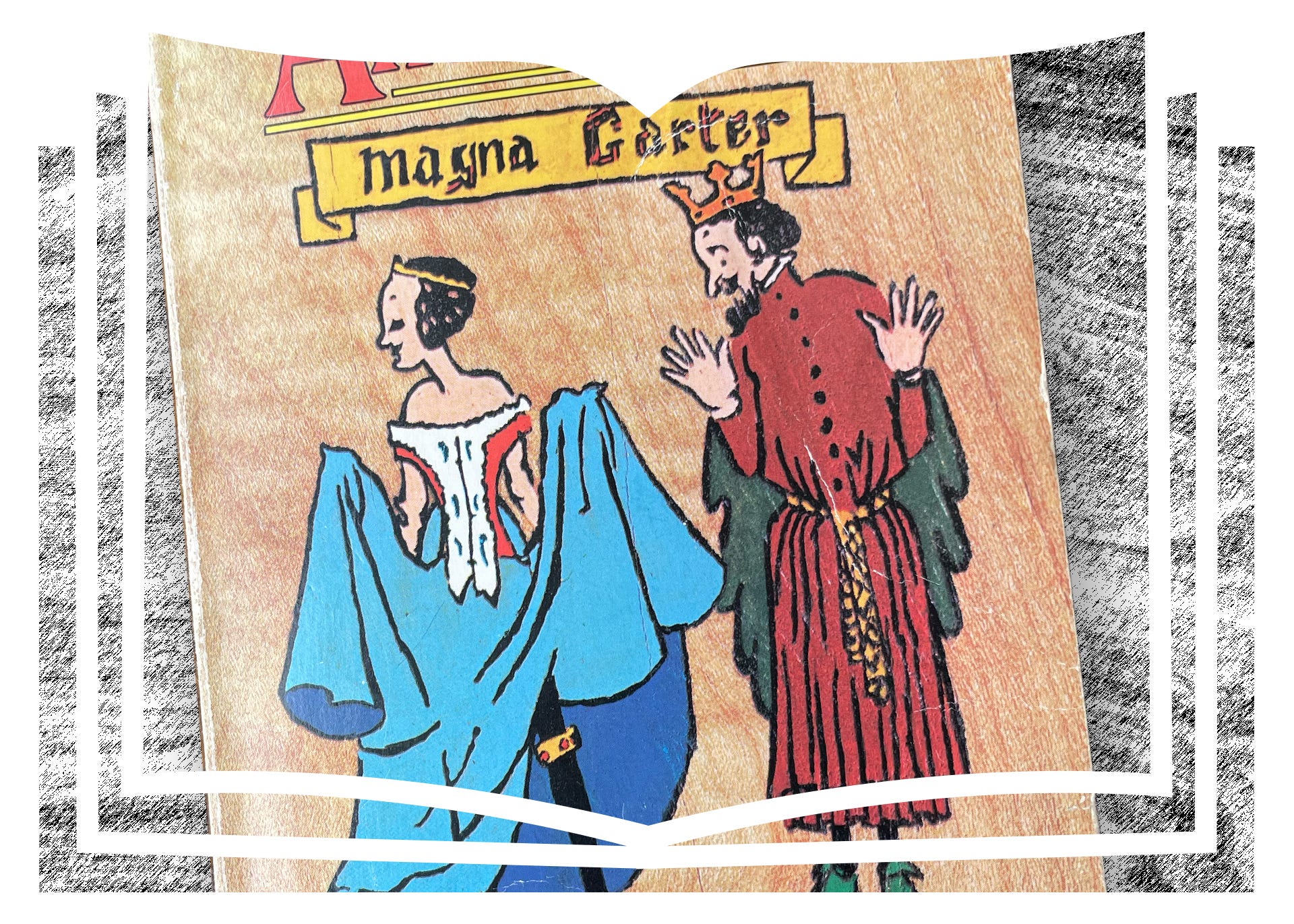
One of the most celebrated comic texts in modern English, 1066 And All That was written by Punch contributor Robert Yeatman and history teacher W C Sellar, with illustrations by John Reynolds. It apes the form of a school history textbook, but one that’s been written by an distracted child staring down the barrel of an end-of-year exam. It presents a mangled, otherworldly version of English (never British) history from the arrival of Julius Caesar to the end of the First World War, confidently identifying ‘103 Memorable Things, 5 Bad Kings and 2 Memorable Dates’ along the way. The authors declare at the beginning: ‘History is not what you thought. It is what you can remember. All other history defeats itself.’
The first memorable date
In 1983 I was 12, and learning about motte and bailey castles at school. I didn’t care much about the ins and outs (or rather, the ups and downs) of castle construction then, and I still don’t care now; but I was paying close attention, because our teacher, Mrs Twombley, was one of those teachers, and she had me in a trance. It was the first time I’d been taught history as a discrete subject, and I was discovering that I really liked it. I was also discovering that Mrs Twombley had a lot of strong opinions about Mrs Thatcher: opinions that were not entirely relevant to the context of the thirteenth century. Lots of history teachers, in my experience, have strong opinions about Margaret Thatcher. I suppose she was just a historical sort of person.
It was around this time that I bought 1066 And All That from our local bookshop, using my own pocket money. I hadn’t heard of it, and I don’t think my parents had read it. But in the way that you do when you’re entering your teens, I’d decided that something (history, in my case) was going to be one of my ‘things’, and this tiny little volume full of jokes felt like that kind of thing a History Person should own.
In this I was completely right, although it took me a few decades to work out why. Although it’s only 125 (small) pages long, 1066 And All That is one of those books that repays close reading over a lifetime, because the more you know, the funnier the jokes become. My most well-developed opinion about it — aside from my belief that it’s a work of genius, and should be in those capsules that we send out into space in the hope of explaining ourselves to aliens — is that it’s one of the most accomplished surveys of English history ever written. For starters, it takes a genuinely unusual and wide-ranging level of knowledge and understanding to write jokes this good. And I have never read a better commentary on the mistakes we make with history, both in the general and in the particular. The riotous confusion of the text satirises the fallacies, prejudices and anachronisms of all truly popular histories, formal or informal; and it is also a devastatingly effective demolition of the peculiarities of English national self-regard.
In my early teens I had enough knowledge to understand the parts about the Tudors (‘Broody Mary’) and Henry VIII’s succession troubles (‘Anne had a girl too, in a way (see Elizabeth).’) But, being a student at a comprehensive school in the 1980s (and not a boy at a boarding school in the 1910s), most of the book was riffing on periods of history that I knew absolutely nothing about. Much of the section about Anglo-Saxon England, for instance, with its mentions of the ‘Venomous Bead’, went straight over my head. It was literally last month, when reading Marc Morris’s The Anglo-Saxons, that I understood one of these jokes (‘Non Angli, sed Angeli’ — ‘not Angles, but Anglicans’) for the first time.
But even so, lots of the individual jokes (‘A Wave of Egg-Kings’) were still funny, because Sellar and Yeatman had an eerie talent for language that is funny in itself even when shorn of meaning. You don’t, for instance, need to understand anything to be made delirious by the end-of-chapter tests (‘How angry would you be if it was suggested that the XIth Chap. of the Consolations of Beothius was in interpolated palimpsest?’) The proof of its universality is that so much of it has become part of the British comic lingua franca: Wrong but Wromantic, the Boer Woer, ‘Do not attempt to write on both sides of the paper at once’. The tropes are uncannily accurate to this day; most British people do mentally categorise their monarchs as either ‘Good’ or ‘Bad’, and the English obsession with being Top Nation isn’t so much a joke as a material fact.
You can find perfectly serious analyses asserting that 1066 And All That is both postmodern and anti-imperialist, and the thing is, I’m not even sure they’re wrong. Don’t take it from me: take it from History Today, which noted that it ‘gleefully rips apart the idealised conception that imperial England had of itself. “War against Zulus. Cause: the Zulus. Zulus exterminated. Peace with Zulus”, runs a line on Victorian history.’ It’s this sense of revelry in Britain’s humiliation that’s notable in a text written a century ago by two Establishment-class products of High Imperial Britain. Long before the Tehran Conference, long before Suez, Sellar and Yeatman saw that British global influence was coming to an end (and thus that ‘History came to a .’), and they seemed entirely cheerful about it; the unwritten code of 1066 And All That is that England’s pretensions to power have always been ludicrous. (It took Britain’s political class another three decades to resign itself to the end of Empire, and some of them haven’t got there to this day.)
The postmodernism is right there in its famous declaration that ‘History is what you can remember’, an assertion that provides more than enough material for a PhD thesis. It’s also in the jokes that overflow the main text and embed themselves in the frontmatter. From the title page (‘ROBERT JULIAN YEATMAN, Failed M.A.. etc., Oxon.’) to the acknowledgements (‘The Editors’ thanks are also due to their wife’), the formalities are disrupted and <steeples fingers> interrogated. This meta approach wasn’t new to me in 1983, because the other publication I was obsessed with at the time was Smash Hits, another text in which the ‘serious’ and the ‘silly’ were wrapped around each other like a double helix. Both publications signal a kind of full-body commitment to the principles of the thing: that the formal structure exists only to hold the material, and that you can bend that structure into any shape you like, if the material is good enough. It’s significant, then, that there isn’t a duff line in the whole book.
I have no doubt that the Smash Hits luminaries — Neil Tennant, David Hepworth, Mark Ellen, Tom Hibbert — knew 1066 And All That like the backs of their hands. It’s that kind of book: beloved of the upper-middles, available in all grammar school libraries, namechecked by broadsheet journalists on social media. It has the same slightly exhausting cultural valence as Molesworth, and I know (from having never read Molesworth) that if you don’t build up an intimacy with these things at a young age, the constant references (usually made by people who went to better schools than you) can feel exclusionary and snotty. But I’m here to tell you, straight from Mrs Twombley’s slightly shabby classroom, that — like the works of Shakespeare and Tom Holland dancing to ‘Umbrella’ — 1066 And All That is so good that it belongs to all of us, whether we know it or not.
The second memorable date
Slightly shamefully for a history graduate, I’m very bad at retaining information. The moment I stop actively learning about something, 90% of the relevant facts simply flee from my head. I say this is shameful ‘for a history graduate’ because I’m not any other kind of graduate, and so I can’t say whether it matters so much for other subjects; but history, done right, is a vast multi-dimensional matrix of information, in which Henry the Lion getting out the wrong side of the bed in Saxony could result in chaos anywhere between the Welsh Marches and Jerusalem. If you can’t firmly affix the points in your matrix — if you can’t remember that Luther’s Ninety-Five Theses roughly coincides with the last years of Leonardo da Vinci, the departure of Magellan, the arrival of European adventurers in new (to them) areas of Mexico and Bangladesh, and a significant expansion of the Atlantic slave trade — then you’re just not going to be very good, as a historian.
As a result, I’m always wildly impressed by people who can read something once and just remember it. For instance: about 15 years after discovering 1066 And All That, when I was 27 and working in publishing, I overheard the following conversation between my boss and an author:
My boss: So when do you think you can deliver the manuscript?
The author: Well, as someone once said: ‘Prediction is very difficult, especially about the future.’
My boss [posh murmured laugh]: Oh, quite. Niels Bohr, wasn’t it?
In that moment, my boss seemed to me devastatingly debonair. I mean, I’d never even heard of Niels Bohr, and yet my boss was, evidently, familiar with all the notable things Niels Bohr (who?) had said and done; furthermore, he was able to pull that knowledge out of his arse at will. He had, I marvelled, reached a pinnacle of generalist fluency; an unfathomable number of facts clicked in his head, like tiny marbles.
And then, quite recently, I realised that this incident took place roughly two months after Michael Frayn’s Copenhagen — a play about Bohr — had opened in London. And my boss was exactly the kind of guy who would get tickets to the hot new play at the National in 1998. In other words: my boss didn’t have a brain like a card catalogue, with all the world’s most important facts codified and memorised and cross-referenced. (Some people do: the other Tom Holland seems to have a brain like this.) He had merely remembered something from a play he had seen a few weeks before. My memory is sub-par, but — and this is important — lots of other people’s memories are sub-par too. Most of us are living error-strewn lives, surfing along on mangled fragments of half-remembered bollocks; and that’s OK.
This spirit of comfortable self-deprecation — the cheerful middle-aged admission of general ignorance and defeat — pervades 1066 And All That. It’s a tone that says: don’t feel bad because you don’t understand the relationship between the Picts, the Irish and the Scots. At least you’ve paid your tax bill and you know where your stopcock is. The fundamental joke of 1066 And All That — that none of us can remember a bloody thing, and it doesn’t matter — acts on the fiftysomething reader like a hot water bottle applied to the lumbar region. As Sellar and Yeatman say in their Compulsory Preface (‘This Means You’): ‘Histories have previously been written with the object of exalting their authors. The object of this History is to console the reader.’
This consolatory proposition underlies much ‘wry’ humour, which is why wry humour tends to find favour with the middle-aged. (Younger people still have hope that they will turn out to be exceptional.) The British humorist Alan Coren deployed this tone regularly, and was extremely good at it; around the time I first read 1066 my father was reading Coren’s Golfing for Cats (1975), with regular breaks to lie down on the carpet and weep with laughter. (Coren called it Golfing for Cats because he’d observed that best-selling books tended to be about cats, golf or Nazis. In a move that absolutely would not be countenanced today, the cover of the first edition sported an enormous swastika.)
I find most wry humour insufferable; all those sloppy toilet books written by people who seem to truly believe that they know everything, and who in fact know little aside from laziness and a lack of self-respect. Most people should be firmly discouraged from looking sideways at things, at least until they’ve learned to look properly, straight-on. But in the right hands comic writing about serious things is a life-enhancing practice, precisely because the nature of things does matter. Well-executed wryness scours the line between the ephemeral and the important. Sellar and Yeatman both fought in the First World War (Yeatman was severely wounded, shot through ‘like a colander’, and won the Military Cross). You’d never know this from the way they write about it (‘Though there were several battles in the War, none were so terrible or costly as the Peace signed in the Chamber of Horrors at Versailles’), but it surely informed their sure-footedness; 100 years later you can read their summation without experiencing any embarrassment on their behalf.
Although I have read 1066 And All That literally hundreds of times, I haven’t finished decoding it yet. Even to a relatively well-read fifty-something, it’s still full of arcana. On the imprint page, in tiny 6-point print underneath the catalogue information, there is a dedication: ‘Absit Oman’. It turns out this is a play on the Latin tag ‘absit omen’ (‘may what I have written not come true’); and it is a joke about Charles Oman, a celebrated Edwardian military historian whose books Sellar and Yeatman probably had to read at school (Fettes and Marlborough, respectively).
In 2026 it took me about two minutes to find this out, but in 1983 I wouldn’t have had a hope in hell. Nobody I knew had heard of Charles Oman, or understood Latin tags. I would have read it, thought ‘that’s probably a joke, but I don’t know how’, and moved on. Like so many things, 1066 And All That is the product of a lost world, a world in which people sometimes had to just not know things, and nevertheless pick up the shreds of their dignity and move on with their lives. What was the date of the Pheasants’ Revolt? Was it King Alfred or King Arthur who married the Lady Windermere? What is the explanation for Lamnel Simkin and Percy Warmneck? The quiet humility of knowing that you don’t know, and that you might never know, was good for the soul. In one of their terrifyingly hostile quizzes, Sellar and Yeatman suddenly demand: ‘What have you the faintest recollection of?’ Not much, to be honest. But that’s OK.
Some jokes, though, were not just comprehensible by 12 year olds, they were written by them.
The Crack-a-Joke Book

We were raised by Puffins. With three TV channels and no internet, for long stretches of our lives reading was the best (and sometimes, the only) way to pass the time. Here we return to the books that made us and analyse what makes them great.
I think my favourite line from 1066 and All That, about my beloved Mary I, is that “England was bound to be CofE, so all the burnings were wasted”.
Still one of my favourite books after nearly 60 years, thanks for reminding me of that xo